Friday, 10 August 2007

RAM Manukau City campaign launch

R A M

Residents Action Movement Manukau campaign launch - feel the beat!

The exciting Cook Island performance group TE VAKA O MAUI kicks off RAM's Manukau campaign launch for the council elections. Come and feel the beat of the drums! Plus there's Mangere's outstanding hip-hop group RECOMMENDED DOSAGE as well as five-part acappella singers NESIAN 5 who are so talented so young. A fantastic evening of drums, songs and laughter along with RAM's core election message that people must come before profits - not the other way round as market politicians are telling us. W H E N This Thursday 1 6 t h A u g u s t @ 7.30 p m W H E R E Mangere East Community Centre, 372 Massey Rd (behind Library) Free of charge Come along and support RAM's policies:

  • Cut council rates of grassroots homeowners.
  • Defend our communities from racist attacks.
  • Free & frequent buses and trains.
  • Save our public assets from corporate colonisation.
  • Protect our park on the Manukau Harbour.
  • And other policies which put people before profits.

Thursday, 9 August 2007

RAM Election launch this Wednesday

R A M

Residents Action Movement

An election launch like no other !

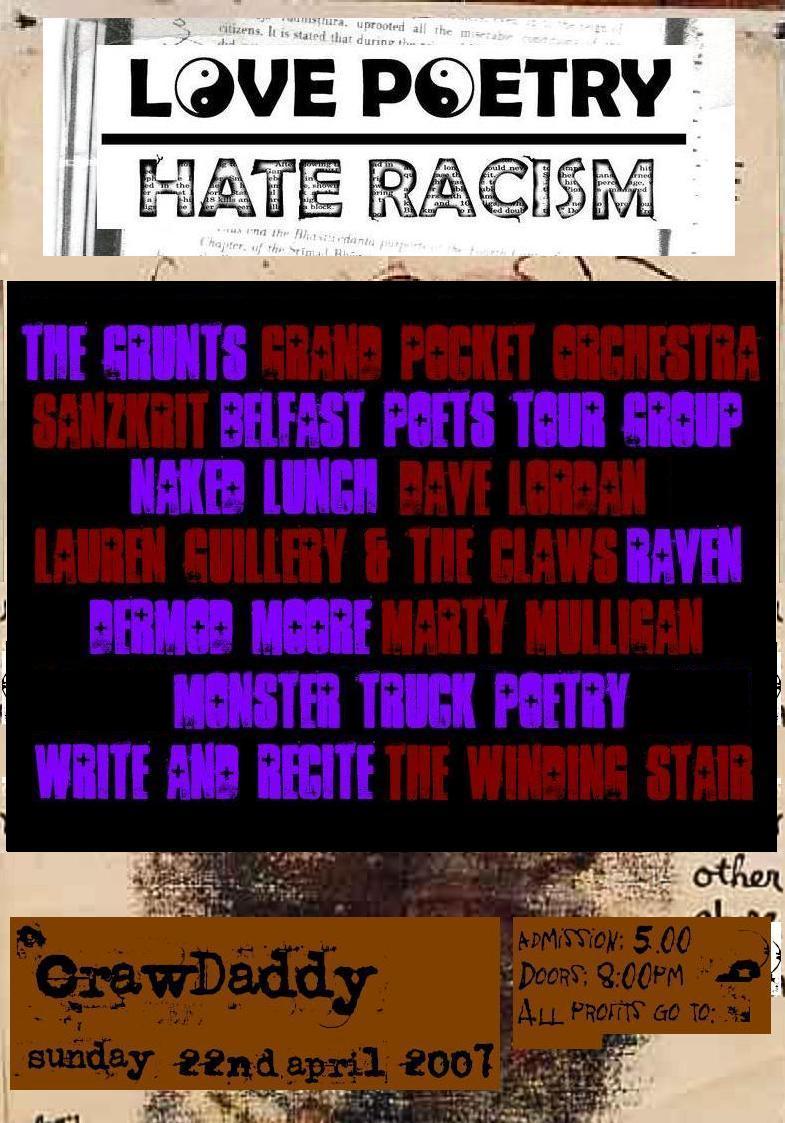
RAM's council election campaign kicks off with: BELFAST POETS TOURING GROUP presents: Love Poetry, Hate Islamophobia Internationally acclaimed performance poets with an action-packed, high-voltage, multi-media show. Rave reviews from their current U.S. tour reprinted bottom of this email. Supporting acts:

  • Latin rock band - ECHEVERRIA Y CIA
  • Good time group - FRANK E. EVANS BAND
P L U S SHOCK! HORROR! RAM announces news that will dismay the tired, useless, status quo politicians in City Vision (Labour) and Citizens & Ratepayers (National). and WOW! TOO MUCH! RAM unveils the most cutting edge billboards of the council elections. These billboards will set the agenda of all election tickets. Seeing is believing! W H E N This Wednesday 1 5 t h A u g u s t @ 7.30 p m W H E R E Trades Hall, 147 Great North Rd, Grey Lynn OPEN TO THE MEDIA. RAM's policies include:
  • Free & frequent buses and trains.
  • Cut council rates of grassroots homeowners.
  • Defend our communities from racist attacks.
  • Save our public assets from corporate colonisation.
  • Protect our park on the Manukau Harbour.
  • And other policies which put people before profits.
RAVE REVIEWS For the Belfast Poets Touring Group on their current tour of U.S. cities The reviews below come from the Minnesota Festival - five stars is the MAXIMUM awarded. 5 stars: "Love words? See this show." by Yvonne Healy: Belfast? I rarely get to see performing art from there, so it was 1st on my go-see list. Clear, humorous, and insightful with the rhythm and themes of another world: kin to our Midwest with images of bad boyfriends, racism, yards of heavy drinking - oh, yeah, and war. Music in the spoken word. Audience response is encouraged: they often perform in bars. 5 stars: "Bravo!" by M. Spicker: Highly recommended. Profound, moving, humane. Extraordinary artists. The emotional impact/intensity I experienced with the performance of these five gifted poets, (Monday-8/6/7-10 pm), was similar to that experienced with a great symphonic or operatic work. Bravo! 5 stars: "Riveting! Don't miss it!!!" by Amy Hubbard: Even if you don't think you are a poetry lover you must see this. Beautifully written and presented this kaleidoscope of media, duets and solos will at turns make you laugh and leave you stunned. 5 stars: "Powerful Word Portraits" by Rick Nielsen: The power of the spoken word retains the ability the fascinate and engage. From various subject matter ranging from area codes to insensitive boyfriends to war, these extremely talented 5 young poetic wordsmiths from Belfast practice their virtuoso craft. If the idea of traveling poets seems improbable here, this is what Fringe Festivals should do best - inspire people to renew feelings of excitement and discovery. These people deserve a wider audience - please give it to them! Four-and-a-half stars: "the universal and the specific" by Loren Niemi: I'm a spoken word guy and these are my people - Northern Ireland outpost. This is good strong material, well crafted, well spoken, with robust language not shackled in hip-hop cadence, strong images, universal and specific themes of war, peace, love and dickhead boyfriends. If I have any complaint it is of wanting more of the specific; more of the ideosyncratic gritty lilting images and turns of phrase that give a sense of Belfast and Derry, invoking time, place. culture that these talented poets have provided with the helpful glossary that comes with the program. Good stuff! Go see it!!! Four stars: "poets invade mpls" by steve legas: I think you must be blocked if you've not seen this show. Poets from Belfast with souls of hip-hop and truth. Do not be afraid of poetry folks. They don't back down from the truth and that makes 'em great to hear. Grab your muckers and head to the Red Eye for this show.

Wednesday, 8 August 2007

Mike Gonzalez on Venezuela: a reply

(This letter was recently sent to Socialist Worker (Britain), who decided not to publish it.) Dear comrades: Mike Gonzalez's report on the foundation of the United Socialist Party of Venezuela (PSUV - July 28) reads like one long missed opportunity. His report seems to begin from a fixed idea – that a workers' revolutionary movement can only grow in opposition to the government of Hugo Chávez. This is a regrettably short-sighted attitude that neglects the mutually reinforcing dialectic between Chávez's government and the mass movement. Mike seems to be searching for guarantees in advance that the PSUV will be the “right kind” of party, and not finding them. But surely the fact that the structure and programme of the PSUV is being left open leaves a huge space for the working-class self initiative that we all agree is vital in a revolutionary situation. The fact that the PSUV will be built on a geographical basis, says Mike, “points to an electoral machine based on constituencies.” In fact, it points to the social reality of Venezuela, where the organised working class are dwarfed by the urban poor, casual workers and petty traders. In a recent article on popular self-organisation in Bolivia, Alex Callinicos (“Dual power in our hands”, Socialist Worker, 6 January 2007) says that given the reality of urban life in the global megaslums, “the territorial class organisation of the [Paris] Commune may come to be increasingly important in the 21st century.” This is a lesson which should be applied to Venezuela. Mike's complaint that the PSUV is “declared from above” misses the clearly obvious – that six million candidates for membership indicates that it has touched a real nerve in the Venezuelan masses. The pessimistic scenarios envisioned in Mike's report can be prevented if Venezuelan revolutionaries join and help build the PSUV – and if those of us overseas seriously engage with it. in solidarity, Daphne Lawless Socialist Worker (Aotearoa - New Zealand)

Tuesday, 7 August 2007

Regional Council chair jumps tickets

RAM - Residents Action Movement Media release 6 August 2007 ARC chair flees sinking City Vision ship Mike Lee, chair of the Auckland Regional Council, is set to announce his sideways shift from the openly Labour Party-dominated City Vision ticket in favour of a supposedly "non-party" Regional People ticket. "This sideways shift is a fraud on the citizens of Greater Auckland," said Grant Morgan, organiser of RAM - Residents Action Movement. "Mr Lee is fleeing the sinking City Vision ship because of its internal feuds and the Labour Party's drop in the polls. He is setting up a City Vision sub-committee which he calls Regional People." "Mr Lee's politics of personal survival mark Regional People (RePe) as an opportunistic grouping of self-seekers and corporate clones," said Grant Morgan. "RePe (pronounced 'ReePee') is refusing to match RAM's promise to cut homeowner rates by increasing big business rates. This is a sign of RePe's corporate soul." "In stark contrast, RAM is standing for definite policies which advance the interests of grassroots people. While our policies around home rate cuts and free public transport will upset Corporate Auckland, RAM puts the interests of working people ahead of the interests of the rich elite." "There will be a clear contest between corporate-aligned RePe and grassroots-aligned RAM in the regional council election," said Grant Morgan.

Monday, 6 August 2007

RAM stands in council elections

RAM stands in council elections
RAM (Residents Action Movement) is standing in the council elections across Greater Auckland. Election campaigning officially kicks off on 13 August. In the 2004 election for the Auckland Regional Council, the RAM team won a massive 87,000 votes. We got one RAM councillor (Robyn Hughes) elected onto the regional council, and narrowly missed out with several other RAM candidates. It is widely believed that the RAM vote will increase in this year's election. RAM is fielding a united team of strong candidates all committed to:
  • Cut council rates for homeowners. Ever more people in New Zealand are being forced into the ranks of the "working poor". Overburdened homeowners urgently need rates relief. This is a vital element in restoring the stability and viability of grassroots communities. For too long, big business has been gouging the rest of Greater Auckland. RAM has long campaigned to reduce home rates by making Corporate Auckland pay its way.
  • Defend our communities from racist attacks. RAM has organised against the sudden rise of organised Islamophonia in New Zealand. Extremists from the Christian right have begun defaming local Muslims with the most disgusting lies. We do not want our country divided by communal hatreds and bloodshed. RAM will continue our determined campaign for social inclusion because we all belong here.
  • Free & frequent public transport. If humanity is to survive climate chaos, our carbon emissions must be slashed by 80% over the next two decades. We cannot muck around if we are to protect our human habitat. RAM has long campaigned to replace carbon-emitting cars with free and frequent buses and trains across urban Greater Auckland. This can be funded by switching state cash away from motorway construction, plus levying a tax on airport arrivals and hotel beds.
  • Save our park on the Manukau Harbour. Pikes Point is the last green space on the Upper Manukau Harbour, bounded by working class suburbs. Despite RAM's opposition the port company, a subsidiary of Auckland Regional Council, is planning to turn Pikes Point into a used car lot. Yet councils are spending megabucks on "beautifying" the upper income Waitemata Harbour. This class discrimination must be overcome so we can protect our environment.
  • Plus other RAM policies to support grassroots people.
Like what you see? Then support RAM. To get lots of RAM councillors elected, RAM must win the "battle of ideas". And that requires getting lots of RAM billboards put up on people's fences across Greater Auckland. Here is how you can help RAM win: BILLBOARDS The MOST IMPORTANT way you can contribute to a RAM victory is to help put up RAM billboards. These billboards measure 1800x900 and go onto the fences of house occupiers who agree with RAM's message. 1. Do you live on a busy road? If you do, you could put a RAM billboard on your fence. 2. Do you have some spare time? If you do, you could ask people you know who live on busy roads to put up a RAM billboard. And/or you could join a RAM billboard team. It would be great if the volunteers who recently helped put up RAM's George Galloway billboards (opposing Islamophobia) could also help with RAM's election billboards. If you can help put up RAM billboards, please immediately REPLY TO THIS EMAIL and say what you can do. DONATIONS If you cannot help with our billboards, can you make a donation to RAM's election fund? At the moment, RAM is still short of $6,000 to fund our all-important billboards. To bridge the finance gap, RAM has arranged a $6,000 loan which must be repaid. Can you help RAM repay our debt? There are two ways you can donate:
  • Make out a cheque to "RAM" and mail to RAM, PO Box 13-157, Auckland. (Please include your email & address so RAM can acknowledge your donation.)
  • Make an electronic payment to RAM. Here are our details. Bank account name: RAM ­ Residents Action Movement. Bank & branch: Kiwibank, Onehunga. Account number: 38-9002-0169572-00. (Then email me at grantmorgan@paradise.net.nz so RAM knows your donation has gone in.)
VOTE RAM The council elections are by postal ballot over a three week period from 22 September to 13 October. Your personal recommendation to all your family and friends to "Vote RAM" will carry a lot of weight. Please spread the word everywhere: "Vote RAM". And tell everyone to get onto the electoral roll so they are allowed to vote. If they don't know how to register, tell them to ring the Electoral Office's toll free number 0508 13 10 2007.

Thursday, 2 August 2007

Demise of the two-state solution


West Chooses Fatah, But Palestinians Don't

By Saree Makdisi

21 June, 2007
Los Angeles Times

In the west, there's a huge sense of relief. The Hamas-led government that has been causing everyone so much trouble has been isolated in Gaza, and a new government has been appointed in the West Bank by the "moderate," peace-loving Palestinian Authority president, Mahmoud Abbas.

So why then do Palestinians not share in the relief? Well, for one thing, the old government had been democratically elected; now it has been dismissed out of hand by presidential fiat. There's also the fact that the new prime minister appointed by Abbas ‹ Salam Fayyad ‹ has the support of the West, but his election list won only 2% of the votes in the same election that swept Hamas to victory. Fayyad and Abbas have the support of Israel, but it is no secret that they lack the backing of their own people.

There is a reason the people threw out Abbas' Fatah party in last year's election. Palestinians see the leading Fatah politicians as unimaginative, self-serving and corrupt, satisfied with the emoluments of power.

Worse yet, Palestinians came to realize that the so-called peace process championed by Abbas (and by Yasser Arafat before him) had led to the permanent institutionalization ‹ rather than the termination ‹ of Israel's 4-decade-old military occupation of their land. Why should they feel otherwise? There are today twice as many settlers in the occupied territories as there were when Yitzhak Rabin and Arafat first shook hands in the White House Rose Garden. Israel has divided the West Bank into besieged cantons, worked diligently to increase the number of Jewish settlers in East Jerusalem (while stripping Palestinian Jerusalemites of their residency rights in the city) and turned Gaza into a virtual prison.

People voted for Hamas last year not because they approved of the party's sloganeering, not because they wanted to live in an Islamic state, not because they support attacks on Israeli civilians, but because Hamas was untainted by Fatah's complacency and corruption, untainted by its willingness to continue pandering to Israel. Fatah leaders were viewed as mere policemen of the perpetual occupation, and the Palestinian Authority had willingly taken on the role of administering the population on behalf of the Israelis. Hamas offered an alternative.

Here in the U.S., Hamas is routinely demonized, known primarily for its attacks on civilians. Depictions of Hamas portray its "rejectionism" as an end in itself rather than as a refusal to go along with a political process that has proved catastrophic for Palestinians on the ground.

Has Hamas done unspeakable things? Yes, but so has Fatah, and so too has Israel (on a much larger scale). There are no saints in the Israeli-Palestinian conflict.

Palestinians, frankly, see a lot of hypocrisy in the West's anti-Hamas stance. Since last year's election, for example, the West has denied aid to the Hamas government, arguing, among other things, that Hamas refuses to recognize Israel. But that's absurd; after all, Israel does not recognize Palestine either. Hamas is accused of not abiding by previous agreements. But Israel's suspension of tax revenue transfers to the Palestinian Authority, and its refusal to implement a Gaza-West Bank road link agreement brokered by the U.S. in November 2005, are practical, rather than merely rhetorical, violations of previous agreements, causing infinitely more damage to ordinary people. Hamas is accused of mixing religion and politics, but no one has explained why its version of that mixture is any worse than Israel's ‹ or why a Jewish state is acceptable but a Muslim one is not.

I am a secular humanist, and I personally find religiously identified political movements ‹ and states ‹ unappealing, to say the least.

But let's be honest. Hamas did not run into Western opposition because of its Islamic ideology but because of its opposition to (and resistance to) the Israeli occupation.

A genuine peace based on the two-state solution would require an end to the Israeli occupation and the creation of a territorially contiguous, truly independent Palestinian state.

But that is not happening. Fatah seems to have given up, its leaders preferring to rest comfortably with the power they already have. Ironically, it is Hamas that is taking the stands that would be prerequisites for a true two-state peace plan: refusing to go along with the permanent breakup of Palestine and not accepting the sacrifice of control over borders, airspace, water, taxes and even the population registry to Israel.

Embracing the "moderation" of Abbas allows the Palestinian Authority to resume servicing the occupation on Israel's behalf, for now. In the long run, though, the two-state solution is finished because Fatah is either unable or unwilling to stop the ongoing dismemberment of the territory once intended for a Palestinian state.

The only realistic choice remaining will be the one between a single democratic, secular state offering equal rights for both Israelis and Palestinians ‹ or permanent apartheid.

SAREE MAKDISI, a professor of English and comparative literature at UCLA, writes often about the Middle East.


The Light At The End Of The Gaza-Ramallah Tunnel

By Omar Barghouti

21 June, 2007
The Electronic Intifada

When I saw some of the images coming out of the infighting in Gaza last week, I suppressed my anguish and steaming anger, recalling the wise, almost prophetic, words of the great Brazilian educator, Paulo Freire, who wrote:

"The central problem is this: How can the oppressed, as divided, unauthentic beings, participate in developing the pedagogy of their liberation? Only as they discover themselves to be 'hosts' of the oppressor can they contribute to the midwifery of their liberating pedagogy. As long as they live in the duality in which to be is to be like, and to be like is to be like the oppressor, this contribution is impossible. The pedagogy of the oppressed is an instrument for their critical discovery that both they and their oppressors are manifestations of dehumanization."

Apparently, neither of the two warring factions succeeded in transcending the being "like the oppressor" part.

The lightening success of Hamas in forcefully taking over the supposed symbols of Palestinian power in Gaza cannot and ought not obscure the fact that, given the overbearing presence of Israel's military occupation, the bloody clash between the Islamist group and its secular counterpart, Fatah, and irrespective of motives, has descended into a feud between two slaves fighting over the crumbs thrown to them, whenever they behave, by their common colonial master.

There is no doubt that a faction within Fatah -- overtly funded, trained and steered by the US and Israel -- is the primary suspect behind the flare-up of this bloody internecine strife, which many observers view as a thinly veiled attempt to destabilize Hamas's democratically-elected government, coercing it into accepting Israeli dictates that it had so far balked from. Furthermore, any decent legal expert will readily admit that the so-called "emergency government," declared by the Palestinian Authority chairman, Mahmoud Abbas, in response to Hamas's take-over in Gaza, violates several articles in the Basic Law, the equivalent of the PA's constitution.

While the corruption, lawlessness, profiteering and even betrayal of sections of Fatah have been known and well documented for some time now, the brutal, reckless and in some cases criminal tactics used by armed groups within Hamas were fresh reminders to neutral bystanders who were willing to give the group the benefit of the doubt that it, too, contains a strong, power-hungry faction that is eager to sacrifice principles and human rights to reach its political objectives. Hamas cannot be exonerated from the accusation that, by participating in the legislative and municipal elections according to laws and parameters set by the Oslo agreements, it has already contributed to legitimizing the products of those agreements and forsaken its claim to being a resistance movement that is primarily dedicated to realizing the main tenets of the Palestinian national program of liberation and self-determination. On top of that, and unlike the far more sophisticated and responsible Hizballah in Lebanon, Hamas, in the last year and a half of ruling at various levels, has revealed its inherent tendency, like all Islamist movements, to impose its exclusionary ideological and social order, and to dismiss and whenever possible suppress diverse views and cultural outlooks that conflict with that order.

In the short term, the political vacuum that will inevitably result from the growing rift between Ramallah and Gaza and the steady collapse of the PA structures and remaining authority on the ground is most likely to be filled by an all-out Israeli reoccupation of the entire West Bank and Gaza. This would announce the official death of the so-called Oslo peace process, which actually collapsed long ago under the weight of Israel's incessantly expanding colonies, apartheid wall -- declared illegal by the International Court of Justice -- and intricate apparatus of oppression and humiliation of the Palestinians under its control.

Such a scenario may either lead to threatening the very survival of the Palestinian national movement and the completion of the well-underway disintegration of Palestinian society or trigger a renaissance of the Palestinian struggle for self-determination. For the latter to occur, however, two difficult but realistic conditions must be met: first, Palestinian structural democratization and political reform and resetting Palestinian national priorities; and second, a critical review and revamping of the Palestinian resistance strategy, both from moral and pragmatic perspectives. Both are urgently called for, to realign the Palestinian struggle with the international social movement and to put the question of Palestine back on the world's agenda as essentially a morally and politically justifiable and viable liberation struggle that can -- again -- capture the imagination and support of progressives and freedom lovers the world over.

In order to counter Israel's dual strategy of, on the one hand, fragmenting, ghettoizing, and dispossessing Palestinians, and, on the other hand, reducing the conflict to a dispute over a partial set of Palestinian rights, the PLO must be resuscitated and remodeled to embody the claims, creative energies, and national frameworks of the three main segments of the Palestinian people: Palestinians in the OPT, Palestinian refugees, and Palestinian citizens of Israel. The PLO's grassroots organizations need to be rebuilt from the bottom up with mass participation, and they must be ruled by unfettered democracy and proportional representation. This process must entail a well-planned transfer of power from the withering PA back to a rejuvenated PLO, including the entire spectrum of the Palestinian political movement.

As to resistance strategies, one cannot and should not strictly separate means from ends. If the struggle for freedom in Algeria, Northern Ireland and South Africa taught us anything, it is this fact. Irrespective of the right of Palestinians to resist foreign occupation by all means, as granted in international law, we have a moral duty to avoid tactics that indiscriminately target innocent civilians and inevitably corrupt our own humanity. Concurrently, and with full deference to the first principle, we have a political obligation to select methods that maximize our gains. Given the ongoing nihilistic abuse and utter futility of Palestinian armed resistance, the uniquely harsh geo-political context of the Palestinian resistance movement, and the de facto fragmentation of the Palestinian people and isolation of its resistance core from potential sources of supply and logistical support, civil resistance that has the potential of engaging and mobilizing the Palestinian grassroots seems not only morally but also pragmatically preferable.

The young Palestinian campaign for boycott, divestment and sanctions (BDS) against Israel, modeled after the anti-apartheid struggle in South Africa, has already shown ample evidence that it has the potential of unifying Palestinians and international solidarity movements in a resistance strategy that is moral, effective and sustainable. In the last few years alone, many mainstream and influential groups and institutions have heeded Palestinian boycott calls and started to consider or apply diverse forms of effective pressure on Israel. These include the British University and College Union (UCU); Aosdana, the Irish state-sponsored academy of artists; the Church of England; the Presbyterian Church (USA); top British architects led by Architects and Planners for Justice in Palestine (APJP); the National Union of Journalists in the UK; the Congress of South African Trade Unions (COSATU); the South African Council of Churches; the Canadian Union of Public Employees in Ontario; and dozens of celebrated authors, artists and intellectuals led by John Berger, among many others.

The intensification of Israel's colonial and racist oppression of the Palestinians, particularly in Gaza, with unprecedented impunity was the main trigger for the spreading boycott. With its wanton destruction of Palestinian infrastructure, willful killing of civilians, particularly children, apartheid wall, Jews-only colonies and roads, incessant confiscation of land and water resources, and horrific denial of freedom of movement to millions under occupation, Israel has shown the international community its total disregard to international law and fundamental human rights.

This latest dose of American -- Israeli-inspired -- "constructive chaos" in the occupied Palestinian territory may well wreak havoc on US-Israeli policy in the region. With the imminent dissipation of the illusion that a national Palestinian sovereignty can be established under the overall colonial hegemony of Israel, many Palestinians are now seriously questioning the wisdom of the two-state mantra and considering to repose their plight as one for equal humanity and full emancipation, within the framework of a unitary, democratic state solution in historic Palestine. After almost three decades of "searing into the consciousness" of Palestinians that only a two-state solution can deliver any of their demands, the US and Israel are harvesting what they sowed: the collapse of any semblance of independence and integrity of the PA -- which was all along charged with relieving Israel's colonial burdens vs. the inhabitants of the occupied West Bank and Gaza -- and the mounting Palestinian discontent with, if not yet revolt against, the game of unilateral Palestinian compromise leading only to insatiable Israeli demands for further compromise, with the simultaneous loss of land, resources, freedoms and the bleak -- and real -- prospects of social breakdown.

The demise of the two-state solution should not be mourned. Besides having passed its expiry date, it was never a moral solution to start with. In the best-case scenario, if UN Resolution 242 were meticulously implemented, it would have addressed most of the legitimate rights of less than a third of the Palestinian people over less than a fifth of their ancestral land. More than two thirds of the Palestinians, refugees plus the Palestinian citizens of Israel, have been maliciously and shortsightedly expunged out of the definition of the Palestinians.

It is now clearer than ever that the two-state solution -- other than being only a disguise for continued Israeli occupation and a mechanism to permanently divide the people of Palestine into three disconnected segments -- was primarily intended to induce Palestinians to give up the inalienable right of their refugees to return to their homes and lands from which they were ethnically cleansed by Zionists during the 1948 Nakba (catastrophe).

A secular, democratic state solution is increasingly being perceived by Palestinians and people of conscience around the world as the moral alternative to Israeli apartheid and colonial rule. Such a solution, which promises unequivocal equality in citizenship, as well as individual and communal rights, both to Palestinians (refugees included) and to Israeli Jews, is the most appropriate for ethically reconciling the ostensibly irreconcilable: the inalienable, UN-sanctioned rights of the indigenous people of Palestine to self-determination, repatriation, and equality in accordance with international law and the acquired and internationally recognized rights of Israeli Jews to coexist in the land of Palestine -- as equals, not colonial masters.

Omar Barghouti is an independent Palestinian political analyst.

Wednesday, 1 August 2007

Venezuela: the struggle for workers' power

Venezuela: The struggle for workers’ power

Stuart Munckton 28 July 2007 From: International News, Green Left Weekly issue #719 1 August 2007.

The Venezuelan revolution, led by socialist President Hugo Chavez, has captured the imagination of millions of people around the world with its increasingly successful challenge to US imperialism and US-backed neoliberal policies that have caused widespread impoverishment across Latin America. Since Chavez’s re-election in December on an explicitly socialist platform, there has been a struggle to significantly “deepen” the revolutionary process towards creating a “socialism of the 21st century”.

One aspect of the process that has been closely watched internationally is the role of the workers’ movement. Venezuela’s union movement has been traditionally weak, organising only a small minority of workers. However, enormous hopes were raised with the formation of the National Union of Workers (UNT) in 2003, which supported the revolutionary process. The UNT quickly overtook the right-wing, discredited Confederation of Venezuelan Workers (CTV), which had helped organise attempts to overthrow the Chavez government. A movement for workers’ co-management in industry also gathered strength in 2005, with a number of experiments in workers’ direct management over production. However the UNT has since been weakened by internal fighting, and the movement for co-management has largely stalled. While Chavez has called for workers to be in the forefront of the revolution, there is a difficult struggle to find a way to advance the organisation of workers in order to drive the increasingly radical economic program of the revolution forward and develop workers’ power. Green Left Weekly spoke to Federico Fuentes, who coordinated a solidarity brigade of Australian trade unionists to Venezuela in May, including an official delegation from the Australian Council of Trade Unions. Participants were able to witness Venezuela’s social transformation as well as meet with a range of forces from the workers’ movement. This is the second part of an interview published in GLW #711, in which Fuentes gave a very positive account of the increasing social gains for ordinary Venezuelans, the strengthening of popular power through the grassroots communal councils, and the deepening radicalisation of the Venezuelan people — reflected in Chavez’s re-election with the highest number of votes in Venezuelan history. Fuentes commented on the significance of and enthusiasm for the United Socialist Party of Venezuela (PSUV), the new party being formed to unite all the often-dispersed pro-Chavez forces from the ground up. Since then, 5.7 million people have expressed an interest in joining the PSUV, far exceeding expectations. Fuentes explained that he encountered “a feeling among the people that, following Chavez’s election victory, now was the time for serious inroads into the capitalist system, that now was the time the revolution would significantly deepen. And this has been expressed especially through the real surge of community organising.” Divisions in the UNT However Fuentes also told GLW about some of the difficulties and contradictions the revolution is grappling with, especially in the workers’ movement. He explained that brigade participants “had quite a lot of meetings with different currents within the UNT, who each expressed their viewpoints on, for instance, the question of holding internal elections in the UNT [divisions around which led to a cold split in the UNT at its May congress last year]. It now appears that by the end of the year there will be some national elections — the first such elections inside the UNT, which was formed over four years ago.” (See article on page 14.) “Everyone inside the UNT agreed, when we met with them, that it has never been as dispersed and fractured as it is now”, Fuentes said. “It is now made up of five different currents, and there is a sense that perhaps the UNT will completely split. At the moment it is a de facto split, where everyone refers to themselves as a particular current of the UNT. No-one actually speaks on behalf of the UNT as a whole. “This was drawn out at the May Day demonstration, which was not called by the UNT, but by a coalition of unions affiliated to the UNT. There were also no speakers on the platform — instead there was one person reading out a statement, which was the only thing the five currents could agree on. No current trusted any of the others to speak.” Fuentes added: “This is aggravated by the fact that the current minister of labour is also a member of one of the currents, leading to a sense of exclusion among other larger elements.” Nonetheless, Fuentes said that there “are some positive steps forward, such as in the public sector union where an electoral commission has been set up involving all five currents to hold elections, which had been delayed for two years. If this is able to occur it will be a step forward towards broader elections within the UNT. Another positive step is the move to unite the four unions in the petroleum sector into one federation.” Fuentes placed the UNT’s difficulties in the context of the broader struggle to create space for new layers of revolutionary militants who are leading on the ground to develop and take control of the process of change. The expansion of the communal councils and formation of the PSUV both aim to facilitate this. Fuentes said: “I have no doubt that if elections were held now, many of the current so-called national leaders of the UNT [from all currents] would not necessarily be re-elected. On the other hand, there are many union activists who are playing a positive role in their day-to-day struggles who are yet to develop as real leaders, and the UNT hasn’t provided a vehicle for that to occur. Among the rank-and-file, people are fed up with the situation and something needs to change.” Fuentes commented on two of the key issues of debate within the union movement. “The first is the role of the union in relation to the government, which partially comes down to how to categorise the government, and beyond that the state.” Fuentes said that while the debate is not expressed in such a counterposed way, it is “essentially about whether the role of the union movement is solely to support government policies, or should the union movement also defend workers against some actions, of, if not so much the government, then the state bureaucracy.” Fuentes told GLW that the second issue related to the recent legislation allowing for the formation of workers’ councils in public and private workplaces across the country, in order to allow workers to exercise democratic control over production. Fuentes said this has provoked the question of “what is the role of unions themselves? Is there a need to go beyond unions to focus on the workers’ councils, giving unions a secondary role? Should the unions and such councils go hand in hand in the next stage of this process, or are unions more important than the workers’ councils?” Fuentes said the latter view “comes from one of the currents that is very concerned about the workers’ councils, [as it] doesn’t believe they will be real organs of power, and therefore doesn’t want to give up the existing role of unions”. Fuentes explained that the biggest problem is that “at the moment things are too polarised and personalised for the discussions to be had properly. The UNT national leadership cannot even sit down to discuss these issues.” Deepening of the revolution The context for the debates within the workers’ movement is the significant deepening of the struggle to create socialism following Chavez’s re-election, including the increasing moves against the capitalist class — most notably the nationalisation of the section of the oil industry that remained in private hands, as well as the main telecommunications company and six electricity companies. Fuentes commented that “Chavez has been clear that the companies being nationalised are those that were previously privatised, and, the government argues, need to come back into state hands”. “Recently the developments over [the privatised steel company] Sidor demonstrate why Chavez is taking this line. Having threatened to nationalise Sidor, which had worked against Venezuelan interests by exporting most of its products overseas, leaving the Venezuelan state to import the same products at higher prices, the government negotiated a settlement with the Argentinean company that owns the majority of shares. Under the agreement, Sidor will sell its steel inside Venezuela at below market prices. So it has put heavy controls on what privately owned companies do, without taking them directly back into state hands. “Alongside this process, there are still a number of factories, which have been left idle or sabotaged by their bosses, being taken over by the workers. A recent example of this is the textile factory Sanitarios Maracay, where the workers have not only occupied the factory, but have opened and run it under workers’ control. This is the first example, as far I know, in the struggle of occupied factories where workers have re-opened a factory under their control completely outside the law and in opposition to the factory’s legal owner.” The National Assembly recently discussed expropriating Sanitarios Maracay. Workers’ participation Fuentes said that “there is an important discussion that is becoming more and more public, which is around the concept [promoted by Chavez] of creating socialist state enterprises”. This is a discussion on how state-owned industry should be organised and how it can be integrated into a new, democratically planned economy run according to people’s needs. The role of the corrupt state bureaucracy the Chavez government has inherited from previous regimes has proven that simply having industry state-owned doesn’t mean it will automatically be run in such a way, but can instead be a source of corruption run on behalf of the old elite. Fuentes said “The debate is not between public or private property, with the government repeatedly stating that there is room for both in the ‘new socialism of the 21st century’. What the revolution is attempting to create is social property — where it is the people who truly own the means of production.” Fuentes explained that “this is a very intense discussion, because there is no doubt there are different wings within the government”. Fuentes said part of the discussion involved the question of workers’ participation in managing state industries. “There are those who are totally opposed to any real form of worker participation in state industry.” Fuentes said that “it seems, for now at least, this is the position Chavez has backed”. However, he added that “this is a discussion that will unfold and many are confident that it will be possible to clarify what workers’ participation means and why it is so important in the state industries”. Fuentes discussed the initial formation of workers’ councils, explaining that “there are a few workers’ councils already set up, outside the framework of any law, often in factories that have already been occupied and then nationalised such as Inveval. “But it is unclear exactly what scope these councils will have, and what their intersection with the communal councils will be. Some in the union movement were a bit concerned about some statements made by the labour minister that seemed to imply that the councils would essentially be given a supervisory role, rather than be real decision-making bodies in the workplace. But I don’t think the question has been resolved yet.” Fuentes argued that a major obstacle to the plan for workers’ councils is that the workers’ movement, which is needed to lead the organisation of workers into councils, is still very weak. “This is an example where the law precedes the struggle, where legislation is in advance of what the actual level of organisation and consciousness of the working class is able to actually achieve on the ground.” Fuentes argued that “this is not necessarily a bad thing, as it can act to stimulate struggle”. GLW asked Fuentes about the state of the movement for workers’ co-management, whereby workers would jointly manage a company with the state, or in some instances a private employer. Fuentes said: “It is pretty fair to say that at a public, official level, and within the UNT, the discourse about co-management has disappeared.” One reason for this, suggested Fuentes, was that “the tendency [within the revolution] that is opposed to workers’ participation in ‘strategic sectors’ of state industry — that is opposed not simply to one or another form of it, but full stop — appears to have been able to get the ear of Chavez”. Fuentes said another reason is the result of bitter experiences in the struggle for co-management, such as in the electricity industry. It wasn’t that electricity workers no longer wanted co-management, but that they no longer raise it “because of the huge fight they had against the management of [state-run company] Cadafe. The management of Cadafe went out of its way to sabotage and defeat moves to introduce co-management. If you go to most workers in the electrical sector and even mention the word co-management, it sends a shiver down their spines.” Fuentes said the workers still raise the concept of workers’ participation, but no longer talk of co-management specifically. Fuentes told GLW that some examples of co-management still exist, most notably at Alcasa, where it “continues to face many problems”. Fuentes explained that because Alcasa has been made a case study for whether co-management could work, “there are a lot of vested interests in ensuring it doesn’t succeed”. “People point to the fact that the production levels at Alcasa are not as good as other similar plants, that it is a very dangerous and polluting plant. This is all true, but this existed before the introduction of co-management. This is why Alcasa was chosen to be the case study, the logic being if it could work at a plant with so many problems, then it would work anywhere.” Fuentes also pointed out that co-management still existed in one small sector of the electricity industry, at Cadafe Sector 7 in the state of Miranda, which has recently been integrated into Cadafe nationally. However, he said the workers are very concerned that, in the process of integrating into the national company, they will lose their experiment. However, whatever problems facing the workers’ movement today, it remains clear that major gains have already been made. One of the aims of the brigade of Australian unionists to Venezuela in May was to gather more information for a debate within the International Labour Organisation about whether it should continue recognising the discredited CTV, or the UNT. Fuentes said that whatever problems the UNT is struggling to overcome, it was clear that the CTV no longer has any real weight among Venezulean workers. “The CTV is no longer really a union federation at all, but is more a political group in opposition to the government. The CTV-organised May Day demonstration had 1000 people at it, and that is the number given by the pro-opposition private media, so maybe it was even smaller in reality. Whereas the May Day march called by unions affiliated to the UNT was at least half-a-million strong, according to the organisers, and probably closer to 1.5 million. “An indication of just how weak the CTV is, is that its current president is also a member of a construction union that happened to provide the largest delegation to the UNT-organised May Day rally. The CTV’s own president has no support within his own union!”

Sunday, 29 July 2007

Big crowds attend Voices of Peace meetings

RAM - Residents Action Movement Media release on Voices of Peace 29 July 2007 Big crowds attend Voices of Peace meetings in Auckland
Last night 800 Aucklanders attended the Voices of Peace meeting at the Auckland Girls Grammar Theatre in Auckland. The theatre was packed out, while scores more had to be turned away. The evening before, a maximum crowd of 450 had packed an Auckland University lecture theatre for the first Voices of Peace meeting. These big crowds heard British MP George Galloway link the global rise of Islamophobia with the US wars in Iraq and Afghanistan, the Israeli occupation and Palestine and similar imperial crusades to exploit the resources and peoples of the Middle East and elsewhere. The other speakers were Javed Khan, president of the Federation of Islamic Associations of NZ, Paul Buchanan, an internationally recognised expert on threat assessment, and Grant Morgan, the organiser of RAM - Residents Action Movement. The more than 1,200 people who attended the two Auckland Voices of Peace meetings contrasted sharply with the pathetic 30 who turned out to the Wellington leg of Mosques and Miracles, the race hate touring show fronted by a group of professional Islamophobes from Australia. "The Aussie Islamophobes had hired the Hope Centre in Lower Hutt which easily holds over 200 people. The 30 registrations they received for the Wellington Mosques and Miracles meeting was a major setback to their aim of building a rate hate movement against Muslims in New Zealand," said RAM organiser Grant Morgan. "I have been informed that less than 200 turned up to the Auckland Mosques and Miracles meeting yesterday at the Greenlane Christian Centre. Again, this was way below the calculations of the organisers." "The tiny numbers turning up to hear the Aussie Islamophobes, compared to the over 1,200 Aucklanders attending the two Auckland Voices of Peace meetings, is a heartening sign that the vast majority of Christians and other people in New Zealand want a society built on the principle of social inclusion, not communal conflict," said Grant Morgan. "However, we must not under-estimate the potential threat posed by these Islamophobes who are claiming that every mosque is a 'centre of war' where New Zealand Muslims are plotting to destroy surrounding cities and terrorise, rape and kill non-Muslims. As George Galloway pointed out, when Adolf Hitler started making similar comments about Jews in Germany, he was treated as a 'music hall joke'. We must tackle this threat in New Zealand before the poisonous lies of the Islamophobes infect the body politic." "Last night, at the Voices of Peace meeting, I pledged that RAM would be campaigning around the theme 'We all belong here' in the September council elections. All good people must unite to defend our Muslim sisters and brothers from the race hate lies of the Aussie Islamophobes and their New Zealand cronies," said Grant Morgan. For more information, contact: Grant Morgan Organiser of RAM - Residents Action Movement 021 2544 515 grantmorgan@paradise.net.nz

VOICES OF PEACE

ACTIVIST WORKSHOP

Today there is a Voices of Peace workshop in Auckland where the nature of Islamophobia will be examined by Muslims and non-Muslims and moves made towards forming a broad activist network which will campaign against racism and other social injustices. GEORGE GALLOWAY will give the introduction. 2-5pm, Sunday 29 July. Fickling Convention Centre, 546 Mt Albert Rd, Three Kings. Limit of 250 participants, so those interested are being advised to get there early. Plenty of off street parking. NO DOOR CHARGE. Donations will be accepted.

Friday, 27 July 2007

Race hate speech by Aussie Islamophobe in Wellington


RAM - Residents Action Movement
Media release on Voices of Peace
27 July 2007

Race hate speech by Aussie Islamophobe in Wellington

Glyn Carpenter of Vision Network claims that there are "no Islamophobes" at the Mosques and Miracles conferences in Wellington and Auckland. He attacks organisers of the alternative Voices of Peace meetings for saying otherwise. (See Mr Carpenter's media release below.)

How does Mr Carpenter reconcile his claims with the fact that, at the short public section of the mostly closed-door Mosques and Miracles conference in Wellington on 25 July, Australian extreme right-wing Christian Daniel Shayesteh stated:

  • "To be a good radical Muslim you must kill Christians & Jews."
  • "Muslims always build mosques on mountainsides... [as] places to retreat when they have destroyed the surrounding cities."
  • "Mosques [are their] centre of war... this is the main purpose/activity of every mosque in the world."
  • "Muslims tell lies [which are] sanctioned by the Qur'an."
  • "The Qur'an says you must terrorise the people who are not Muslim."
  • "The Qur'an sanctions the killing of non-Muslims to advance Islam ­ but not the killing of virgins. They are [first] raped and then killed."
  • "In Islam your wife is your property, an animal, she must be corrected by beating[s]."
  • "Muslims... have sad, angry faces."

RAM organiser Grant Morgan, a convenor of the Voices of Peace meetings, posed these questions: "I ask Mr Carpenter: if this is not Islamophobia, then what is it? I say to Mr Carpenter: how can you defend such blatant race hate talk? I ask Mr Carpenter: Why are you defending the Australian extremists like Mr Shayesteh who are now touring New Zealand trying to create a race hate movement in our country?"

"While I am not a Muslim, I have been inside almost all mosques across Greater Auckland. I can assure the people of New Zealand that, contrary to Mr Shayesteh's lurid claims about 'every mosque in the world' being a 'centre of war', there are no caches of AK47's in the storage cupboards or stacks of bomb-making gear in the basements of this region's mosques," said Grant Morgan.

"RAM will be campaigning hard in the looming council elections in Auckland against the Islamophobia that Mr Carpenter is defending," said Grant Morgan. "We will be saying - We ALL belong here. RAM believes that all councillors and all council candidates have a public duty to protect our communities from the sort of race hatred that Mr Shayesteh and other Australian Islamophobes are now trying to spread inside our country."

A full report on the open section of the Wellington Mosques and Miracles conference is below.

Grant Morgan

Organiser of RAM - Residents Action Movement
021 2544 515
grantmorgan@paradise.net.nz


Mosques and Miracles

Hope Centre
Lower Hutt


PUBLIC (OPEN) SESSION ONLY


19:30 hrs Wednesday 25th July 2007

Speakers: Stuart Robinson, Mark Durie, Daniel Shayesteh (keynote speaker ­ Iranian former muslim (radical) political leader...now the Director of the interdenominational organisation 'Exodus from Darkness')

There have been 15 conferences in 5 nations.

Mosques and Miracles: Revealing Islam and God's Grace (book) by Stuart Robinson
Pt 1: What Islam is doing around the world - taking over the world
Pt 2: Why it's happening, what is driving them
Pt 3: What God is doing (supernatural responses) and what "we" can do - "what to say to a Muslim if you happen to find yourself sitting next to one on the train"

Public meeting began with an excited crowd on its feet...mass singing accompanied by loud "rock" band ­ - lots of repetition of praise, hand waving, some in a state of rapture...all this while our Honorary Consul for Israel, with wife and two others, sat quietly bemused...though it was soon evident how delighted Mr Zwartz must have been with the objectives of the "missionary team".

Points from Daniel Shayesteh's talk:

_ Westerners have no experience of Islam and don't understand ­ don't know the facts and TRUTH. Added a story about an Egyptian, Zakariah Botross, who was visited by Jesus in a dream and then by the holy spirit. He is a Coptic Christian and cannot live in the Middle East as converts to Christianity must be killed. He now lives in the States...the FBI told him that one man had come to the US just to find where he lived ­ there is reward for millions of dollars on his head.

_ It is a myth that Christians, Muslims and Jews worship the same God. The God of Christians has a personality...is a personal God. The God of all other religions, particularly Islam, is impersonal. "The Christian God is lovely, he is the best!" and the admiring crowd smiled with knowing delight when Daniel shouted "Jesus is yummy, he's delicious!" Whereas Jesus of the Koran will return and destroy the Cross and Christianity...much tut-tutting followed this.

_ Christians and Jews are unclean - Mr Zwartz and friends did not look concerned - ­ and you must cleanse yourself after touching them or having them in your house...and the cleansing is expensive. Jew and Christian are the worst swearwords in Islamic countries.

_ To be a good radical Muslim you must kill Christians and Jews. Hizbollah was started as an army to take over Israel and kill off Jews...it was to capture Lebanon with Israel as the goal. Then move on the US where there are many Jews.

_ Muslims always build mosques on mountainsides...wherever they are (indicating the surrounding hills) they will search for places in the mountains...they have maps. These are safe havens where they can plan in isolation and places to retreat to when they have destroyed the surrounding cities. This is why they live in caves in the mountains of Afghanistan.

_ There are two main reasons for the establishment of mosques:

1. Centre of War ­ against non-Muslims...non-Muslims are ingenuous and don't realise this is the main purpose/activity of every mosque in the world...the idea of peace is a myth ­ a lie.
2. Build the mosque, own the country ­ when a mosque is built, then in Islam's eyes that country belongs to the Islamic world and not to the non-Muslims who live there. "Is there a mosque here?" A resounding "YES" is the reply as the audience looked around at each other. This is going to be the destiny of your country, they have a plan. Wake up! Then he said he wasn't there to frighten people and promptly mentioned that, as part of his Islamic training in Iran, he had been taught how to cut of the heads of non-Muslims...gasps from the audience.

- Muslims tell lies ­ sanctioned by the Koran...in Islam it is okay to lie in order to further the aims of the religion. Great emphasis placed on lying...theme repeated throughout the talk. The leaders all know the truth, their followers will not. They lie about the true aims of Islam and westerners gullibly believe them ­ because we are so nice.

_ Islamic law is the worst in the world because it is of God and cannot be questioned...in contrast to Communism which is of the people and can be overcome.

_
The Koran says you must terrorise the people who are not Muslim...it is joy in Islam to give pain to your opposition.

_
The Koran sanctions the killing of non-Muslims to advance Islam but not the killing of virgins. They are raped and then killed.

_
Apostasy (conversion from Islam) is punishable by death...much reference to this by example. He elaborated on persecution stating that this was the typical experience of non-Muslims in Muslim countries...some convincing examples from Saudi Arabia. He referred to recent stories from Iran of people killing their own children who had converted...he said they had no choice because Allah teaches that Christians need to be killed. The people have no choice ­ if they do not kill their children, the whole family will suffer humilation and ostracism.

_
Women must be veiled from the age of 7 as they can be married at this age...more horrified gasps from audience. The paedophilic intimation was obvious. He gave examples of old men with wives, as young as 6, and asked the audience to imagine what it would be like. Reference, with quotations from the Koran, about Mohammed's marriage to a 6yr old which was consummated when she was 9.

_
In Islam your wife is your property, an animal, she must be corrected by beating. Jesus said love your wife. Daniel apologised to his wife when he converted and called her "honey".

_
Christianity takes away the uncertainty of one's future...there is security of eternal life, of happiness, of justice. No other religion guarantees salvation in return for simple belief. "Christianity is the best" and "Jesus is nice"... "the people are lovely...the music is lovely too".

_
Muslims are taught to hate and to punish...they have sad, angry faces. He repeated this and finished with a picture of his three smiling daughters and wife and commented on their lovely hair ­ earlier we had seen a photo taken when they were younger in Iran, dressed in black and hair covered...serious faces ­ he said their expressions were due to Islam.

Concluding words from MC:

"That was one man who was trained to hate, kill and destroy. God can work amazing changes in our lives. Once an agent of destruction and death and now an agent of love and life." Made a comparison with Saul becoming Paul after meeting Jesus on the road of Damascus.
Prayers followed, especially for people who stood because they felt particularly moved by the presence of God this night ­ the pastor asked that "God would visit these lives supernaturally tonight". He then asked for pledges to support the mission ­ and asked people to buy the DVD of the night on sale in the foyer. "What will you do to continue this work? I ask you in the presence of God." Emphasis on taking action before it is too late. The mission will continue in many nations...in the UK next year. Muslims need to be saved...pray for them...hug them!


http://www.scoop.co.nz/stories/PO0707/S00314.htm

No Islamophobes at Mosques and Miracles

Thursday, 26 July 2007, 8:42 am

Press Release: Vision Network of NZ
No Islamophobes at Mosques and Miracles ³Where are the ³Voices of Peace?²

Contrary to statements made by organisers of the ³Voices of Peace² conference, the Mosques and Miracles conference speakers and attendees are anything but Islamophobes.

Glyn Carpenter of Vision Network of New Zealand, who has helped promote the Mosques and Miracles conferences, says ³the conference is essentially a reminder to Christians of the basic teaching to love others. Certainly the speakers are sharing from their considerable experience of Islam, which includes living in Islamic countries, about the diversity within Islam, and issues to be considered.

It is ironic and concerning that organisers of a conference called ³Voices of Peace² would use terms like ³NZ Islamophobes², ³Aussie extremists², and ³far-right Islamophobic idealogues² about this conference.

ENDS

Glyn Carpenter,
National Director
Vision Network of New Zealand


VOICES OF PEACE
AUCKLAND MEETINGS

GEORGE GALLOWAY will be addressing these two meetings:

TOWN MEETING

7.30pm, Saturday 28 July.
Auckland Girls Grammar School Theatre.
16 Howe St (off Karangahape Rd).
The three other speakers are:
  • JAVED KHAN, president of Federation of Islamic Associations of NZ.
  • PAUL BUCHANAN, international security analyst & director of the Working Group on Alternative Security Perspectives.
  • GRANT MORGAN, organiser of RAM - Residents Action Movement.
Limit of 800 seats, so those interested are being advised to get there early. NO DOOR CHARGE. Donations will be accepted. Off street car parks available.

UNIVERSITY MEETING

6.30pm, Friday 27 July.
[NOTE: Meeting starts a half-hour later than first advertised.]
Library Basement, University of Auckland, Alfred St, central city (opposite Maidment Theatre).
The three other speakers are:
  • NIBRAS KARDAMAN, young Muslim woman & representative of the Working Together Group.
  • HANNAH SPIERER co-leader of Greens on Campus.
  • GRANT MORGAN, organiser of RAM - Residents Action Movement.
NO DOOR CHARGE. Donations will be accepted.

Both meetings OPEN TO THE MEDIA.

ACTIVIST WORKSHOPS

There will also be Voices of Peace workshops where the nature of Islamophobia will be examined by Muslims and non-Muslims and moves made towards forming a broad activist network which will campaign against racism and other social injustices. George Galloway will give the introduction.
2-5pm, Sunday 29 July.
Fickling Convention Centre, 546 Mt Albert Rd, Three Kings.
Limit of 250 participants, so those interested are being advised to get there early. Plenty of off street parking. NO DOOR CHARGE. Donations will be accepted.

Wednesday, 25 July 2007

NZ Islamophobes echo touring Aussie extremists


RAM - Residents Action Movement
Media release on Voices of Peace
25 July 2007

NZ Islamophobes echo
touring Aussie extremists

Voices of Peace public meetings, featuring British MP George Galloway, are being held in Auckland on 27-29 July to counter the first stirrings of organised Islamophobia in New Zealand. These meetings (advertised at bottom) are being hosted by RAM, the Residents Action Movement.

"A group of far right Islamophobic ideologues from Australia, headed by Stuart Robinson and Daniel Shayesteh, have entered New Zealand to wage war against Muslims and their religion," said RAM organiser Grant Morgan.

"These offshore extremists demonise Islam as an 'evil' force of 'violence', alleging that Muslims in New Zealand will 'terrorise' everyone else in a 'holy war' until they either 'submit' to Allah or are 'killed'. Their denunciation of 'multiculturalism' exposes their racist hostility towards not only Muslims, but also other recent immigrants to this country."

"These Australian bigots are speaking at closed-door 'Mosques and Miracles' conferences in Auckland and Wellington between 25-28 July. Their aim is to recruit the leadership core of a racist campaign against New Zealand Muslims and their faith," said Grant Morgan.

This Australian-imported Islamophobia is being echoed by a minority of New Zealand's Christian leaders who are promoting the 'Mosques and Miracles' tour. They include:

  • MURRAY DILLNER, director of the New Zealand chapter of Middle East Christian Outreach, an extreme right fundamentalist missionary group. Dillner is a key organiser of the "Mosques and Miracles" tour in this country. He alleges that radical Islam will "take away the freedoms we have in New Zealand and we will no longer have freedom of speech". Many Muslims have immigrated to New Zealand in order to take over the country. He links the "threat" of Islam in New Zealand to the terrorist attacks in America on 11 September 2001. "It's an underlying threat, but it's like the twin towers - they imploded. Islam does the same thing to a society - it makes it implode. The mindset of Islam is to take over the world. They will do it by any means they can." Dillner is calling on the church in New Zealand to "rise up" against Islam. ("Challenge Weekly" 19.3.07 and "The Press" 23.3.07.)

  • BRUCE QUEDLEY, director of the New Zealand chapter of Open Doors, which is organising the "Mosques and Miracles" conferences in Auckland and Wellington. Quedley said that Islam was often portrayed as a religion of peace, but "realistically that's not what happens". He claims that Christian and Jewish people are compelled to pay a special tax and live as second-class citizens in Islamic society if they wish to live at peace with Muslims. ("Challenge Weekly" 19.3.07 and "The Press" 23.3.07.)

  • 'CHALLENGE WEEKLY', an ultra-conservative Christian newspaper circulated mainly within New Zealand's right-wing Baptist and fundamentalist churches. Starting in March 2007, when it carried the headline "Conferences to look at 'threat' of Islam in NZ", this paper has uncritically supported the Islamophobic agenda of the "Mosques and Miracles" conferences.

  • GLYN CARPENTER, national director of Vision Network, a right-wing fundamentalist coalition in New Zealand. After the Baptist church that was hosting the Christchurch "Mosques and Miracles" conference pulled out in reaction to its "intolerant" ideologues, Carpenter stepped into the role of chief New Zealand spokesperson for the Australian extremists. Carpenter has tried to pretty up their image, saying: "It's a pity that media coverage has portrayed the conference as being anti-Islam. It's created unnecessary fears. It's not that." He claimed that "Mosques and Miracles" organisers were not trying to present Islam as "bad". However, he criticised the "element within Islam which is hostile to Western countries and to the Christian faith". ("Challenge Weekly" 19.3.07 and 21.5.07.)

Over recent months, Destiny Church leader BRIAN TAMAKI has begun publicly attacking New Zealand Muslims and their faith. While playing no apparent role in the "Mosques and Miracles" conferences, Tamaki's statements reveal a mindset close to that of the Australian Islamophobes. Here are a few of Tamaki's comments:

  • Tamaki accused the New Zealand government of promoting a statement on religious diversity which "downplays our Christian heritage and represents our country as religiously neutral in an attempt to placate radical Muslims". ("Challenge Weekly" 21.5.07.)

  • "We are at a point where Christian-based nations must not be afraid to declare their religious allegiance... This would mean that alternative or foreign religions would not be afforded equal status to the established national religion, therefore restrictions on these religions would need to apply." He warned that New Zealand should learn from Britain and France where large-scale immigration had been permitted and "mosques are allowed to flourish", and this "proliferation of Islam has significantly weakened their sense of national safety". ("NZ Herald" 29.5.07 and "Challenge Weekly" 28.5.07.)

  • "This nation must have the right to discuss... whether we are going to establish and affirm and accept our religious identity as a country, or whether we are going to walk away and let that be lost, perhaps forever, and to allow foreign religions and foreign beliefs and other philosophies to proliferate into our country and begin to defile the very soil of this land." ("NZ Herald" 30.5.07.)


"RAM is organising the Voices of Peace meetings as a positive alternative to the sudden growth of organised racism against Muslims in New Zealand," said Grant Morgan. "RAM supports the values of social inclusion, equal rights for all and world peace. We must win the battle of ideas against the Islamophobes, or else we will end up living in a country where racism has become the dominant ideology."


VOICES OF PEACE
AUCKLAND MEETINGS

GEORGE GALLOWAY will be addressing these two meetings:

TOWN MEETING

7.30pm, Saturday 28 July.
Auckland Girls Grammar School Theatre.
16 Howe St (off Karangahape Rd).
The three other speakers are:
  • JAVED KHAN, president of Federation of Islamic Associations of NZ.
  • PAUL BUCHANAN, international security analyst & director of the Working Group on Alternative Security Perspectives.
  • GRANT MORGAN, organiser of RAM - Residents Action Movement.
Limit of 800 seats, so those interested are being advised to get there early. NO DOOR CHARGE. Donations will be accepted. Off street car parks available.

UNIVERSITY MEETING

6.30pm, Friday 27 July.
[NOTE: Meeting starts a half-hour later than first advertised.]
Library Basement, University of Auckland, Alfred St, central city (opposite Maidment Theatre).
The three other speakers are:
  • NIBRAS KARDAMAN, young Muslim woman & representative of the Working Together Group.
  • HANNAH SPIERER co-leader of Greens on Campus.
  • GRANT MORGAN, organiser of RAM - Residents Action Movement.
NO DOOR CHARGE. Donations will be accepted.

Both meetings OPEN TO THE MEDIA.

ACTIVIST WORKSHOPS

There will also be Voices of Peace workshops where the nature of Islamophobia will be examined by Muslims and non-Muslims and moves made towards forming a broad activist network which will campaign against racism and other social injustices. George Galloway will give the introduction.
2-5pm, Sunday 29 July.
Fickling Convention Centre, 546 Mt Albert Rd, Three Kings.
Limit of 250 participants, so those interested are being advised to get there early. Plenty of off street parking. NO DOOR CHARGE. Donations will be accepted.

Tuesday, 24 July 2007

Australian extremist in NZ to wage war on Islam


RAM - Residents Action Movement
Media release on Voices of Peace
24 July 2007

Australian extremist in NZ
to wage war on Islam


Anti-war MP GEORGE GALLOWAY was recently suspended for 18 days from the British Parliament by pro-war politicians he has been fighting for decades. In the longest investigation in its history, a Westminster parliamentary committee found that Mr Galloway was innocent of any corruption, contrary to the smears of Tony Blair and George Bush, but suspended him anyway. The 10-person committee of pro-war, anti-Palestinian politicians were upset that "proper respect" was not shown to them as they hounded the one British MP who has all along opposed the unjust and murderous occupation of Iraq.

Mr Galloway has all along linked George Bush's so-called "War on Terror" with the global spread of Islamophobia, saying that Muslims and their faith are being demonised in a bid to legitimise the US state's crusade for oil and power. The British MP shot to world fame in 2005 when he testified before the US Senate and in effect put George Bush and his cronies "on trial" for war crimes.

Mr Galloway will be speaking against Islamophobia in Auckland on 27-29 July at Voices of Peace meetings hosted by RAM, the Residents Action Movement. (Meeting details below.)

"Voices of Peace is being held to counter the first stirrings of organised Islamophobia in New Zealand," said RAM organiser Grant Morgan.

"A group of right-wing Christian extremists from Australia are now in New Zealand to spread a message of hatred towards Muslims and Islam. They claim that Islam is the 'anti-Christ' and that Muslims are 'on the march' to take control of New Zealand. They allege that Muslims will destroy democracy here and force everyone to 'submit' to Islam, or else be enslaved or killed. They call for the 'mother' of all 'spiritual wars' to be waged against 'evil' Islam."

"The purpose of their closed-door 'Mosques and Miracles' conferences in Auckland and Wellington is to incite hundreds of people into forming the core of a racist campaign against New Zealand Muslims and their faith," said Grant Morgan.

One of the main "Mosques and Miracles" speakers is Daniel Shayesteh, an extreme right Christian preacher from Sydney. His ministry in Australia, called "Exodus from Darkness", seeks to convert Muslims to his version of fundamentalist Christianity through a lurid depiction of Islam as the satanic force of darkness.

Shayesteh claims to be a convert from an Islamic revolutionary organisation in Iran. He was elected to Khomeini's government in 1981, but after political disagreements with the Iranian regime he fled to Turkey in 1988. From there he entered Australia with the help of fundamentalist Christians. He taught business at the University of Technology in Sydney for eight years, but was fired after complaints about his extremist Christian harassment of others. He then began a new career: the demonisation of Islam.

In a letter to New Zealand's "Investigate" magazine (July 2007), Shayesteh wrote that he is "speaking out" to people in the West about the "dangers of Islam". Since 2003, he said, "I have been travelling worldwide, including NZ, to spread awareness [about Islam]."

Shayesteh is funded by several extreme right Christian groups, including The Christian & Missionary Alliance (a US-based evangelical coalition which is antagonistic to Islam) and Open Doors (a closed-door organisation which sees Christianity as a "persecuted church"). The New Zealand chapter of Open Doors is organising the "Mosques and Miracles" conferences in Wellington (25-26 July) and Auckland (27-28 July). The phone number of Open Doors is (09) 620 4200.

In New Zealand, Shayesteh is uncritically supported by "Challenge Weekly" newspaper which circulates widely inside right-wing Baptist and fundamentalist churches.

"[The Qur'an] is a book of war, which turns Muslims against the world," alleges Syahesteh on his website. "Jihad is the Arabic word for 'war' against non-Muslims... It's very important for people in the West to understand that Islam is not a religion of peace. Any Muslim who doesn't get involved in Jihad is sinning. That's the doctrine of Islam."

Another Shayesteh quote: "...Muslims want you to accept Islam as your religion; otherwise, they are not going to stop terrorism. To stop fighting against infidels is a sin in Islam."

And another: "Islam is the only religion that decrees the demolishing of other religions even to the cost of killing their followers unless they follow Muhammad."

Shayesteh's website (www.ministryblue.com/exodus) is full of similar quotes. More quotes appear below.

Shayesteh is closely linked to the reverend Fred Nile, national president of Australia's ultra-conservative Christian Democratic Party who was elected to the New South Wales parliament. Nile has advocated a moratorium on Muslim immigration into Australia and a ban on Muslims being elected to the NSW parliament. Shayesteh, on his website, praises Nile for being "a heart for this nation" and for his "support of what I am doing".

"The alliance between Syahesteh and Nile points to the political agenda of the Australian Islamophobes now touring New Zealand," said Grant Morgan. "They aim to incite non-Muslim communities into a war against our own Muslim community. But this is not the sort of New Zealand that the vast majority of our citizens want."

"RAM is organising Voices of Peace as a positive alternative to their racism against Muslims. RAM supports the values of social inclusion, equal rights for all and world peace. We are heartened by the groundswell of support that Voices of Peace is receiving from grassroots people. And we are proud to have such a powerful voice for world peace as George Galloway on our platform," said Grant Morgan.


MORE QUOTES FROM SHAYESTEH'S NEWSLETTERS

  • "All my talks were about... the way to combat the threat of Islam..."

  • "Both the Qura'an and the Sharia commands Muslims to prepare themselves for terrorizing... Christians and non-Muslims."

  • "Islam is not a peaceful religion... We see that Islam is fighting all nations... It's the holy war of Islam..."

  • "Muslim ideology is cloaked in violence... The Muslim holy book seeps with violence... Osama bin Laden is the servant of Islam. Islam is the enemy of this country... Osama bin Laden can be changed, but Islam cannot. Osama bin Laden is just a tool in the hand of Islam."

  • "[Muslims] have to terrorize Christians and Jews by frightening them. By killing them, [Muslims] can take Islam... to the rest of the world."

  • "Islam does not believe in freedom and democracy... If you criticize Islam and Muhammad, your fingers should be chopped [off] first and then your head."

  • "It was Jesus who said love your enemy and fight against evil [Islam]... It is impossible to change Islam."

  • "The Kingdom of Allah on earth would mean the elimination of all other religions. At the top of the list are Judaism and Christianity."

  • "[Shayesteh] urged people to avoid a passive approach to multiculturalism unless they wanted to see Judeo-Christian and democratic values indiscriminately uprooted from their communities and nation [by Islam]."

  • "Islam teaches lying, deceiving, etc as legitimate tools for the sake and progress of religion."

  • "Muslims... will not compromise with the West, but they are delighted if the West chooses to compromise with Islam."

  • "...Radical Islam... acted as suicide bombers because of their own spiritual imprisonment... Nothing could change the heart of a hostile Muslim except Jesus. If we introduce radical Muslims to Jesus, Jesus will transform them from the kingdom of darkness into the kingdom of light... Their problem is fundamentally spiritual..."


VOICES OF PEACE
AUCKLAND MEETINGS

GEORGE GALLOWAY will be addressing these two meetings:

TOWN MEETING

7.30pm, Saturday 28 July.
Auckland Girls Grammar School Theatre.
16 Howe St (off Karangahape Rd).
The three other speakers are:
  • JAVED KHAN, president of Federation of Islamic Associations of NZ.
  • PAUL BUCHANAN, international security analyst & director of the Working Group on Alternative Security Perspectives.
  • GRANT MORGAN, organiser of RAM - Residents Action Movement.
Limit of 800 seats, so those interested are being advised to get there early. NO DOOR CHARGE. Donations will be accepted. Off street car parks available.

UNIVERSITY MEETING

6.30pm, Friday 27 July.
[NOTE: Meeting starts a half-hour later than first advertised.]
Library Basement, University of Auckland, Alfred St, central city (opposite Maidment Theatre).
The three other speakers are:
  • NIBRAS KARDAMAN, young Muslim woman & representative of the Working Together Group.
  • HANNAH SPIERER co-leader of Greens on Campus.
  • GRANT MORGAN, organiser of RAM - Residents Action Movement.
NO DOOR CHARGE. Donations will be accepted.

Both meetings OPEN TO THE MEDIA.

ACTIVIST WORKSHOPS

There will also be Voices of Peace workshops where the nature of Islamophobia will be examined by Muslims and non-Muslims and moves made towards forming a broad activist network which will campaign against racism and other social injustices. George Galloway will give the introduction.
2-5pm, Sunday 29 July.
Fickling Convention Centre, 546 Mt Albert Rd, Three Kings.
Limit of 250 participants, so those interested are being advised to get there early. Plenty of off street parking. NO DOOR CHARGE. Donations will be accepted.

Sunday, 22 July 2007

Community leaders support Voices of Peace


RAM - Residents Action Movement
Media release on Voices of Peace
22 July 2007

Community leaders support
Voices of Peace


British MP George Galloway will be speaking against Islamophobia in Auckland on 27-29 July at Voices of Peace meetings hosted by RAM, the Residents Action Movement. (Meeting details below.)

"A group of hard-core, professional Islamophobes from Australia are coming to New Zealand in a few days time to spread a message of hatred towards Muslims and Islam," said RAM organiser Grant Morgan.

"These right-wing Christian extremists claim that Islam is the 'anti-Christ'. They claim that Muslims are 'on the march' to take control of countries like New Zealand. They claim that Muslims will destroy democracy here and force everyone to 'submit' to Islam, or else face being enslaved or killed. They call for the 'mother' of all 'spiritual wars' to be waged against 'evil' Islam."

"These and similar racist claims are the theme of a 400-page book titled 'Mosques and Miracles' which is the ideological framework for their New Zealand conferences of the same name. The lead speaker at these conferences is the book's author, Australian Baptist preacher Stuart Robinson."

"These right-wing Australian bigots are out to poison the minds of fundamentalist Christians at closed-door conferences in Auckland and Wellington. They want to incite hundreds of people into forming the core of a highly political campaign against New Zealand Muslims and their faith," said Grant Morgan.

"Ironically, the organising body of their closed-door conferences is Open Doors, a fundamentalist Christian group operating on both sides of the Tasman as well as in many other countries. The closed-door secrecy of Open Doors highlights their deliberate use of misleading language, such as their fraudulent claims to really 'love' Muslims."

The phone number for Open Doors New Zealand is (09) 620 4200. Their Mosques and Miracles conferences are advertised at www.meco.zuyouth.com

"RAM is organising Voices of Peace as a positive alternative to their racism against Muslims," said Grant Morgan.

"RAM supports the values of social inclusion, equal rights for all and world peace. We are heartened by the groundswell of support that Voices of Peace is receiving from grassroots people and their community leaders."

The broad support for Voices of Peace can be seen in the following statements by community leaders:

EMILY COLGAN
Organiser of the Auckland Council of Christian, Muslim & Jewish Youth.
"The NZ Council of Christian, Muslim & Jewish Youth is highly supportive of any endeavour to encourage religious coexistence. We strongly assert our vision of harmony between faiths through mutual understanding to counter those whose views are divisive and promote ignorance and intolerance. Thus we strongly support the Voices of Peace initiative as a demonstration of hope in a world unnecessarily perceived as being divided between competing religious ideologies."

PAUL G. BUCHANAN
Director of the Working Group on Alternative Security Perspectives.
"New Zealand has more to fear from tsunamis than it does from Islamic terrorism because it has no history of meddling in the affairs of Islamic countries. However, since 9/11 New Zealand has adopted a more hostile policy towards Muslim immigrants and has increased scrutiny of the resident Muslim population. This policy is exactly the type of scapegoating and discrimination that breeds resentment amongst disenchanted elements of targeted communities. By any objective criteria, Islam poses no threat to the Kiwi way of life unless New Zealand authorities and the public continue to ostracise Muslims simply because of who they are."

JAVED KHAN
President of the Federation of Islamic Associations of New Zealand.
"While Muslims in New Zealand generally live in peace with others, Muslims in other countries are not so lucky. I hope that George Galloway will enlighten New Zealand on the plight of Muslims facing a rising tide of Islamophobia. This racism against Muslims is linked to the so-called 'War on Terror', which was never sanctioned by the United Nations. It was simply a ploy of the superpowers to plunder the rich resources of the Middle East. To defeat terror and religious extremism, Muslims, Christians, Jews and all others should practice a 'unity in diversity'. This will surely lead to peace and harmonious co-existence for all humanity. All faiths have a common theme of working for peace as a basic condition for leading lives acceptable to God Almighty. This was the message of all our prophets and seers of all ages."

ROBYN HUGHES
RAM councillor on the Auckland Regional Council.
"New Zealand is a small country, so Kiwis know what it is to be a minority. That's why Kiwis get in behind the All Blacks and Team NZ when they represent our small nation in David and Goliath events. It is this camaraderie that makes us unique as a people. We support those who are doing brave and courageous things. This generosity of spirit extends to standing up for those who are being bullied. We won¹t put up with it. While not a believer, I will defend anyone's right to their religion, so long as they do no harm to others. The Muslims I have met are kind and loving people, unlike religious bigots who spout their hatred of those who do not share their beliefs."

MAAN ALZAHER
Organiser of the Working Together Group within the Muslim community.
"We in New Zealand have been enjoying peace. Let's stand together to defend it and close the door on the messengers of hate. All of us, black and white, Pakeha and Maori, Muslims and non-Muslims, believers and non-believers, should stand shoulder to shoulder to deny the messengers of hate a foothold on our islands. We are the majority, they are the minority. Let our voices of peace be loud."

BRUCE KEELEY
Co-president of the NZ Council of Christians & Muslims.
"The National Statement on Religious Diversity was recently adopted in draft form as a basis for ongoing discussion within our nation. It seeks to provide a framework for the recognition of New Zealand's diverse faith communities and their harmonious interaction with each other and with other groups in society. This positive initiative stands comfortably alongside the work of the Council of Christians & Muslims which promotes mutual understanding and respect between our two faith communities. Voices of Peace provides yet another voice for the building of an inclusive, just and non-discriminatory society in Aotearoa/New Zealand, a vision which CCM thoroughly endorses."

NIBRAS KARDAMAN
Young Muslim woman speaking at Voices of Peace university meeting.
"New Zealand is known as a country that respects the values and cultures of its citizens, irrespective of their origins and background. New Zealanders are not people who tolerate injustice, or acts of hatred and prejudice. Positive race relations and religious acceptance have become important features of this society's attitudes, and Muslims have taken part in building and shaping this country over the last century. People who encourage intolerance, misunderstanding and hate towards Muslims in this country do so from a position of ignorance about Islam. Inclusion, rather than community division or marginalisation, is the New Zealand way. It's the way forward for the future."

JOHN HINCHCLIFF
Vice-chancellor emeritus of AUT University and Auckland City councillor.
"More than ever before, with the huge arsenals of nuclear, bacteriological and chemical weaponry, we must learn to respect and affirm our differences of belief. Every religion seems cursed to have its supply of fanatics. We must embrace those many Muslims who share with so many Christians the ways of love, peace and respect for everyone, regardless of their beliefs or backgrounds. Those self-righteous fanatics among every religion, including Christianity and Islam, who affirm a faith that engenders violence and hatred must be challenged to find the true teachings of their prophets and theologians."


VOICES OF PEACE
AUCKLAND MEETINGS

GEORGE GALLOWAY will be addressing these two meetings:

TOWN MEETING

7.30pm, Saturday 28 July.
Auckland Girls Grammar School Theatre.
16 Howe St (off Karangahape Rd).
The three other speakers are:
  • JAVED KHAN, president of Federation of Islamic Associations of NZ.
  • PAUL BUCHANAN, international security analyst & director of the Working Group on Alternative Security Perspectives.
  • GRANT MORGAN, organiser of RAM - Residents Action Movement.
Limit of 800 seats, so those interested are being advised to get there early. NO DOOR CHARGE. Donations will be accepted. Off street car parks available.

UNIVERSITY MEETING

6.30pm, Friday 27 July.
[NOTE: Meeting starts a half-hour later than first advertised.]
Venue to be confirmed, but will almost certainly be the Library Basement, University of Auckland, Alfred St, central city.
The three other speakers are:
  • NIBRAS KARDAMAN, young Muslim woman & representative of the Working Together Group.
  • HANNAH SPIERER co-leader of Greens on Campus.
  • GRANT MORGAN, organiser of RAM - Residents Action Movement.
NO DOOR CHARGE. Donations will be accepted.

Both meetings OPEN TO THE MEDIA.

ACTIVIST WORKSHOPS

There will also be Voices of Peace workshops where the nature of Islamophobia will be examined by Muslims and non-Muslims and moves made towards forming a broad activist network which will campaign against racism and other social injustices. George Galloway will give the introduction.
2-5pm, Sunday 29 July.
Fickling Convention Centre, 546 Mt Albert Rd, Three Kings.
Limit of 250 participants, so those interested are being advised to get there early. Plenty of off street parking. NO DOOR CHARGE. Donations will be accepted.