Showing posts with label Green Party. Show all posts

Friday, 18 June 2010

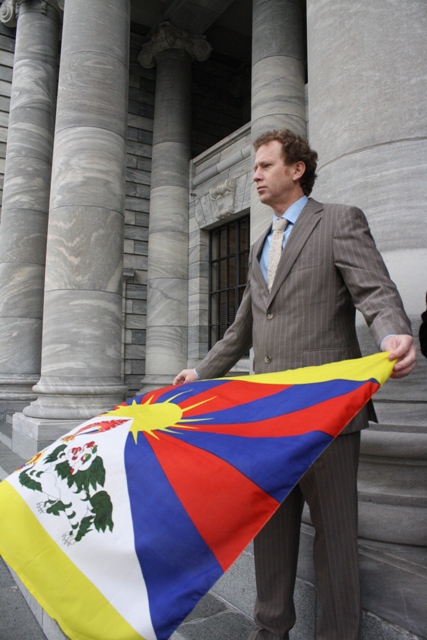
Green co-leader Russel Norman assulted by Chinese goon squad

According to reporters and Russel Norman himself, a dozen Chinese agents surrounded him, shoved him, pulled an umbrella over his head, stole his Tibetan flag and stomped on it, and his hand when he tried to get it back. PM John Key says all this is very ‘disappointing’, but it’s clear he means any embarrassment caused to the Chinese Vice President Xi Jinping, not this thugs’ attack on freedom of speech.

There’s a bit of history of this sort of thing. 11 years ago in Christchurch it was the New Zealand police who tried to protect the Chinese premier from the horrifying sight of pro-Tibetan protesters, the cops pushed the protesters back and parked a bus in front of them. They were later found to have abused their powers.

Oddly enough I’ve been thinking and reading a bit about China and Tibet recently, although not because of the VP’s trade delegation.

A recent report on New Zealand agribusiness says Chinese demand saved the economy from the worst of the (first round of) the global economic crisis. How long will this last?

Meanwhile, strikes by Chinese workers have been making the news and prompting debate among socialist bloggers in the UK. UNITYblog readers might be interested in this post by Lenin’s Tomb and this response from sympathetic to China Andy Newman at Socialist Unity.

And on the topic of Tibet, this article in the latest Austrian Green Left Weekly (a paper Mr Norman used to sell) responding to a report in the May 22 Sydney Morning Herald, that the Dalai Lama has declared himself “half Marxist half Buddhist”
– David


Incident outside Parliament – Russel Norman’s statement


The mistreatment of Green Party Co-leader Russel Norman on the grounds of Parliament by Chinese security personnel shows how important it is to stand up for democracy and human rights, the Green Party said today.

Dr Norman was assaulted by Chinese security personnel outside Parliament as he was making a stand against China’s human rights record in Tibet.

“Because John Key’s Government let Chinese security control our Parliament, it stopped being a safe place for democracy,” Dr Norman said.

“I’ve laid a complaint with the Police because New Zealanders need to know they are free to speak without fear of violence or recrimination.”

Dr Norman said the Government needs to defend the right of its citizens to free speech because it is one of the cornerstones of democracy.

“I’m asking that John Key make a clear statement that this sort of behaviour is not acceptable in New Zealand,” Dr Norman said.

Thursday, 8 October 2009

Interview with Sue Bradford

UNITYblog editor David C spoke with Green Party MP Sue Bradford on Monday, September 28, three days after she announced her resignation from parliament and return to grassroots activism.
DC: Why are you resigning from parliament?
SB: My decision to resign is a delayed but direct outcome of the result of the co-leadership contest which happened earlier this year. Since then I’ve done some serious thinking about what the next steps in my life should be.
[The contest was between Sue Bradford and Metiria Turei. Turei was elected female co-leader of the Green Party.]
The Green Party made a clear and democratic decision about the style and direction of the leadership, and I accept totally the democratic decision of the party. But it left me in a difficult position. After much thought, and discussing the issue with key friends and allies, I decided the best thing would be to make a clear break from parliament, and to look for opportunities back in the real world.
Politically I intend to be fully engaged. I feel like I’m going back to where I came from, to community and union activism. But quite how that expresses itself, you never know until you’re out there doing it.
DC: What did you feel that the leadership contest was about? Where you and Metiria Turei presenting two different visions for the party, or just two different styles or personalities?
SB: It was both. Obviously we’re very different people – different ages, ethnicities, experiences. I’m a lot older than Metiria, and there’s pros and cons on the whole issue of age. It was also about slightly different ideas about where the party could and should go.
When we came into parliament in 1999 – with Nandor Tanczos and myself and Rod Donald and others – we were very fresh and new and challenging. We presented a radical image and a radical reality. We were challenging the existing grey old parties. We had a lot of great policy and new ideas and some big issues to campaign on, both on the social and economic area and in the environmental area.
In the ten years since then, I feel we’ve become a little bogged down in parliamentary routine and the detail, and perhaps we have lost some of that fresh radical edge. Radicalism is not about age, it’s about a state of mind, about always being open to change, and about trying to be out on the edge of the politics that we believe in.
In losing some of that freshness and that willingness to be out there and radical and risk-taking politically, we’ve to some extent lost our point of difference with the older parties.
DC: What are some of things about being in parliament that bogs you down?
SB: Or bogs the party down?
DC: Or individual MPs?
SB: There’s a huge amount of detail to deal with on any piece of legislation, in select committee and in the House. All the legislation we deal with is very detailed and we do have to engage with it and do a really good job on it. Sometimes that can become a little overwhelming and become the primary focus – the detail, rather than the broader picture.
One example of that, where I think that we’ve become a bit bogged, is in the area of climate change, which has to be one of the key issues of our day. But I think that we have tended to get bogged in technicalities, rather than accepting and understanding that it is an economic issue and must be treated as such. We should be presenting a radical analysis of climate change and the solutions to it.
If I had become leader I would have liked us to have been engaging in a really lively dialogue with the young climate justice activists – who have what I think is a cutting edge analysis about climate change – rather than just seeing it as a question of how to compromise on emissions trading schemes.
DC: Obviously the emissions trading scheme being introduced now is terrible, but do you think emissions trading schemes can solve the climate crisis?
SB: No, not at all, I think that emissions trading schemes are just another capitalist game, using a failed market model. There’s not even any accurate way of measuring emissions.
The key thing about climate change is that all countries and all governments around the world have to cut emissions. That comes down to having the political will to do the things that are necessary. While technical issues are important, that’s not the main thing, it’s a question of political will.
And behind that is the issue of in whose interests do we cut emissions? Do we do it in a way where the low income and ordinary people in our society can survive? Or do we do it in a way where it just exacerbates the growing gap between rich and poor?
That plays out internationally where so far it’s the poorest nations that have already copped it the worst in terms of the impacts of climate change, and if we’re not careful that will continue to get worse. So there’s a kind of neo-colonialist thing going on with the response to climate change.
DC: The Green Party prides itself on working in a different way from the other parties in parliament, but one thing where it does seem to be following the model of the dominant parties is that the MPs seem to be the dominant force in the party and the party seems to be largely an electoral machine, would that be fair?
SB: I don’t think so actually. I think there’s always going to be a tendency for any party that has elected MPs for the caucus to be powerful and dominant. The Green Party has always worked very hard to try and maintain as much as a balance of power as possible.
We have quite a complex structure. We have the caucus and we also have two other parts of the party that are supposed to balance that, which are the party executive and the party’s own leadership – our co-convenors – and then the policy network, which is a policy-making and approval wing of the party. So there’s three branches. The other two branches are really there to try to counter-balance the MPs.
I’m not saying that it works perfectly, but our people are strong on having their voice heard, and if MPs do something that annoys them, they tend to make a pretty loud noise about it. And they do hold the MPs to account if they think they’re going crook.
DC: You gained a reputation – which I think surprised a lot of people – of being someone who could put together deals across party lines, particularly around Section 59, the private members bill that gave children the same legal protection from assault as adults.
Coming into parliament, your opinion say of National Party MPs probably wasn’t all that high, I just wonder, how you found it working alongside the people responsible for Rogernomics and the benefit cuts in the 1990s, and all those things that you’d fought against? Obviously you have to be civil to them... Was that a hard thing to do? Did it change you opinion of those people?
SB: It was certainly a very rapid learning curve during my first days in parliament. Within a few weeks I’d been placed on the special select committee dealing with the Employment Relations Bill and the re-nationalisation of ACC. This was in very early 2000, and that was the ideological battleground of that time. So I found myself sitting on a select committee with people like Max Bradford and Lockwood Smith and Richard Prebble and other key architects of right-wing economics in this country. I had to learn very fast how to operate in that context. As well as being lobbied by major insurance companies, the Business Roundtable and people I’d always just seen automatically as the enemy.
It’s part of the job, learning how to work with MPs from across the House and with lobbyists from wherever. And I came to feel very strongly that even though some of the lobbyists – not just on those bills, but on many others of course – are diametrically opposed politically to where I come from, and from where the Green Party comes from, I still felt an obligation to listen to them, and to be civil and respectful and to try and pick up any points that might be good. The same with submitters. Because if I was expecting the National Party to be civil and listen well to a worker from a Tokoroa timber mill making a submission on the Employment Relations Bill, then I had the same obligation to be respectful when I heard someone from the Employers and Manufacturers Association.
It’s part of democracy to take all the opinions and ideas and experiences on board, and then come to your political conclusion about what you do about that piece of legislation. And I’ve enjoyed, and actually it’s been a privilege, to have that experience of working with people across political lines. Many of whom, in the past, would not have given me the time of day. I think that’s good in a democracy, because I still believe that it’s better that we do our politics with words and legislation, rather than machetes and guns, as happens in some countries in the world. Of course our democracy’s not perfect, but I’ve certainly done my best to try and make it work.
DC: Is there any one highlight of your ten years in parliament?
SB: The highlight was getting three private members bills through in the last parliament. Not just the repeal of Section 59, but the one that lifted the wages for young workers aged 16 to 17 – which has not been rolled back, thank goodness – as well as my bill extending the time some mothers can keep their babies with them in prison. So there were the legislative highlights.
One of the most important things for me has been the ability, because of being an MP, to give a voice to unemployed people and beneficiaries and low paid workers, in a way that I don’t think has happened in parliament for some time. I think it probably happened back in the 1930s or earlier, when the early Labour Party came in, when there was that raw voice of what’s actually happening for real people, with poverty and unemployment.
I’ve tried to give that voice expression in parliament for the whole ten years. And also other voices too, like that of people with mental illness and their families, people with disabilities, children and young people. I’ve really tried to give a voice to the most vulnerable and exploited in our society, to the extent that I could. It’s never enough. I mean I feel bad that I’ve never been able to do enough, but I’ve done what I could.
DC: Are there any regrets? Anything you feel you’ve missed out on because of your time in parliament? Or anything you couldn’t do or couldn’t speak up on?
There have probably been times when I’ve been held back a little bit, in what I could say. But that’s part of being part of the Green Party caucus, with collective caucus responsibility. When you’re part of a political party, there’s a commitment to being part of the group and representing the group, rather than yourself. That’s important to me, I don’t believe in individualism in politics. That’s added to by the fact that you’re a member of parliament and very visible, so at times I guess I would have been a little held back, but not much.
DC: You’ve said in one of your recent statements that you’re still a radical.
SB: Yes.
DC: Are you still a socialist?
SB: Yes.
DC: Did you find it difficult to retain your radical politics in parliament?
SB: No, I haven’t found it difficult at all.
I’ve found it hard, in recent decades, to identify myself with a label. When I was young it was easy, we all called ourselves labels. As you keep maturing in political life, it’s harder. But if anything I think I’d call myself an ecosocialist and a feminist.
The fact that I’ve got a clear structural understanding of our economy and our society – and have had since I was pretty young, even though it keeps evolving and I keep learning – this is a strength in parliament. Because it means you don’t get lost in the detail. No matter what the issue was, even issues that seem quite tangential, like prostitution reform or gambling or racing, issues that aren’t right at the heart of things. I suppose you could almost call Section 59 that. But I’ve always had an analysis behind what I’m doing, and I’m always clear whose side I’m on in any political debate. And I don’t think I’ve ever sold out.
DC: What does a term like ecosocialism mean to you, both in terms with what’s wrong with capitalism and the sort of changes you’d like to see?
SB: That’s a huge question, you could write a book on that.
I came originally from a communist and socialist background, from when I was pretty young. I kept learning through that. The big thing that traditional communism and socialism missed was what we humans were and are, doing to the earth and the physical environment around us – we just weren’t aware of it. Although I’ve come to realise that Marx actually did have some understanding about it.
[Karl Marx was one of the founders of communism and socialism.]
So in the early ’70s, when the Values Party [forerunner of the Green Party] and some of the Green movements around the world started to raise and talk about it, I began to realise that there’s no way that we can leave the environment out of the equation.
We have to understand that the economy is basically a subsidiary of the environment, and that we humans can’t survive without the planet on which we depend for our existence. That means that environmental and social and economic justice issues have to be brought together into the same basket.
That’s what the Green Party policy and charter are about – caring for earth, caring for people. That’s why I joined the Green Party and stood for parliament, because the kaupapa [philosophy] is one that I support.
We have to do everything we can to redress the damage that we’ve done to the life of this planet, and try and nurture the life that’s on it. To do that well we also have to create a society in which everyone has a chance, and in which the gap between those who have and those who have not is diminished – and that’s the social and economic justice side of the Green kaupapa.
From my frame of reference that’s ecosocialism, but of course to other people in the Green Party they wouldn’t see it within that frame at all. Ecosocialism is just one means, feminism is another. Trying to live as responsible Treaty partners is another frame of reference which the Green Party attempts to live by. So we try to do all these things and Green Party members and MPs tend to have quite diverse lenses through which we see our Green kaupapa, but I see mine through this particular lens.
DC: I know in the Green Party of England and Wales there’s a group called Green Left, who describe themselves as “an anti-capitalist, eco-socialist current within the Green Party”. Would something like that fit in with the way the Green Party operates here?
SB: I’ve been interested in how they do that do that in the UK. But I think that we have a strong culture in the Green Party of Aotearoa not to form factions. Right through the time I’ve been active, since ’98, there’s been a real strong commitment from people not to form either closed or open factions. It’s a big no no, people wouldn’t like it. Beyond that, it may be that our party is too small to sustain that kind of open and clear factionalism that characterises other Green Parties and parties like the Labour Party here. I don’t know what might happen in the future. But it certainly not a direction I’m looking at taking.
DC: Now that you’re going back to the grassroots, what’s the first campaign that you think you’ll get involved in?
SB: It’s too soon to say. I’m very conscious that things change all the time. There are different campaigns happening at the moment and new ones arising. I will build on my current union and community base and probably start going to more demonstrations and more meetings, and just work my way into it. There’s so much work to be done, but to be any use one has to focus. And I’m not ready to make those kinds of decisions yet.
DC: One of the campaigns that’s going on is the Bad Bank’s campaign, and you’re speaking at a public meeting on Thursday night. Why did you agree to speak at that meeting? Why do you think the banks and their behaviour is an important issue?
SB: For the last 30 to 40 years we’ve seen the world economy run to meet the needs of the banks and financial institutions of capital, rather than in the interests of everyone else in society. The role of banks and the financial sector is a key issue, both locally and internationally. It’s important that we analyse what the banks and financial institutions have done and are doing. It’s really important to expose what they’re doing, but also to come up with some solutions, because we still need money as a means of exchange. So I welcomed the opportunity to speak at the meeting and to see what’s going on with that campaign.
DC: One last question. Will the SIS be re-opening your file?
SB: Quite possibly.

Friday, 2 October 2009

Check out Chris Trotter’s blog on Bradford

by David
I had more or less stopped paying any attention to Chris Trotter over the last few years, since he’s become a champion of the Labour Party. That changed when a Green Party member suggested I check out Trotter’s commentary on Sue Bradford’s resignation, at his blog Bow Alley Road. “This time Trotter’s got it right” they said, sounding a little surprised. Over the last week there’s been a number of posts and some interesting comments too, like this one from former Green MP Nandor Tancoz (who also has his own blog):
Hi Chris

 A better argued post than the Sept 25th one, IMHO ;).My reply there addresses some of what I see as the errors of that post.

I think that here you are absolutely right that the Greens have been extraordinarily naive at times about the power of evidence. One of my questions over the years has been ‘what is the Green extra-parliamentary power base’?. Votes are not enough, as the so-called ‘winter of discontent’ (2001?) demonstrated. Labour has the union movement. National has sheer economic power. If the Greens want to make serious moves to address the causes of ecological degradation, this will entail, ultimately, a new economic system - a steady state economy of some description that does not depend on increasing consumption. And those who most benefit from the status quo won’t give it up very easily.
My own interview with Sue Bradford, conducted on Monday will be up here early next week (it’s taking a long time to transcribe from the tape!).

Friday, 25 September 2009

Sue Bradford is ‘going back to the grassroots’

by David
UNITYblog editor I’m resisting the urge to write some sort of political obituary chronicling Bradford’s political career. After all, she’s resigning from parliament, not politics. “I’ll be going back to the grassroots,” she says. That at least is something to look forward to. However, unless Bradford leads a spectacular revival of grassroots campaigning by the Greens, her departure from Parliament will most likely accentuate the Green’s drift into accommodation with National, Labour and the exploitation of people and planet those parties uphold. Having said that, it’s doubtful Bradford could have done anything about this by staying inside parliament. In the Green Party's official statement Bradford admits that her defeat by Metiria Turei in the recent contest to for female co-leader of the party was an important part of her decision to resign: “The Party made a clear and democratic decision, but of course it was personally disappointing and I’m ready for a change.” I don’t know how Green Party members saw the choice they made. Turei is an excellent speaker and appears to be a capable politician, but for all I know the desire to present a younger face, may have been the biggest factor for Party members. Whatever the reasons Turei, despite her anarchist roots, and co-leader and former socialist Russel Norman seem happy to continue the Green’s transformation into parliament’s environmental lobby, an appendage rather than an alternative to National and Labour. Now, without the restrictions of parliament to hold her back, I hope Bradford will continue to resist her party’s rightwards trend.

Friday, 18 September 2009

All-party support for pollution market is the real ETS outrage

by David UNITYblog editor
Outrage has greeted the deal reached between the National and Maori Parties over the pollution market policy (emissions trading scheme or ETS). But the really terrible thing is not the Maori Party’s sell out, or the details of the deal -- and both these are horrible -- it’s the fact that a pollution market is only response to climate change any party in parliament can come up with. Just as bad (or even worse) is that the major environmental groups campaigning for action on climate change -- Greenpeace and 350 -- are also putting their faith in the pollution market approach. They should be blowing the lid on the world-wide pollution market con-job. Because, although the details of the National-Maori Party version may be worse than the Labour-Green version, which ever way you look at it, emissions trading stinks. It won’t do a thing to reduce pollution or prevent climate change. All pollution markets are based around giving corporate polluters the right to pollute, the right to profit from buying and selling pollution credits and the right to pass any costs they do incur on to their customers. All assume that rather than actually cutting emissions, or fundamentally changing they way they do things (this would hurt profits too much) polluting industries will be able to buy “off set” credits from somewhere else (who knows where?). All these schemes ignore the fact that to transition to a low carbon economy will require a massive transformation of how we do just about everything. And this will require planning and co-ordination and should require democratic participation, not rising prices and blind faith in the market. Recognising the reality of pollution market politics, begs the question: is the Maori Party’s support for National’s ETS any worse than the Green’s support for Labour’s ETS? After all, climate change is the issue the Greens should be making a stand and giving leadership. In my view, neither Labour nor the Greens have any right to criticise the Maori Party until they themselves oppose pollution market madness.

John Minto: Politicians fiddle while climate collapses

From Stuff 15/09/2009 National and the the Maori Party traded their way closer to environmental catastrophe yesterday with a deal agreed to amend the Emissions Trading Scheme passed in the last term of the Labour government. It’s a deal with no winners and the environment, which in the end means all of us, the big loser. The previous Labour proposals had too little regard for the environment but this one has even less. Politicians are by the nature of their employment short-term thinkers. The three-year electoral cycle dominates decision-making. For National it’s simply delivering the review of the ETS which Act demanded as part of its election agreement, while future generations will regard the Maori Party role as simply trading opportunities for future generations for temporary baubles as in some of the land transactions of the past. There is simply no mechanism for climate change to be prevented under capitalism. For its very survival capitalism depends on growth. It’s like a pyramid selling scheme where confidence in the system relies on the belief we can always move forward with more and more consumers into an infinite future. Each individual is encouraged to believe we need a bigger cake rather than sharing the cake more evenly. Growth is the mantra of the marketeers while the environment is crying out -- enough! Many would say, and I include myself here, that capitalism has been going head to head with humanity for the past 300 years. Now climate change is where capitalism goes head to head with the life-support systems of the planet itself. I read recently a quote to the effect that asking capitalism to voluntarily stop growing is like asking a person to voluntarily stop breathing. The capitalist response to climate change has predictably been to create a market for carbon -- a so-called “cap and trade” arrangement whereby the levels of carbon would be capped and permits to pollute traded in a market. It’s one of those schemes which sounds plausible on paper but which will be quite impossible to work globally. It would set in concrete the injustices faced by developing countries that have seen their resources exploited to drive up living standards elsewhere in the world while delivering so little local benefit. It allows the worst polluters to purchase the right to keep polluting. There's an old proverb among the indigenous Indian population of North America which says a tribe would look seven generations into the past and seven into the future before major decisions related to the environment were made. Those people were in tune with their world. Maori in New Zealand were not here long enough to reach such a profoundly sustainable view of this land and its resources and Pakeha arriving here saw only resources to exploit. The combined efforts of National and the Maori Party have created an agreement with less than a generation in foresight. New Zealand is taking to Copenhagen the equivalent of a damp piece of paper to fight a bushfire.

Friday, 21 August 2009

Greens should come into line with leftists on GST

by Grant Morgan Green Party co-leader Russel Norman has issued a media statement on GST Stop messing with GST and start investigating a CGT. The good part is that the Green MPs will oppose lifting the rate of GST. But there are also significant bad parts to Norman's statement, such as: Norman calls on the government to "stop messing with GST". Yet, if the interests of the grassroots are to be served, the Green should be messing with GST, which is perhaps the central pillar of neo-liberalism in New Zealand. We need to get rid of GST altogether, and replace it with the likes of a Financial Transactions Tax that directly hits the speculators as reversals of the tax breaks enjoyed by the rich since the days of Roger Douglas. Norman justified a Capital Gains Tax on the basis that it "is found in most OECD countries". These same OECD countries, like virtually all countries in the world with a goods & services tax, exclude food (and often other essentials) from GST. Yet the Green MPs went against OECD and world trends by refusing to support RAM's GST-off-food campaign. This contradiction tears at the heart of Green politics in Aotearoa. Arguing against raising GST, Norman employs three basic ideas: 1. It "would hammer those in the lower and middle income brackets". In effect, Norman admits that GST hits the poor far more than the rich. That being so, why is the Green caucus still backing GST? 2. It would "likely send New Zealand into a deeper recession". That being so, wouldn't removing GST from food (and other measures to roll back GST) increase the spending power of the grassroots and thus assist in economic recovery? 3. "For most New Zealanders even a small rise in GST will wipe out any financial advantage they may have gained in last December's tax cuts". Yes, that is true. Yet the Green caucus argued against removing GST from food on the spurious grounds that it would give only a one-off benefit. In fact, the benefits of removing GST from food would not only be permanent, but would rise in value as food costs rose over time. The Green caucus appears to be in a wildly contradictory position in regards to GST. It is time that everyone on the left told them so. The Green MPs should be told to come into line with consistent leftists in OECD countries, and around the world, and start advocating for the removal of GST from food as a starting point to getting rid of this neo-liberal tax altogether.

Wednesday, 12 August 2009

Bad banks: NZ people vs banks $38 million and rising

Green Party media release 11 August 2009 The struggling New Zealand taxpayer is tens of millions of dollars out of pocket due to the fight between the Inland Revenue Department and some of our largest banks, said Green Party Co-Leader Dr Russel Norman. Figures obtained by the Green Party show that as at 31 July 2009, the total cost for all Structured Finance cases against some of New Zealand’s largest banks is approximately $38,500,000. In July the High Court found in favour of the IRD in a court case involving the BNZ. The case revolved around a particular kind of transaction known as Structured Finance. The IRD considered these types of transactions to be tax avoidance. The ruling - subject to the latest appeal - meant the BNZ must pay at least $416 million in back taxes. “This is a David and Goliath fight,” said Dr Norman. “However unlike the recent movie championing alleged ‘Kiwi battler’ Dave Henderson’s fight against the IRD ‘We are here to Help’ – this time the IRD is David and the banks are Goliath. “The decision today by the BNZ to appeal a High Court decision that went against the bank will see the cost to the NZ taxpayer of fighting Structured Finance cases blow out even further,” said Dr Norman. “We know from our experience of New Zealand’s de-regulated financial market in the 80s that if banks can get away with paying less tax they will. “The problem then is who picks up the tab – and that is the greater New Zealand public. At present the Government have set up a working group to study tax – and suggestions coming from this group are that GST should be raised to 15 percent.” The Tax Working Group announced by Finance Minister Bill English in May includes Business Roundtable chairperson Rob McLeod. Earlier this year Mr McLeod gave evidence on behalf of the BNZ in the High Court in his capacity as a tax expert. “Surely when picking a group to look at the New Zealand tax system we should be casting the net further than ‘tax experts’ who give evidence in court cases on behalf of banks engaged in fighting our own IRD,” said Dr Norman.

Tuesday, 7 July 2009

Marxism Alive 2009 conference video, Part 3

This third and final post of video footage from Socialist Worker's Marxism Alive 2009 conference, held on June 27, features Green MP Catherine Delahunty and Labour MP Darien Fenton speaking in the third conference session: Transitioning to a human centred economy in Aotearoa
Green MP Catherine Delahunty
Labour MP Darien Fenton

Saturday, 4 July 2009

Marxism Alive 2009 conference video, Part 2


Several dozen activists attended Socialist Worker's Marxism Alive conference on June 27. It was broadest gathering of the Left in Auckland in recent memory. Over the course of the day-long educational forum, the panel speakers and participants contributed to a penetrating analysis of trends and charted moves to unify the Left. Here is the second in a series of video highlights from key conference debates.
Conference participants discuss Broad Left unity

Don Archer, Socialist Worker
David, Socialist Worker
Grant Brookes, Socialist Worker

Wednesday, 1 July 2009

Marxism Alive 2009 conference video, Part 1

Several dozen activists attended Socialist Worker's Marxism Alive conference on June 27. It was broadest gathering of the Left in Auckland in recent memory. Over the course of the day-long educational forum, the panel speakers and participants contributed to a penetrating analysis of trends and charted moves to unify the Left. A series of video highlights from key debates will be posted on UNITYblogNZ over the coming days.
Is National the new natural party of government? Will Labour return to social democracy?
Daphna Whitmore, Workers Party
Sarita Divis, Alliance Party
Grant Brookes, Socialist Worker

Wednesday, 19 November 2008

FEATURE ARTICLE: Protecting the people from the market crisis

by GRANT MORGAN chair of RAM - Residents Action Movement 19 November 2008 VALUING THE MAJORITY RAM wants a society based on the values of humanity, ecology, co-operation, equity and democracy. (For fuller details, go to The RAM Plan on http://www.ram.org.nz/.) These are the default values of workers, Maori, leftists, ecologists, immigrants, intellectuals, pensioners, feminists, religious believers, students, small proprietors and others at the grassroots who make up the vast majority of citizens.

Friday, 19 September 2008

RAM asks CTU for democratic debate & vote on 'pollution market'

Residents Action Movement Media release 5 September 2008 Over the last four years, RAM (Residents Action Movement) has been campaigning for free and frequent public transport in main centres. "Free and frequent trains and buses, funded by a switch of government money from highways and car tunnels, is a boldly realistic policy in an era of global warming, peak oil and traffic jams," said Roger Fowler, RAM's transport speaker. "This one policy change would do far more to tackle carbon emissions than the entire Emissions Trading Scheme being driven by the Labour, Green and NZ First parties. And it would keep more money in the pockets of workers." "It is very disappointing to see the Green politicians supporting Labour's drive to pass the ETS legislation," says Elliott Blade, RAM's environmental co-speaker and parliamentary candidate for Maungakiekie. "This law will establish a pollution market in New Zealand where corporations make money out of global warming while life-threatening emissions keep on rising." Like RAM, the Maori Party has come out strongly against the ETS. Maori Party MP Te Ururoa Flavell told Parliament on 2 September that, in addition to Treaty of Waitangi concerns over the ETS, the Maori Party opposes the scheme because:
  • It would not be effective in reducing greenhouse gas emissions.
  • It is "not transparent".
  • "Polluters do not pay", but instead receive massive subsidies that amount to "corporate welfare".
  • Therefore the stated aim of economic incentives to cut emissions is "defeated".
"The Maori Party's exposure of the ETS makes them the foremost ecological party in the current Parliament," says Michelle Ducat, environmental co-speaker for RAM. "The mantle of ecological guardian has slipped from the shoulders of the Green Party onto the Maori Party." Meanwhile the Council of Trade Unions (CTU) has come out with qualified support for the ETS. On 2 September, CTU economist Peter Conway said that climate change policy should "not rely too substantially on market-based mechanisms such as emissions trading". However, Mr Conway flagged CTU support for the ETS "compromise" reached between Labour, NZ First and the Greens, including the one-off electricity rebate to all households in 2010 and the one-off cash payment to beneficiaries, seniors and low-wage workers. While admitting that "this bill is not perfect", Mr Conway claimed "the risks of not taking concrete steps outweigh any disadvantages". RAM has serious concerns about the CTU's stance on the politics of global warming and how the ETS will impact on workers. "The CTU is giving shame-faced support to a pollution market which will reward polluters for trading in greenhouse gas emissions. This is not an effective challenge to global warming. The government needs to urgently legislate mandatory targets directing corporate polluters to clean up their act," said Oliver Woods, co-leader of RAM's candidates group and parliamentary candidate for Auckland Central. "The one-off payments under the new-look ETS will go nowhere near to compensating workers for unfair cost increases heaped on them so that corporations can profit from trading in pollution," noted Grant Brookes, co-leader of RAM's candidates group and parliamentary candidate for Wellington Central. "By backing the ETS, the CTU seems to be acting against the best interests of its own members." "Already some unionists are questioning whether the CTU's stance has more to do with backing Labour in an election year rather than protecting workers and the environment. The best way for the CTU to answer these questions would be to allow all sides of the debate to be presented to their 350,000 members and ask them to reach a collective decision," said Mr Brookes. RAM is calling on the CTU to widely circulate the Maori Party's views on the ETS. "The Maori Party is the only party in Parliament criticising the concept of a pollution market," says Grant Morgan, chair of RAM. "National and Act support a pollution market, merely wanting it to deliver even more corporate welfare to the polluters than the current ETS." "On behalf of RAM, I have requested the CTU leadership to publicise the Maori Party and RAM's criticisms of the ETS within their affiliate unions so more than one side of the story is heard by workers," said Mr Morgan. "I have also requested the CTU to promote a broad debate inside its affiliated unions in a lead-up to a democratic vote by workers about whether or not they should support a pollution market."

Sunday, 31 August 2008

Will history repeat for the Greens?

by Auckland union activist "History never repeats, I tell myself before I go to sleep." This line of wishful thinking from a Split Enz hit song sums it up for the Greens leadership. Just as the Alliance leadership were dragged by their Labour government allies into supporting the vengeful invasion of Afghanistan against wide opposition in their membership ranks. The Greens leadership has been dragged into Labour's "pollution trading" scheme, against wide opposition in their membership ranks. The Greens leadership will be optimistically humming the Split Enz tune before they go to bed each night until the election. They'll be hoping like hell the voting public won't abandon them, as happened to the Alliance.

Friday, 29 August 2008

Call 'pollution market' by its real name, says RAM

RAM - Residents Action Movement Media release 26 August 2008 Green co-leader Jeanette Fitzsimons today claimed that her party had won "substantial changes" to the Emissions Trading Scheme (ETS) following talks with Labour cabinet ministers. How accurate is this claim by Ms Fitzsimons? Going into the talks with Labour, the most loudly voiced concerns of the Green Party caucus were that the agriculture and transport sectors were not coming into the ETS early enough. Ms Fitzsimons today said that now "a target for agricultural emissions reduction before 2015 will be gazetted". But is this really a "substantial change" to the ETS? Not according to Grant Morgan, chair of the Residents Action Movement, better known as RAM, a broad left people's movement. "One very important word has been left out of the new agreement on the ETS," Mr Morgan observed. "That word is 'mandatory'. So long as a closer target for agricultural emissions reduction is not made mandatory, it's just a lot of hot air. It's government spin because agriculture does not have to meet the voluntary target. Sadly, the Greens are recycling Labour's spin and thus misleading public opinion." Nor will there be any hastening of the transport sector's entry into the ETS under the new deal struck between Labour and the Greens. "The transport sector will remain able to pollute with impunity until 2015," noted Roger Fowler, RAM's transport spokesperson. "As well, the Green caucus has consistently refused to support RAM's campaign over the last four years for free and frequent public transport as a boldly realistic way of slashing carbon emissions. We need to shift motorway funds into fare-free trains and buses, but the Greens won't agree because they know Labour strongly disapproves. They are putting their political pact with Labour ahead of our environment." Going on the evidence, neither of the two most loudly voiced Green concerns have been met by Labour's recent tweakings of the ETS. This is at variance with Green claims of "substantial changes", which appear to be mostly aimed at winning votes. "RAM calls on the Green Party leadership to reject the Emissions Trading Scheme as a whole," said Michelle Ducat, RAM's ecology co-spokesperson. "The solution to climate change does not lie in creating a market for pollution, where corporations trade their greenhouse gas credits and debits on a new stock exchange. This is merely placing the market in charge of the problem that they created in the first place." Ms Ducat's comments seem to be vindicated by the experiences of Europe. In many Western European countries, emissions trading schemes have been in place for years, yet official statistics reveal that greenhouse gas pollution has been increasing, not decreasing. Late last week, Green leaders called for responses on whether their party should support or reject the ETS. Yesterday a Green Party spokesperson revealed that the 2,000 email responses were split 50:50. Since most of these responses were likely to be from Green members, it seems their rank-and-file are split down the middle over the issue. "It is very worrying that the Green Party caucus refuse to call the Emissions Trading Scheme by its real name - a pollution market," said RAM chair Grant Morgan. "Big corporations around the world are raking in grotesque profits from trading in greenhouse gases which could kill off all life on our planet. Their pollution market is both immoral and scary." "RAM has put up a positive, robust alternative to the Green Party MP's who are giving away ecology as they cuddle up to Labour," said Mr Morgan. "In our RAM Plan, we put humans and our habitat before the profits and power of the big corporations who think they can dictate to everyone else on the planet." Backgrounders:

For more information, contact: Grant Morgan 021 2544 515 grantmorgan@paradise.net.nz Roger Fowler 021 2999 491 mangere.east.access@paradise.net.nz Michelle Ducat 027 308 2521 michelle@ducat.co.nz

Saturday, 23 August 2008

Green Party dilemma - are we for emissions trading, or not?

On Tuesday 26 August the Green Party caucus is going to decide whether it will vote for Labour's emissions trading scheme, or not. But it seems the Green Party MPs aren't sure, so they want to hear from the public as to which way they should vote. See the NZ Herald articles, Greens leave decision with the public (22 August) and Greens get mixed views on emissions trading scheme (23 August). You can tell the party what you think by emailing ets@greens.org.nz RAM activists Peter de Waal and Roger Fowler have already emailed their thoughts to the Green Party. See Peter de Waal Carbon trading is a stupid idea and Roger Fowler Let's introduce free public transport - an example to the world More UNITYblog readers should email the Green Party. And if you want your contribution to be posted on UNITYblog as well, email to editor@unityblognz.com

Carbon trading is a stupid idea

by Peter de Waal RAM activist 22 August 2008 Carbon trading is a stupid idea and will never work for the simple reason that you can not expect the same "free-market" which created the greenhouse gas problem in the first place is going to be capable of reducing the world's emissions. Added to this, such schemes will only transfer more costs onto ordinary people as the business corporations will push up prices to pay for this nonsense. The only people to benefit from carbon trading will be the business corporations, the banks, the stock market parasites and their lawyers. The Greens need a much better policy centred around the ideas of using new carbon taxes to urgently build a new low- emission infrastructure here in New Zealand, which will also have the beneficial effect of helping keep society running as peak oil begins to bite hard and the 'normal' way of life becomes a distant memory. The Green Party also needs to clearly explain to the public the reasons why this infrastructural investment and extra taxation is necessary, particularly at a time when most families are struggling to survive. If the Greens persist with this free-market carbon tax trading strategy without it being directly tied to local low-emmission infrastructure investment such as free public transport, then the Greens can expect to get a real pasting in the elections this year. The Greens need to leave Parliament with it's jet-set lifestyle at 35,000 feet and put their feet back on the ground and listen to ordinary people who are struggling to buy food, pay bills etc. Green and left voters don't want a bar of this corporate carbon-trading nonsense. The question is: has the Green Party got what it takes to stand up to the business corporations and the Labour Party on this question or have they become captured and sold out to the free-market? Sent to Green Party ets@greens.org.nz (22 August 2008)

Sunday, 17 August 2008

Small parties lose their gloss, giving National a big lead

by Auckland union activist According to recent poll results Labour remains steady, but National has gained at the expense of the smaller parties. While Labour's support has not moved down, Labour has failed to capture the imagination of new grassroots voters for their centrist politics. And their chances of governing again are slipping as voter support for the smaller parties, particularly the Greens, appears to be weakening. In my opinion where the smaller left leaning parties have failed, is by becoming captured by the Labour government, dragging them to the right. This happened most spectacularly in the past with the Alliance, and now we see the same process occurring with the Greens. This has obviously made them indistinguishable from Labour to grassroots voters. Potentially the People's Procession to Parliament, which will be delivering the message to the politicians that people don’t want their food taxed, could tap into the mood for change for the left. RAM, a people’s movement, which will be standing a full list of candidates for the party vote and a number of electoral candidates, could be an attractive option for grassroots voters disillusioned with the other parties. To beat National we need RAM to succeed. See Nat's Romping Ahead from the Dominion Post, 16 August 2008. Visit RAM's website http://www.ram.org.nz/

Thursday, 5 June 2008

Green Party leaders have muffed it again

The NZ Green Party's election posters. Are the Greens making the mistake of putting image before substance? Have they lost their radical edge?

by Ondine Green

The Greens had their chance to put some real excitement into the election campaign at their annual conference at Queen's Birthday weekend. And they muffed it.

Rumour had it leading up to the conference that the Greens were going to call for price controls on milk for domestic consumption. While this would not have had nearly as much of an impact on working people's skyrocketing food bills as – say – RAM's proposal to remove GST from food, it would have been at least a small step. Plus, it would have fired a warning shot across the bows of big agribusiness, easily New Zealand's number 1 producer of greenhouse emissions.

And what did Green leader Jeanette Fitzsimmons finally announce in her speech? That she was going to (get this) ask Fonterra nicely to bring milk prices down.

This is exactly why the Green Party has reached the limits of its claim to be any sort of radical alternative to the two-party duopoly. Even a tiny and easily achievable goal has to be trashed if it gives the appearance of bucking the almighty free market in any way. The Rubicon was crossed on this issue when they endorsed Labour's plan for “emissions trading” - also known as bribing big business not to wreck the planet quite so quickly.

Of course, the Greens are behind the eight-ball in this campaign anyway. They've traded off most of their distinctiveness and radical image (let alone any radical policies) to become “acceptable coalition partners for Labour”. Those with long memories might remember what happened when the Alliance did that ten years ago. Why exactly should struggling families vote for the Greens if it's just Labour policies with extra political correctness?

And this has happened with the Green's so-called “social justice” wing (represented by such high fliers as co-leader Russel Norman and MP Sue Bradford) in ascendancy. If the “blue-green” wing (represented by people like ex-MP Mike Ward, who did his best to stop Russel Norman taking over Nandor Tanczos's seat in Parliament) had their way, it would be even worse, and we might be seeing the Greens emulate their German cousins and hooking up with the right.

The Green leadership have been inside the bubble of Parliament for twelve years now – long enough to “go native” and forget that there's a real world of real working people with real hardships out there. Only that can explain why Jeanette Fitzsimmon's speech went out of its way to tick off who they seem to think are their real enemies – Parliamentary journalists like Guyon Espiner. Certainly those people don't particularly like the Greens, but then the Parliamentary media are in the entertainment business above all and the Greens aren't nearly as “fun” for them as Winston Peters. Which is, of course, why his political career keeps rising from the dead.

The Green's weak campaign gimmick - “Some things are bigger than politics” - shows all the signs that they've decided to play for the attention of media moguls and political journalists, not ordinary people. It's all icing and no cake. Only a party which puts concrete, achievable proposals for making ordinary people's lives better – no matter what the spin doctors and boardroom boys thinks – has any hope of motivating working people to the polls this October, and stopping a nasty Nat victory.

