By Richard M Bennett
31/03/08 "Asia Times" -- - Given the historical context of the unrest in Tibet, there is reason to believe Beijing was caught on the hop with the recent demonstrations for the simple reason that their planning took place outside of Tibet and that the direction of the protesters is similarly in the hands of anti-Chinese organizers safely out of reach in Nepal and northern India.
Similarly, the funding and overall control of the unrest has also been linked to Tibetan spiritual leader the Dalai Lama, and by inference to the US Central Intelligence Agency (CIA) because of his close cooperation with US intelligence for over 50 years.
Indeed, with the CIA's deep involvement with the Free Tibet Movement and its funding of the suspiciously well-informed Radio Free Asia, it would seem somewhat unlikely that any revolt could have been planned or occurred without the prior knowledge, and even perhaps the agreement, of the National Clandestine Service (formerly known as the Directorate of Operations) at CIA headquarters in Langley.
Respected columnist and former senior Indian Intelligence officer, B Raman, commented on March 21 that "on the basis of available evidence, it was possible to assess with a reasonable measure of conviction" that the initial uprising in Lhasa on March 14 "had been pre-planned and well orchestrated".
Could there be a factual basis to the suggestion that the main beneficiaries to the death and destruction sweeping Tibet are in Washington? History would suggest that this is a distinct possibility.
The CIA conducted a large scale covert action campaign against the communist Chinese in Tibet starting in 1956. This led to a disastrous bloody uprising in 1959, leaving tens of thousands of Tibetans dead, while the Dalai Lama and about 100,000 followers were forced to flee across the treacherous Himalayan passes to India and Nepal.
The CIA established a secret military training camp for the Dalai Lama's resistance fighters at Camp Hale near Leadville, Colorado, in the US. The Tibetan guerrillas were trained and equipped by the CIA for guerrilla warfare and sabotage operations against the communist Chinese.
The US-trained guerrillas regularly carried out raids into Tibet, on occasions led by CIA-contract mercenaries and supported by CIA planes. The initial training program ended in December 1961, though the camp in Colorado appears to have remained open until at least 1966.
The CIA Tibetan Task Force created by Roger E McCarthy, alongside the Tibetan guerrilla army, continued the operation codenamed ST CIRCUS to harass the Chinese occupation forces for another 15 years until 1974, when officially sanctioned involvement ceased.
McCarthy, who also served as head of the Tibet Task Force at the height of its activities from 1959 until 1961, later went on to run similar operations in Vietnam and Laos.
By the mid-1960s, the CIA had switched its strategy from parachuting guerrilla fighters and intelligence agents into Tibet to establishing the Chusi Gangdruk, a guerrilla army of some 2,000 ethnic Khamba fighters at bases such as Mustang in Nepal.
This base was only closed down in 1974 by the Nepalese government after being put under tremendous pressure by Beijing.
After the Indo-China War of 1962, the CIA developed a close relationship with the Indian intelligence services in both training and supplying agents in Tibet.
Kenneth Conboy and James Morrison in their book The CIA's Secret War in Tibet disclose that the CIA and the Indian intelligence services cooperated in the training and equipping of Tibetan agents and special forces troops and in forming joint aerial and intelligence units such as the Aviation Research Center and Special Center.
This collaboration continued well into the 1970s and some of the programs that it sponsored, especially the special forces unit of Tibetan refugees which would become an important part of the Indian Special Frontier Force, continue into the present.
Only the deterioration in relations with India which coincided with improvements in those with Beijing brought most of the joint CIA-Indian operations to an end.
Though Washington had been scaling back support for the Tibetan guerrillas since 1968, it is thought that the end of official US backing for the resistance only came during meetings between president Richard Nixon and the Chinese communist leadership in Beijing in February 1972.
Victor Marchetti, a former CIA officer has described the outrage many field agents felt when Washington finally pulled the plug, adding that a number even "[turned] for solace to the Tibetan prayers which they had learned during their years with the Dalai Lama".
The former CIA Tibetan Task Force chief from 1958 to 1965, John Kenneth Knaus, has been quoted as saying, "This was not some CIA black-bag operation." He added, "The initiative was coming from ... the entire US government."
In his book Orphans of the Cold War, Knaus writes of the obligation Americans feel toward the cause of Tibetan independence from China. Significantly, he adds that its realization "would validate the more worthy motives of we who tried to help them achieve this goal over 40 years ago. It would also alleviate the guilt some of us feel over our participation in these efforts, which cost others their lives, but which were the prime adventure of our own."
Despite the lack of official support it is still widely rumored that the CIA were involved, if only by proxy, in another failed revolt in October 1987, the unrest that followed and the consequent Chinese repression continuing till May 1993.
The timing for another serious attempt to destabilize Chinese rule in Tibet would appear to be right for the CIA and Langley will undoubtedly keep all its options open.
China is faced with significant problems, with the Uighur Muslims in Xinjiang province; the activities of the Falun Gong among many other dissident groups and of course growing concern over the security of the Summer Olympic Games in August.
China is viewed by Washington as a major threat, both economic and military, not just in Asia, but in Africa and Latin America as well.
The CIA also views China as being "unhelpful" in the "war on terror", with little or no cooperation being offered and nothing positive being done to stop the flow of arms and men from Muslim areas of western China to support Islamic extremist movements in Afghanistan and Central Asian states.
To many in Washington, this may seem the ideal opportunity to knock the Beijing government off balance as Tibet is still seen as China's potential weak spot.
The CIA will undoubtedly ensure that its fingerprints are not discovered all over this growing revolt. Cut-outs and proxies will be used among the Tibetan exiles in Nepal and India's northern border areas.
Indeed, the CIA can expect a significant level of support from a number of security organizations in both India and Nepal and will have no trouble in providing the resistance movement with advice, money and above all, publicity.
However, not until the unrest shows any genuine signs of becoming an open revolt by the great mass of ethnic Tibetans against the Han Chinese and Hui Muslims will any weapons be allowed to appear.
Large quantities of former Eastern bloc small arms and explosives have been reportedly smuggled into Tibet over the past 30 years, but these are likely to remain safely hidden until the right opportunity presents itself.
The weapons have been acquired on the world markets or from stocks captured by US or Israeli forces. They have been sanitized and are deniable, untraceable back to the CIA.
Weapons of this nature also have the advantage of being interchangeable with those used by the Chinese armed forces and of course use the same ammunition, easing the problem of resupply during any future conflict.
Though official support for the Tibetan resistance ended 30 years ago, the CIA has kept open its lines of communications and still funds much of the Tibetan Freedom movement.
So is the CIA once again playing the "great game" in Tibet?
It certainly has the capability, with a significant intelligence and paramilitary presence in the region. Major bases exist in Afghanistan, Iraq, Pakistan and several Central Asian states.
It cannot be doubted that it has an interest in undermining China, as well as the more obvious target of Iran.
So the probable answer is yes, and indeed it would be rather surprising if the CIA was not taking more than just a passing interest in Tibet. That is after all what it is paid to do.
Since September 11, 2001, there has been a sea-change in US Intelligence attitudes, requirements and capabilities. Old operational plans have been dusted off and updated. Previous assets re-activated. Tibet and the perceived weakness of China's position there will probably have been fully reassessed.
For Washington and the CIA, this may seem a heaven-sent opportunity to create a significant lever against Beijing, with little risk to American interests; simply a win-win situation.
The Chinese government would be on the receiving end of worldwide condemnation for its continuing repression and violation of human rights and it will be young Tibetans dying on the streets of Lhasa rather than yet more uniformed American kids.
The consequences of any open revolt against Beijing, however, are that once again the fear of arrest, torture and even execution will pervade every corner of both Tibet and those neighboring provinces where large Tibetan populations exist, such as Gansu, Qinghai and Sichuan.
And the Tibetan Freedom movement still has little likelihood of achieving any significant improvement in central Chinese policy in the long run and no chance whatever of removing its control of Lhasa and their homeland.
Once again it would appear that the Tibetan people will find themselves trapped between an oppressive Beijing and a manipulative Washington.
Beijing sends in the heavies
The fear that the United States, Britain and other Western states may try to portray Tibet as another Kosovo may be part of the reason why the Chinese authorities reacted as if faced with a genuine mass revolt rather than their official portrayal of a short-lived outbreak of unrest by malcontents supporting the Dalai Lama.
Indeed, so seriously did Beijing view the situation that a special security coordination unit, the 110 Command Center, has been established in Lhasa with the primary objective of suppressing the disturbances and restoring full central government control.
The center appears to be under the direct control of Zhang Qingli, first secretary of the Tibet Party and a President Hu Jintao loyalist. Zhang is also the former Xinjiang deputy party secretary with considerable experience in counter-terrorism operations in that region.
Others holding important positions in Lhasa are Zhang Xinfeng, vice minister of the Central Public Security Ministry and Zhen Yi, deputy commander of the People's Armed Police Headquarters in Beijing.
The seriousness with which Beijing is treating the present unrest is further illustrated by the deployment of a large number of important army units from the Chengdu Military Region, including brigades from the 149th Mechanized Infantry Division, which acts as the region's rapid reaction force.
According to a United Press International report, elite ground force units of the People's Liberation Army were involved in Lhasa, and the new T-90 armored personnel carrier and T-92 wheeled armored vehicles were deployed. According to the report, China has denied the participation of the army in the crackdown, saying it was carried out by units of the armed police. "Such equipment as mentioned above has never been deployed by China's armed police, however."
Air support is provided by the 2nd Army Aviation Regiment, based at Fenghuangshan, Chengdu, in Sichuan province. It operates a mix of helicopters and STOL transports from a frontline base near Lhasa. Combat air support could be quickly made available from fighter ground attack squadrons based within the Chengdu region.
The Xizang Military District forms the Tibet garrison, which has two mountain infantry units; the 52nd Brigade based at Linzhi and the 53rd Brigade at Yaoxian Shannxi. These are supported by the 8th Motorized Infantry Division and an artillery brigade at Shawan, Xinjiang.
Tibet is also no longer quite as remote or difficult to resupply for the Chinese army. The construction of the first railway between 2001 and 2007 has significantly eased the problems of the movement of large numbers of troops and equipment from Qinghai onto the rugged Tibetan plateau.
Other precautions against a resumption of the long-term Tibetan revolts of previous years has led to a considerable degree of self-sufficiency in logistics and vehicle repair by the Tibetan garrison and an increasing number of small airfields have been built to allow rapid-reaction units to gain access to even the most remote areas.
The Chinese Security Ministry and intelligence services had been thought to have a suffocating presence in the province and indeed the ability to detect any serious protest movement and suppress resistance.
Richard M Bennett, intelligence and security consultant, AFI Research.

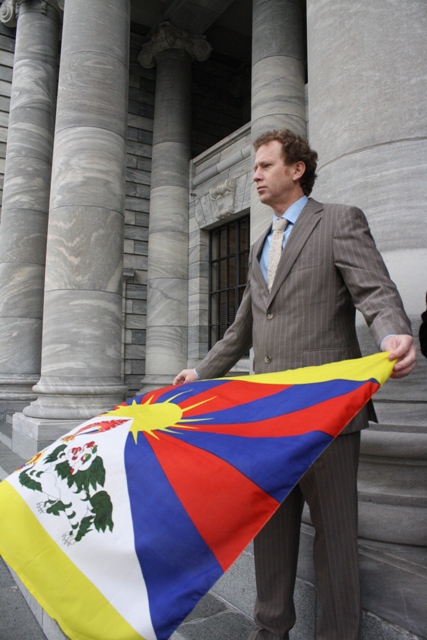 There’s a bit of history of this sort of thing. 11 years ago in Christchurch it was the New Zealand police who tried to protect the Chinese premier from the horrifying sight of pro-Tibetan protesters, the cops pushed the protesters back and parked a bus in front of them. They were later found to have abused their powers.