Showing posts with label China. Show all posts

Monday, 17 January 2011

The currency king is (almost) dead, long live who?

by Grant Morgan

On the eve of a trip to Washington, China's president Hu Jintao has openly spelt out the demise of the US dollar as the world reserve currency.

Yet he also admits that it would be "a fairly long process" to make China's renminbi an international currency, not to mention replacing the weakening greenback as the unrivaled currency of global commerce.

In other words, the currency king is (almost) dead, long live who? (not Hu).

All this is an indicator of two system-changing trends. First, it points to a hegemonic vacuum in the world system as no one imperial power looks likely to gain the relative dominance that America enjoyed after the Second World War.

Second, it highlights the deathly financial instability of global capitalism as its high-stakes gamble on building ever higher mountains of debt looks certain to be a sure loser.

The important task facing the world's majority is to make sure that financial chaos and capitalist collapse doesn't take them down too.

That will require a grassroots revolution to separate the worthwhile world of work from the parasitical world of high finance where capitalist crooks and state swindlers luxuriate in a fool's paradise at the expense of people and planet.

This Financial Times article below gives more background on president Hu's comments: Hu questions future role of US dollar

Saturday, 21 August 2010

iPhone 4: Capitalism, inbuilt obsolescence and ‘blood’ phones

The high demand for coltan is helping fuel the bloody civil war in the Democratic Republic of Congo as rival armies fight over reserves.

By Stuart Munckton
from Green Left Weekly via Links
August 1, 2010

“Yes, the notable features with iPhone 4 – both the device and the iOS4 – are mostly tweaks”, said a June 22 review on the popular site BoingBoing.net. “But what tweaks they are.”

In the interests of full disclosure, I’ll admit I have no idea what “iOS4” means. But my eye was caught by the admission that the iPhone 4, launched in Australia on July 29, was almost the same as the iPhone 3.

Corporations use “inbuilt obsolescence” as part of artificially creating markets. This means the products they sell are deliberately made to break down — so we have to keep buying more.

Friday, 18 June 2010

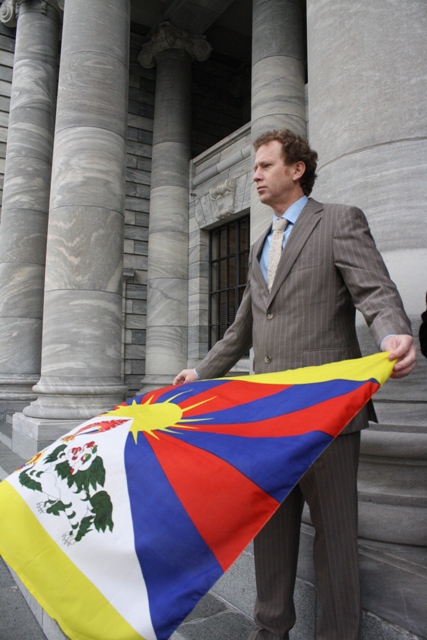
Green co-leader Russel Norman assulted by Chinese goon squad

According to reporters and Russel Norman himself, a dozen Chinese agents surrounded him, shoved him, pulled an umbrella over his head, stole his Tibetan flag and stomped on it, and his hand when he tried to get it back. PM John Key says all this is very ‘disappointing’, but it’s clear he means any embarrassment caused to the Chinese Vice President Xi Jinping, not this thugs’ attack on freedom of speech.

There’s a bit of history of this sort of thing. 11 years ago in Christchurch it was the New Zealand police who tried to protect the Chinese premier from the horrifying sight of pro-Tibetan protesters, the cops pushed the protesters back and parked a bus in front of them. They were later found to have abused their powers.

Oddly enough I’ve been thinking and reading a bit about China and Tibet recently, although not because of the VP’s trade delegation.

A recent report on New Zealand agribusiness says Chinese demand saved the economy from the worst of the (first round of) the global economic crisis. How long will this last?

Meanwhile, strikes by Chinese workers have been making the news and prompting debate among socialist bloggers in the UK. UNITYblog readers might be interested in this post by Lenin’s Tomb and this response from sympathetic to China Andy Newman at Socialist Unity.

And on the topic of Tibet, this article in the latest Austrian Green Left Weekly (a paper Mr Norman used to sell) responding to a report in the May 22 Sydney Morning Herald, that the Dalai Lama has declared himself “half Marxist half Buddhist”
– David


Incident outside Parliament – Russel Norman’s statement


The mistreatment of Green Party Co-leader Russel Norman on the grounds of Parliament by Chinese security personnel shows how important it is to stand up for democracy and human rights, the Green Party said today.

Dr Norman was assaulted by Chinese security personnel outside Parliament as he was making a stand against China’s human rights record in Tibet.

“Because John Key’s Government let Chinese security control our Parliament, it stopped being a safe place for democracy,” Dr Norman said.

“I’ve laid a complaint with the Police because New Zealanders need to know they are free to speak without fear of violence or recrimination.”

Dr Norman said the Government needs to defend the right of its citizens to free speech because it is one of the cornerstones of democracy.

“I’m asking that John Key make a clear statement that this sort of behaviour is not acceptable in New Zealand,” Dr Norman said.

Thursday, 14 January 2010

Pipeline Geopolitics: Major Turnaround. Russia, China, Iran Redraw Energy Map

by Amb. M. K. Bhadrakumar from Global Research 12 January 2010 The inauguration of the Dauletabad-Sarakhs-Khangiran pipeline in early January connecting Iran's northern Caspian region with Turkmenistan's vast gas field may go unnoticed amid the Western media cacophony that it is "apocalypse now" for the Islamic regime in Tehran. The event sends strong messages for regional security. Within the space of three weeks, Turkmenistan has committed its entire gas exports to China, Russia and Iran. It has no urgent need of the pipelines that the United States and the European Union have been advancing. Are we hearing the faint notes of a Russia-China-Iran symphony? The 182-kilometer Turkmen-Iranian pipeline starts modestly with the pumping of 8 billion cubic meters (bcm) of Turkmen gas. But its annual capacity is 20bcm, and that would meet the energy requirements of Iran's Caspian region and enable Tehran to free its own gas production in the southern fields for export. The mutual interest is perfect: Ashgabat gets an assured market next door; northern Iran can consume without fear of winter shortages; Tehran can generate more surplus for exports; Turkmenistan can seek transportation routes to the world market via Iran; and Iran can aspire to take advantage of its excellent geographical location as a hub for the Turkmen exports. We are witnessing a new pattern of energy cooperation at the regional level that dispenses with Big Oil. Russia traditionally takes the lead. China and Iran follow the example. Russia, Iran and Turkmenistan hold respectively the world's largest, second-largest and fourth-largest gas reserves. And China will be consumer par excellence in this century. The matter is of profound consequence to the US global strategy. The Turkmen-Iranian pipeline mocks the US's Iran policy. The US is threatening Iran with new sanctions and claims Tehran is "increasingly isolated". But Mahmud Ahmadinejad's presidential jet winds its way through a Central Asian tour and lands in Ashgabat for a red-carpet welcome by his Turkmen counterpart, Gurbanguly Berdymukhammedov, and a new economic axis emerges. Washington's coercive diplomacy hasn't worked. Turkmenistan, with a gross domestic product of US$18.3 billion, defied the sole superpower (GDP of $14.2 trillion) - and, worse still, made it look routine. There are subplots, too. Tehran claims to have a deal with Ankara to transport Turkmen gas to Turkey via the existing 2,577km pipeline connecting Tabriz in northwestern Iran with Ankara. Indeed, Turkish diplomacy has an independent foreign-policy orientation. Turkey also aspires to be a hub for Europe's energy supplies. Europe may be losing the battle for establishing direct access to the Caspian. Second, Russia does not seem perturbed by China tapping into Central Asian energy. Europe's need for Russian energy imports has dropped and Central Asian energy-producing countries are tapping China's market. From the Russian point of view, China's imports should not deprive it of energy (for its domestic consumption or exports). Russia has established deep enough presence in the Central Asian and Caspian energy sector to ensure it faces no energy shortage. What matters most to Russia is that its dominant role as Europe's No 1 energy provider is not eroded. So long as the Central Asian countries have no pressing need for new US-backed trans-Caspian pipelines, Russia is satisfied. During his recent visit to Ashgabat, Russian President Dmitry Medvedev normalized Russian-Turkmen energy ties. The restoration of ties with Turkmenistan is a major breakthrough for both countries. One, a frozen relationship is being resumed substantially, whereby Turkmenistan will maintain an annual supply of 30bcm to Russia. Two, to quote Medvedev, "For the first time in the history of Russian-Turkmen relations, gas supplies will be carried out based on a price formula that is absolutely in line with European gas market conditions." Russian commentators say Gazprom will find it unprofitable to buy Turkmen gas and if Moscow has chosen to pay a high price, that is primarily because of its resolve not to leave gas that could be used in alternative pipelines, above all in the US-backed Nabucco project. Third, contrary to Western propaganda, Ashgabat does not see the Chinese pipeline as a substitute for Gazprom. Russia's pricing policy ensures that Ashgabat views Gazprom as an irreplaceable customer. The export price of the Turkmen gas to be sold to China is still under negotiation and the agreed price simply cannot match the Russian offer. Fourth, Russia and Turkmenistan reiterated their commitment to the Caspian Coastal Pipeline (which will run along the Caspian's east coast toward Russia) with a capacity of 30bcm. Evidently, Russia hopes to cluster additional Central Asian gas from Turkmenistan (and Kazakhstan). Fifth, Moscow and Ashgabat agreed to build jointly an east-west pipeline connecting all Turkmen gas fields to a single network so that the pipelines leading toward Russia, Iran and China can draw from any of the fields. Indeed, against the backdrop of the intensification of the US push toward Central Asia, Medvedev's visit to Ashgabat impacted on regional security. At the joint press conference with Medvedev, Berdymukhammedov said the views of Turkmenistan and Russia on the regional processes, particularly in Central Asia and the Caspian region, were generally the same. He underlined that the two countries were of the view that the security of one cannot be achieved at the expense of the other. Medvedev agreed that there was similarity or unanimity between the two countries on issues related to security and confirmed their readiness to work together. The United States' pipeline diplomacy in the Caspian, which strove to bypass Russia, elbow out China and isolate Iran, has foundered. Russia is now planning to double its intake of Azerbaijani gas, which further cuts into the Western efforts to engage Baku as a supplier for Nabucco. In tandem with Russia, Iran is also emerging as a consumer of Azerbaijani gas. In December, Azerbaijan inked an agreement to deliver gas to Iran through the 1,400km Kazi-Magomed-Astara pipeline. The "big picture" is that Russia's South Stream and North Stream, which will supply gas to northern and southern Europe, have gained irreversible momentum. The stumbling blocks for North Stream have been cleared as Denmark (in October), Finland and Sweden (in November) and Germany (in December) approved the project from the environmental angle. The pipeline's construction will commence in the spring. The $12-billion pipeline built jointly by Gazprom, Germany's E.ON Ruhrgas and BASF-Wintershall, and the Dutch gas transportation firm Gasunie bypasses the Soviet-era transit routes via Ukraine, Poland and Belarus and runs from the northwestern Russian port of Vyborg to the German port of Greifswald along a 1,220km route under the Baltic Sea. The first leg of the project with a carrying capacity of 27.5bcm annually will be completed next year and the capacity will double by 2012. North Stream will profoundly affect the geopolitics of Eurasia, trans-Atlantic equations and Russia's ties with Europe. To be sure, 2009 proved to be a momentous year for the "energy war". The Chinese pipeline inaugurated by President Hu Jintao on December 14; the oil terminal near the port city of Nakhodka in Russia's far east inaugurated by Prime Minister Vladimir Putin on December 27 (which will be served by the mammoth $22-billion oil pipeline from the new fields in eastern Siberia leading to China and the Asia-Pacific markets); and the Iranian pipeline inaugurated by Ahmadinejad on January 6 - the energy map of Eurasia and the Caspian has been virtually redrawn. The year 2010 begins on a fascinating new note: will Russia, China and Iran coordinate future moves or at least harmonize their competing interests?

Wednesday, 22 July 2009

Towards the integration of the Dollar and the Euro?

by Michel Chossudovsky from Global Research 20 July 2009 With a view to restoring financial stability, World leaders have called upon the Group of 20 countries (G-20) to instigate a new global currency based on the IMF's Special Drawing Rights (SDRs). The media has presented the global currency initiative as a consensus building process, in which BRIC countries (Brazil, Russia, India and China) would participate in the revamping of the international monetary system.

Friday, 27 February 2009

THE GREAT IMPLOSION: Second and third catastrophes on the horizon?

by GRANT MORGAN 27 February 2009 The Economist magazine, the world's most famous propagandist of corporate globalisation, has long presented an ultra-optimistic face to the world. But no longer. Now The Economist is starting to speculate gloomily about a break-up of the European Union as countries in eastern Europe slide into bankruptcy, endangering not only many of the continent's big banks but also the viability of the euro-zone itself. The magazine's latest cover story editorial carries this grim sub-heading: "If eastern Europe goes down, it may take the European Union with it." (Full story below.) While various scenarios for saving eastern Europe from bankruptcy are floated by The Economist, even its editor doesn't sound at all convinced about their practicality. Significantly, the editor fails to mention that important west European economies, such as Italy and Spain, are likewise teetering on the very brink of bankruptcy. It's a continent-wide economic earthquake whose shock waves look likely to bring down banks, institutions and governments, and possibly shake Old World capitalism to its foundations. If these things come to pass, they will constitute the Second Catastrophe of the Great Implosion, as I call the current mega-crisis, which was sparked by the bursting of America's housing and credit bubbles. Barack Obama has just addressed a joint session of Congress in Washington, delivering two mutually contradictory messages. First, he admitted that the world's largest economy is reliant on historically high deficits as the government's eye-watering welfare payments to corporate America become the last line of defence for a market in meltdown. Second, he promised to move swiftly towards reducing the deficits, without giving any indication of how such an economic miracle could actually happen. Why should Obama talk so fervently about reducing the deficits? After all, US public opinion is fixated on something else entirely: the need for ever-bigger government bailouts of a failed economy. The answer is as simple as it is un-American. The US president is addressing not his "fellow Americans", but rather China's market Stalinist government, the biggest lender to the world's most indebted nation. The commander-in-chief of the planet's most feared military machine is appealing to America's former enemies, the dictators of Communist China, to keep on propping up "the leader of the free world". If the Chinese were to stop or even reduce their buying of T-bonds, as US Treasury bonds are called, or demand a level of interest payments judged to be ruinous to the US economy, then we would see the Third Catastrophe of the Great Implosion: the bankruptcy of the home of the world's reserve trading currency, the greenback. That would send world trade, already reduced to its lowest level in decades, into a deadly tailspin. These ominous developments indicate not only the ideological bankruptcy of 21st century capitalism, but also foretell its likely economic bankruptcy in the not-too-distant future. And when the heartlands of capitalism plunge into prolonged economic ruination, as they did in the Great Depression of the 1930s, all that looks "solid" and "certain" can vanish in a puff of corporate cigar smoke. The international left needs to unite around realistic strategies to protect people from market meltdown and its twin evil, the climate crisis. To do so, we leftists must educate ourselves to interpret the economic danger signals. And we must organise ourselves to play the leadership role of our lives. The future of the world is now at stake. At times of global emergency, the opinions and the actions of small groups of leftists can assume an importance way beyond what is possible in capitalism's "ordinary times", that seemingly calm era when the seeds of today's chaos were planted. See The Economist editorial Eastern Europe's woes: If eastern Europe goes down, it may take the European Union with it (26 Feb 2009) Grant Morgan is a longtime socialist campaigner and writer based in Auckland, New Zealand. He invites websites to publish this analysis, and readers to give feedback. Email grantmorgan@paradise.net.nz

Saturday, 21 February 2009

Asia Economy: The Coming Fury

by Walden Bello
9 February 2009
For over 40 years now, the cutting edge of the region's economy has been export-oriented industrialization (EOI). Taiwan and Korea first adopted this strategy of growth in the mid-1960s, with Korean dictator Park Chung-Hee coaxing his country's entrepreneurs to export by, among other measures, cutting off electricity to their factories if they refused to comply.

Thursday, 1 January 2009

Towards the integration of the Dollar and the Euro?

by Michel Chossudovsky from Global Research 20 July 2009 With a view to restoring financial stability, World leaders have called upon the Group of 20 countries (G-20) to instigate a new global currency based on the IMF's Special Drawing Rights (SDRs). The media has presented the global currency initiative as a consensus building process, in which BRIC countries (Brazil, Russia, India and China) would participate in the revamping of the international monetary system. Russia and China have put forth "proposals" which have been highlighted as possible alternatives to the dollar. China has proposed the formation of a new global currency based on a reform of SDR system: "It is a feasible plan to reform the present SDR and make it into a real settlement currency, a universally accepted 'currency basket' that would replace the dollar at the heart of the monetary system," (Li Ruogu, chairman of the Export-Import Bank of China, Reuters, 6 July 2009) China's proposal does not imply a major shift in global banking arrangements, nor does it open up a window of debate regarding monetary reform. On the other hand, Russian President Dmitry Medvedev has explicitly questioned the composition of the SDR basket and has called upon the IMF "to expand the currency basket of SDRs to include the Chinese yuan, commodity currencies and gold in order that it matures into a reserve currency." Geopolitics Global Geopolitics bears a relationship to the international monetary system. Control over money creation is an instrument of economic conquest. The invasion and occupation of Iraq was to exclude rival Russian and Chinese interests from the Middle-East and Central Asian oil fields. The reform of the international monetary system is a project of the dominant financial elites, which is discussed behind closed doors. It is unlikely that Russia and China, which in large part remain subordinate to Western banking interests, will perform a significant role in central banking functions at a global level. Moreover, this initiative occurs at a time of East West confrontation, amidst veiled US-NATO threats directed against Russia as well China. The establishment of a new global currency and central banking system is an instrument of global economic domination which is intimately related to the broader US-NATO military agenda. While the SDR basket composition could be modified or revised, it is unlikely that the Yuan and the Ruble would be allowed to perform a role as major reserve currencies. What is more likely to occur is the formation of a global proxy currency predicated largely on the Euro and the US dollar. In response to the Dollar-Euro hegemony, Russia, China and the member states of the Shanghai Cooperation Organization (SCO) may decide to develop bilateral trading arrangements in Rubles or Yuan (renminbi). Special Drawing Rights SDRs are a composite accounting unit used by the IMF and the World Bank in loan agreements with member countries. The SDR is a basket of essentially four major currencies: the US dollar, the Euro, the British pound and the Japanese Yen. The IMF has recently presented a plan for issuing debt denominated in SDRs rather than US dollars. The media has heralded this decision as a major innovation, when in fact the Bretton Woods institutions have, for many years, been issuing debt denominated in SDRs. "Today, the SDR has only limited use as a reserve asset, and its main function is to serve as the unit of account of the IMF and some other international organizations. The SDR is neither a currency, nor a claim on the IMF. Rather, it is a potential claim on the freely usable currencies of IMF members." (IMF Fact Sheet on SDRs) What would happen if a new global currency were to be devised using the existing SDR framework? SDRs would no longer be an accounting unit but a unit of currency in a basket. Actual central banking functions, however, would not necessarily be transferred to the IMF, they would remain in the hands of four constituent central banks: The US Federal Reserve, the European Central Bank based in Frankfurt, the Bank of England and the Bank of Japan. I The IMF is a bureaucracy which serves the interests of major private financial institutions. While the IMF would formally be responsible for overseeing a global currency, the IMF would not actually be responsible for monetary policy. Under the existing SDR composition, the central banking functions would be divided between four central banks. These central banks are in turn controlled by a handful of private banking interests. A global currency based on the existing SDR arrangement would not fundamentally change the global monetary order. The SDR would be a proxy currency. Under the present composition of the SDR, what we would be dealing with is an alliance between US, British, European and Japanese banking institutions, ultimately with the US dollar and the Euro predominating. Euro-Dollar Rivalry From the outset in 1999, there has been a clash between the Euro and the dollar. In Eastern Europe, the former Soviet Union, the Balkans extending into Central Asia, the dollar and the Euro are competing with one another. Ultimately, control over national currency systems is the basis upon which countries are colonized. While the U.S. dollar prevails throughout the Western Hemisphere, the Euro and the U.S. dollar are clashing in the former Soviet Union, Central Asia, Sub-Saharan Africa and the Middle East. Prior to the invasion of Iraq in March 2003, there was a political confrontation between the Franco-German alliance and the dominant Anglo-American military axis. With the election of pro-US governments in both France and Germany, a political consensus seems to have emerged with regard to the Middle East war. In turn, this consensus regarding the US-NATO military agenda favors greater cooperation and integration between the US and the EU in global financial and monetary affairs. Would this potential "alliance" between powerful overlapping American, British, European and Japanese banking interests lead to the integration of the Euro and the dollar into a single global currency? This integration would lead to reinforcing the hegemonic control of a small number of global banking and financial institutions over the process of money creation. This, in turn, would overshadow the functions of national central banks, encroach on the sovereignty of the Nation State and eventually lead to a new phase of the global debt crisis.

Saturday, 1 November 2008

Asia Economy: The Coming Fury

by Walden Bello from Foreign Policy in Focus 9 February 2009 For over 40 years now, the cutting edge of the region's economy has been export-oriented industrialization (EOI). Taiwan and Korea first adopted this strategy of growth in the mid-1960s, with Korean dictator Park Chung-Hee coaxing his country's entrepreneurs to export by, among other measures, cutting off electricity to their factories if they refused to comply. The success of Korea and Taiwan convinced the World Bank that EOI was the wave of the future. In the mid-1970s, then-Bank President Robert McNamara enshrined it as doctrine, preaching that "special efforts must be made in many countries to turn their manufacturing enterprises away from the relatively small markets associated with import substitution toward the much larger opportunities flowing from export promotion." EOI became one of the key points of consensus between the Bank and Southeast Asia's governments. Both realized import substitution industrialization could only continue if domestic purchasing power were increased via significant redistribution of income and wealth, and this was simply out of the question for the region's elites. Export markets, especially the relatively open U.S. market, appeared to be a painless substitute. The World Bank endorsed the establishment of export processing zones, where foreign capital could be married to cheap (usually female) labor. It also supported the establishment of tax incentives for exporters and, less successfully, promoted trade liberalization. Not until the mid-1980s, however, did the economies of Southeast Asia take off, and this wasn't so much because of the Bank but because of aggressive U.S. trade policy. In 1985, in what became known as the Plaza Accord, the United States forced the drastic revaluation of the Japanese yen relative to the dollar and other major currencies. By making Japanese imports more expensive to American consumers, Washington hoped to reduce its trade deficit with Tokyo. Production in Japan became prohibitive in terms of labor costs, forcing the Japanese to move the more labor-intensive parts of their manufacturing operations to low-wage areas, in particular to China and Southeast Asia. At least $15 billion worth of Japanese direct investment flowed into Southeast Asia between 1985 and 1990. The inflow of Japanese capital allowed the Southeast Asian "newly industrializing countries" to escape the credit squeeze of the early 1980s brought on by the Third World debt crisis, surmount the global recession of the mid-1980s, and move onto a path of high-speed growth. The centrality of the endaka, or currency revaluation, was reflected in the ratio of foreign direct investment inflows to gross capital formation, which leaped spectacularly in the late 1980s and 1990s in Indonesia, Malaysia, and Thailand. The dynamics of foreign-investment-driven growth was best illustrated in Thailand, which received $24 billion worth of investment from capital-rich Japan, Korea, and Taiwan in just five years, between 1987 and 1991. Whatever might have been the Thai government's economic policy preferences — protectionist, mercantilist, or pro-market — this vast amount of East Asian capital coming into Thailand could not but trigger rapid growth. The same was true in the two other favored nations of northeast Asian capital, Malaysia and Indonesia. It wasn't just the scale of Japanese investment over a five-year period that mattered, however; it was the process. The Japanese government and keiretsu, or conglomerates, planned and cooperated closely in the transfer of corporate industrial facilities to Southeast Asia. One key dimension of this plan was to relocate not just big corporations like Toyota or Matsushita, but also small and medium enterprises that provided their inputs and components. Another was to integrate complementary manufacturing operations that were spread across the region in different countries. The aim was to create an Asia Pacific platform for re-export to Japan and export to third-country markets. This was industrial policy and planning on a grand scale, managed jointly by the Japanese government and corporations and driven by the need to adjust to the post-Plaza Accord world. As one Japanese diplomat put it rather candidly, "Japan is creating an exclusive Japanese market in which Asia Pacific nations are incorporated into the so-called keiretsu [financial-industrial bloc] system." China Masters the Model If Taiwan and Korea pioneered the model and Southeast Asia successfully followed in their wake, China perfected the strategy of export-oriented industrialization. With its reserve army of cheap labor unmatched by any country in the world, China became the "workshop of the world," drawing in $50 billion in foreign investment annually by the first half of this decade. To survive, transnational firms had no choice but to transfer their labor-intensive operations to China to take advantage of what came to be known as the "China price," provoking in the process a tremendous crisis in the advanced capitalist countries’ labor forces. This process depended on the U.S. market. As long as U.S. consumers splurged, the export economies of East Asia could continue in high gear. The low U.S. savings rate was no barrier since credit was available on a grand scale. China and other Asian countries snapped up U.S. treasury bills and loaned massively to U.S. financial institutions, which in turn loaned to consumers and homebuyers. But now the U.S. credit economy has imploded, and the U.S. market is unlikely to serve as the same dynamic source of demand for a long time to come. As a result, Asia's export economies have been marooned. The Illusion of "Decoupling" For several years China has seemed to be a dynamic alternative to the U.S. market for Japan and East Asia's smaller economies. Chinese demand, after all, had pulled the Asian economies, including Korea and Japan, from the depths of stagnation and the morass of the Asian financial crisis in the first half of this decade. In 2003, for instance, Japan broke a decade-long stagnation by meeting China's thirst for capital and technology-intensive goods. Japanese exports shot up to record levels. Indeed, China had become by the middle of the decade, "the overwhelming driver of export growth in Taiwan and the Philippines, and the majority buyer of products from Japan, South Korea, Malaysia, and Australia." Even though China appeared to be a new driver of export-led growth, some analysts still considered the notion of Asia "decoupling" from the U.S. locomotive to be a pipe dream. For instance, research by economists C.P. Chandrasekhar and Jayati Ghosh, underlined that China was indeed importing intermediate goods and parts from Japan, Korea, and ASEAN, but only to put them together mainly for export as finished goods to the United States and Europe, not for its domestic market. Thus, "if demand for Chinese exports from the United States and the EU slow down, as will be likely with a U.S. recession," they asserted, "this will not only affect Chinese manufacturing production, but also Chinese demand for imports from these Asian developing countries." The collapse of Asia's key market has banished all talk of decoupling. The image of decoupled locomotives — one coming to a halt, the other chugging along on a separate track — no longer applies, if it ever had. Rather, U.S.-East Asia economic relations today resemble a chain-gang linking not only China and the United States but a host of other satellite economies. They are all linked to debt-financed middle-class spending in the United States, which has collapsed. China's growth in 2008 fell to 9%, from 11% a year earlier. Japan is now in deep recession, its mighty export-oriented consumer goods industries reeling from plummeting sales. South Korea, the hardest hit of Asia's economies so far, has seen its currency collapse by some 30% relative to the dollar. Southeast Asia's growth in 2009 will likely be half that of 2008. The Coming Fury The sudden end of the export era is going to have some ugly consequences. In the last three decades, rapid growth reduced the number living below the poverty line in many countries. In practically all countries, however, income and wealth inequality increased. But the expansion of consumer purchasing power took much of the edge off social conflicts. Now, with the era of growth coming to an end, increasing poverty amid great inequalities will be a combustible combination. In China, about 20 million workers have lost their jobs in the last few months, many of them heading back to the countryside, where they will find little work. The authorities are rightly worried that what they label "mass group incidents," which have been increasing in the last decade, might spin out of control. With the safety valve of foreign demand for Indonesian and Filipino workers shut off, hundreds of thousands of workers are returning home to few jobs and dying farms. Suffering is likely to be accompanied by rising protest, as it already has in Vietnam, where strikes are spreading like wildfire. Korea, with its tradition of militant labor and peasant protest, is a ticking time bomb. Indeed, East Asia may be entering a period of radical protest and social revolution that went out of style when export-oriented industrialization became the fashion three decades ago. Walden Bello is a Foreign Policy In Focus columnist, a senior analyst at the Bangkok-based Focus on the Global South, president of the Freedom from Debt Coalition, and a professor of sociology at the University of the Philippines. Sources 1. Hisahiko Okasaki, "New Strategies toward Super-Asian Bloc," This Is (Tokyo), August 1992. Reproduced in Foreign Broadcast Information Service Daily Report: East Asia Supplement, Oct. 7, 1992. 2. "China: the Locomotive," The Straits Times, February 23, 2004.

Sunday, 26 October 2008

Meet the World's New Reserve Currency: The Chinese Yuan

by Mike Whitney from Information Clearing House 25 October 2008 Things are getting worse. On Friday morning, futures trading was halted for the first time ever after futures plunged more than 5 percent. The sell-off came after another 500-plus down day on the Dow followed by steep declines in equities markets across Europe and Asia. Japan's benchmark index, the Nikkei, slipped more than 9.5 percent after Toyota and Samsung reported disappointing earnings. The news was equally bad in Europe where shares were battered across the continent on fears of a global recession. Since September, $16 trillion has been erased from global stock market value. Losses in the US--where the financial turmoil originated--have been much smaller than other, more vulnerable markets. The Dow is down less than 40 percent from its peak of 14,000, whereas Hong Kong, Poland and China have all tumbled more than 60 percent. Its a bloodbath.

Monday, 11 August 2008

Russel Norman: speech to parliament on FTA with China

This trade agreement between New Zealand and China fails to protect the sovereignty of the democratically elected Government of New Zealand, and it places significant restrictions on the future ability of the New Zealand Government and Parliament to pass regulations to protect the people and environment of Aotearoa New Zealand.
There are many reasons why the New Zealand Government should not have signed this preferential trade agreement with China, not least of which is the fact that New Zealand signed this agreement while China was involved in the murderous oppression of the people of Tibet. It is also of grave concern that this agreement has no binding labour or environmental standards. The lower wages and standards in China will effectively be a non-tariff barrier to fair trade, giving corporations that pollute or pay inhumane wages a competitive advantage over those that do not.

Tuesday, 29 July 2008

Hone Harawira on the FTA with China

Hone Harawira, MP for Te Tai Tokerau

24 July 2008

I tera wiki, i whakanuitia ana a Rererangi Aotearoa e te Minita Tapoi e Damien O’Connor, i te whakatuwheratanga o te rere-kotahi, mai i a Beijing, ki Tamaki Makaurau.

Last week, Tourism Minister Damien O’Connor was heaping praises upon Air New Zealand as they launched the first non-stop service between Auckland and Beijing.

E mea ana te minita, “he marea hokohoko tino nui ki Haina, mo ake tonu”.

“This very important long-term Chinese market” was how the Minister put it.

Tuesday, 8 July 2008

Oil price shock means China is at risk of blowing up

by Ambrose Evans-Pritchard from The Telegraph 7 July 2008 The great oil shock of 2008 is bad enough for us. It poses a mortal threatto the whole economic strategy of emerging Asia.The manufacturing revolution of China and her satellites has been built oncheap transport over the past decade. At a stroke, the trade model looks obsolete.

Saturday, 10 May 2008

GPJA submission on FTA with China

Submission to the government by Global Peace & Justice Auckland (GPJA) on the Free Trade Agreement between the government of New Zealand and the regime of the People’s Republic of China.

7 May 2008 1. Global Peace and Justice Auckland is a network of Auckland based groups and individuals concerned to promote justice and peace both around the world and within New Zealand. 2. We are strongly opposed to the Free Trade Agreement between New Zealand and the Peoples’ Republic of China because the agreement is bad for New Zealand workers, bad for Chinese workers and is a slap in the face for Tibetans struggling under China’s yoke. 3. We appreciate there will be increases in trade on paper with the result our economy will grow. However as we have seen over the past eight years, growth does not mean those in greatest need will benefit. New Zealand still has 180,000 children locked into poverty despite what the Prime Minister describes as the most sustained period of economic growth for a generation. 4. The economic growth predicted as a result of the FTA will likewise not improve the standard of living for the most vulnerable New Zealanders but it will instead decrease the standard of living for tens of thousands of New Zealand workers. 5. We should remember the trade surplus New Zealand enjoyed with China in the mid 1980s. In other words we exported more to China than we imported. However this reversed dramatically when import tariffs were removed or phased out. There was a flood of cheap imports from China which turned the trade surplus into a billion dollar deficit. When the government began negotiations for the free trade agreement in December 2004 the deficit with China was $1.5 billion. A year later it had grown to over $2 billion. Over 20 years our exports stagnated while China flooded New Zealand with sweated imports. 6. As a direct result tens of thousands of jobs were lost from our manufacturing sector as New Zealand companies went to the wall. Some survived only by shifting their manufacturing base to China. Others transformed into importing companies and helped fill the shelves of the Warehouse with cheap low-quality products. But these bargain goods carry a very high price. 7. The Ministry of Economic Development has estimated 16 jobs are lost for every one million dollars of imported products we could make here. A simple calculation shows about 50,000 jobs lost to Chinese imports alone. As more tariffs are phased out under the free trade agreement we can expect as many as 20,000 more New Zealand workers to lose their jobs with many more families driven below the poverty line. 8. We should also expect many more New Zealand workers to suffer in industries which struggle to compete. We have the example of Air New Zealand (owned by the New Zealand government) which forced New Zealand workers in aircraft maintenance to accept reduced working conditions as the price for retaining the jobs in New Zealand. 9. None of this seems to concern the Labour government. To our Labour politicians this is free trade on one of those fictitious level playing fields. 10. The Chinese economy is built on long hours, child labour, forced labour and poverty wages. Is it free trade when New Zealand workers are expected to compete with workers paid less than $1 an hour for 16-hour days? Is it free trade when China operates prison labour camps where as many as seven million inmates work without pay and nothing in the way of health and safety standards to produce goods to compete with New Zealand products? China has repeatedly refused to sign up to even the most basic of labour standards under the International Labour Organisation such as bans on forced labour and the right to organise independent trade unions. Those Chinese who dare to speak out are silenced. 11. Why would New Zealand give preferential trade status to a brutal, repressive regime like this? The answer is that the FTA with China benefits already wealthy corporate interests. 12. Through the FTA New Zealand increasingly is outsourcing its manufacturing sector to China. This prevents us developing manufacturing here at a time when global warming and high fuel prices will increasingly make international trade (from a country as far away from markets as New Zealand) much more expensive. We are putting too many eggs in one basket through relying more heavily on farming products for future prosperity. 13. Back in 1998 our Prime Minister had a different view. She criticised the then Prime Minister, National leader Jenny Shipley, for putting trade ahead of human rights and said “…we have had this pitiful simpering about there being a distinction between business issues and issues of human rights and democracy. If that value had been applied in 19th century England and North America, then we would still have slavery, because the representatives of those who employed slaves would claim that there was no connection between that issue and their business values.” 14. A year later in the speech from the throne the newly elected Labour government told us “legitimate issues of labour standards and environmental concerns need to be integrated better with trade agreements.”

15. But all this has gone out the window. They are meaningless platitudes. Through this FTA the government is saying it is happy for New Zealand to deal with these 21st century slave-owners, buying their products at reduced rates. 16. There can be no doubt also that the FTA is helping the Chinese regime bolster its stranglehold on democracy and human rights. The FTA legitimises the regime and turns a blind eye to its anti-worker and anti-union policies. 17. And what about the Tibetans? At a time when there have been renewed calls for autonomy from the people of Tibet and greater levels of violence and repression against the people it sends all the wrong messages for New Zealand to sign an FTA with the country. 18. Finally it is a travesty of democracy here in New Zealand for this FTA to have been agreed and signed by the government before New Zealanders (aside from a few in business and compliant trade union leadership) have had the opportunity to see and discuss it and its ramifications. 19. We wish to be heard by the committee in support of this submission. John Minto Spokesperson Ph (09) 8463173 (H) (09) 8469496 (W) www.gpja.org.nz

Monday, 21 April 2008

NZ Labour - a party without principle

A recent headline in The Guardian (18 April) reads: ‘Chinese ship carries arms cargo to Mugabe regime’. Here we have a ship full of arms for Robert Mugabe so he can repress the democratic revolt in Zimbabwe, supplied by the same Chinese regime which the Labour government in New Zealand has embraced in a free trade deal, held up by a dockers’ strike in South Africa which, if done in New Zealand, would be illegal under the Employment Relations Act passed by Helen Clark's administration in 2000. Makes you think doesn’t it? This series of events on the on other side of the world highlights just how far Labour is from a progressive politics grounded in basic human rights. It’s all about the almighty dollar, and to hang with basic principles like democracy and workers’ right to strike. To secure a free trade agreement with China that will boost the profits of Fonterra and other NZ companies, Labour is willing to turn a blind eye to human rights abuses in China. And what chance that Helen Clark is going to loudly condemn gun-running by China to help a despotic Zimbabwe regime crush a broad based democratic movement? Not likely. This is the tangled world of pro-corporate profit driven politics without principle that the Labour Party has embraced. The party is no longer a progressive force in New Zealand.
Chinese ship carries arms cargo to Mugabe regime by David Beresford in Johannesburg The Guardian 18 April 2008 A Chinese cargo ship believed to be carrying 77 tonnes of small arms, including more than 3m rounds of ammunition, AK47 assault rifles, mortars and rocket-propelled grenades, has docked in the South African port of Durban for transportation of the weapons to Zimbabwe, the South African government confirmed yesterday. It claimed it was powerless to intervene as long as the ship's papers were in order. Copies of the documentation for the Chinese ship, the An Yue Jiang, show that the weapons were sent from Beijing to the ministry of defence in Harare. Headed "Dangerous goods description and container packing certificate", the document was issued on April 1, three days after Zimbabwe's election. It lists the consignment as including 3.5m rounds of ammunition for AK47 assault rifles and for small arms, 1,500 40mm rockets, 2,500 mortar shells of 60mm and 81mm calibre, as well as 93 cases of mortar tubes. The carrier is listed as the Cosco shipping company in China. Continue

Sunday, 20 April 2008

Rod Donald was right

Chinese free trade deal will cost human rights and environment
from Green Weekly 16 April 2004 Like a free lunch with Roger Douglas, there is no such thing as ‘free trade’ with China. “Business will go out of business, workers will be put out of work and Labour will lose the support of labour,” said Rod Donald. China’s labour standards make Dickensian sweatshops look enlightened with the number of work related deaths per year equivalent to the population of Greater Wellington. The list of human rights violations are long and include; exporting goods made by bonded and prison labour; prohibiting strikes; repressing attempts to organise unions apart from one government controlled entity; and not ratifying international conventions eliminating forced labour and guaranteeing workers the right to organise. “Free trade means we’ll be forced into a ‘race to the bottom’, as our own labour and environmental standards will be compromised, and our trade deficit with China will balloon past the present $1.3 billion,” said Rod.

Beijing: Clark's gold(en?) medal

by ROD ORAM From Sunday Star Times Sunday, 13 April 2008 http://www.stuff.co.nz/emailafriend/4478130a1865.html With questions from UNITYblog. Rod : The very best thing about the free trade agreement with China is the overwhelmingly positive response from business leaders. No question about this. Rod: For the first time in more than a decade they are actually excited and ambitious about a big opportunity that will improve New Zealand's fortunes. If they follow through with bold strategies and excellent execution, they will start to solve our two biggest economic problems, one external and one internal. Rightly, the government is cautious about the impact of the FTA. It estimates it will generate some $350m a year in trade benefits plus a further $115m in tariff savings. This, though, would be an easy target to beat if business got serious about using the FTA to help New Zealand overcome its weak external performance... Similarly, the FTA could help overcome a serious internal weakness in our economy. As a tiny country far from our main markets, we are drastically short of the people, capital and plants we need to grow faster in more productive, less inflationary ways. By more productive, does Rod mean more exploitative? By less inflationary, does Rod mean less wage increases? Rod: The impact of inbound investment from China will be far greater. It already totalled $1.66b as of March 2006, and much more is expected. For example, the Chinese state electricity grid company is reported to be planning a joint bid with Cheung Kong Infrastructure, a Hong Kong company, for the Wellington electricity lines business being sold by Vector. Will the new Chinese bosses be able to run this contract with cheap indentured Chinese labour, outside New Zealand Labour Laws? Rod: The FTA will have a big impact on our internal economic constraints if New Zealand businesses grasp the opportunity of doing more with China in two ways. The first, is by investing there to get access to the country's abundant industrial resources. Once approved, New Zealand companies will be treated like domestic ones. Will the Chinese workers of these New Zealand companies also be treated in the same brutal manner as they domestic ones? Rod: So far only Fonterra, Nuplex, Skellerup, Glidepath and a handful of other companies have invested in China. Their commitment totalled $333m as of March 2006, the latest figures available. But the FTA will help open up China to many more businesses by giving them a bit more comfort and predictability. Will this greater comfit and predictability for business, be at the experience, of greater discomfit and insecurity for workers, here and in China? Rod: For example, Icebreaker, the Wellington-based clothing company, buys around one-third of the New Zealand merino clip. The wool is processed and made into garments - 1.5m last year - in a cluster of very large, high-technology plants in Shanghai, owned by overseas companies. Has anyone in the government ever investigated the conditions and pay of those working for Icebreaker in these Chinese plants? Do they even care? Rod: That's a very challenging business model that eludes most New Zealand companies. But if more of them began to see such opportunities, they would be far less gloomy than they are currently about their prospects in this tightly constrained domestic market. What are the domestic constraints Rod Oram says makes NZ companies gloomy, why doesn't he mention them? Could these constraints be environmental protections, union rights, labour laws, or safety regulations? Rod: Such a very rare sense of optimism emanated from the 190 business people who travelled with Prime Minister Helen Clark to Beijing for the FTA signing. Travel always works wonders for changing perceptions. The trip might change business perceptions of the prime Minister. Many of the delegates would have seen her up close for the first time. They would have appreciated her deep knowledge of many NZ businesses, her keen interest in their ambitions and strategic issues and her excellent skills communicating and negotiating on their behalf with foreign leaders. Why is a so called Labour Prime Minister negotiating on behalf of business, rather than on behalf of the workers who voted for her? When did our Prime Minister last show a keen interest in the ambitions and strategic issues important to workers? Or ever use her excellent skills communicating and negotiating on their behalf with anybody? Could it be that our Labour Government is only labour in name? Rod: A senior European trade diplomat who saw her in action on a New Zealand trade mission to India in October 2004 once told this columnist that Helen Clark was the best politician he had seen play that role, with the exception of the-then finance minister of Ireland. Our free trade agreement with China is testament to that. But does anyone know who Rod Oram is comparing Helen Clark to? Is this mysteriously unnamed finance minister of Ireland an extreme neo-liberal rightwing fanatic?

NZ jobs must come before free trade

RAM - Residents Action Movement Media release 17 April 2008 "It is obvious that free trade is devastating New Zealand's manufacturing sector and its jobs," said Oliver Woods, co-organiser of RAM - Residents Action Movement. "The latest casualties have come with Fisher & Paykel's decision to close its plant in Dunedin as a consequence of New Zealand's free trade deals with China and Thailand. The corporation will relocate the work overseas to low-wage economies that return higher profits to an already-profitable business that made $61 million after tax last year. " "The NZ government signs a free trade deal with the dictatorial Chinese regime and then stands idly by as Kiwi families struggle with job losses and rising food prices. Meanwhile hardworking taxpayers fund cabinet ministers going on cocktail-fueled free trade missionary expeditions to distant capitals. There is something wrong with this picture!" said Mr Woods. "Workers are caught between the big corporations like Fisher & Paykel who put greater profits before job security, and the big political parties like Labour and National that worship at the altar of free trade, the almighty dollar and radical free market economics. Fisher & Paykel's behaviour is an indicment on the corporate politics of this country!" "RAM stands with the workers who are going to lose their jobs in Dunedin, and their families and their community who are going to suffer with them. New Zealand must put people before profit, and allow workers the dignity of stable, well-paid jobs," said Mr Woods. For more information, contact: Oliver Woods Co-organiser of RAM - Residents Action Movement 021 072 4647 oliver.woods@gmail.com

Wednesday, 16 April 2008

China FTA - A win win situation for the bosses

The bilateral Free Trade Agreement with China, as well as being generally quarantined from New Zealand Regulation, has a "national treatment" penalty provision. "Each party shall accord to investments and activities associated with such investments, with respect to management, conduct, operation, maintenance, use, enjoyment or disposal, by the investors of the other party treatment no less favourable than that accorded, in like circumstances, to the investments and associated activities by its own investors." This could set the scene for compensation to be paid to Chinese investors for any restrictions are put on their investment, with the proviso that unless these restrictions "may be reasonably justified in the protection of the public welfare, including public health, safety and the environment". As this slim escape clause does not mention employment law, it is probable that the indentured Chinese work teams that NZ employers want to bring here, will be working at grossly inferior rates and conditions to New Zealand locals. It works the other way, like for example Air New Zealand employing Chinese stewards. New Zealand employers will be able to pay much less for these contracts, relying on the brutal enforcement of low wages by their Chinese contractor. The bulk of the money will go to the contractor and not the workers. As the bosses like to say: “a win win situation”.

Monday, 14 April 2008

Principled opposition to FTA with China

We are living in interesting times. The debate on the Free Trade Agreement (FTA) with China is one that will either swing to the right or the left. Inside the Labour Party opposition to the FTA is being cast as a racist stance. When the Maori Party opposed the FTA Phil Goff made a statement on TV 3 news that the Maori Party were "prejudiced". Immediately TV3 news went straight into a story about anti-Chinese racism. This harsh and unfair criticism of the Maori Party's principled opposition to the FTA was in sharp contrast to both Labour and National's response to New Zealand First’s belated opposition, which was based on racism and opportunist scapegoating. Instead Labour and National's response to NZ First was conciliatory and even supportive, both parties said they wanted to keep him on as Foreign Minister. In fact Peter's stance has helped them in spreading their fiction that all opposition to the FTA is based on xenophobia. Goff went as far as saying that Peters’ opposition was bullshit – which is true. According to Fran O'Sullivan he did everything to clear the path for the FTA, including calling on people not to be harsh on China over Tibet. And also manipulating the NZ First caucus to postpone their meeting to decide and announce their opposition until after the deal had been signed. The danger of NZ First pandering to anti-Chinese racism, and so gaining kudos for the right, is a real and present danger. Particularly as we predict the costs for working people of this deal will be negative and possibly extremely so. For a racist right wing anti-union xenophobic party to be the beneficiary of Labour's betrayal of working people would be a tragic side-effect of the FTA. As Chinese and Kiwi workers would be pitted against each other. While big business here and in China laughs all the way to the bank. We should be explaining and arguing that the FTA is final proof that the Labour Party has gone from being the advocate of working people to being the advocate of big business. It’s the corporate elites who’ve been calling for the FTA and who will be its beneficiaries. We must make the argument that the FTA will harm both New Zealand and Chinese workers. And that rather than getting workers to compete against each other we should be putting our hand out to our Chinese brothers and sisters to frustrate the practical implementation of this deal. I’m promoting a call inside the union movement to demand that the Chinese indentured work gangs due to be brought here are paid no less than us and receive all the other work rights that we enjoy.