
An emotional and inspiring video that was created as a joint project between five indigenous communities in Peru with the message: ‘We wish from out hearts that these rights we are proposing will be added to and that people across the world recover their harmony with our Mother Earth.’
Via Climate & Capitalism
Showing posts with label international views. Show all posts
Showing posts with label international views. Show all posts
Monday, 6 December 2010
Video: Capitalism is a doomsday machine
Derek Wall of the UK Green Party speaking at the Coalition of Resistance conference in London, November 27.
Via Climate & Capitalism
Via Climate & Capitalism
Saturday, 4 December 2010
Bolivia: Cancún must not be Can’t-cún
Against these powerful interests, Bolivia believes the only way forward for saving the Earth and its people is mass popular pressure
By Pablo Solon, Bolivian ambassador to the UN
Guardian, November 30, 2010
Via Climate & Capitalism
 As climate talks start this week in Cancún, the common refrain that pervades the media and some negotiators is of “low expectations.” I wonder whose expectations they are talking about. Do they think the one million people in the Bolivian city El Alto, who face increasingly chronic water shortages from the disappearance of glaciers, have low expectations? Do they think Pacific islanders whose homelands will soon disappear beneath the rising sea have low expectations? I believe that the majority of humanity demands and has high expectations that our political leaders should act to stop runaway climate change.
The reality is that the talk of “low expectations” is a ploy by a small group of industrialised countries to obscure their obligations to act. They are playing politics with the planet’s future. If the Cancún talks set sail with no wind, then no-one will be angered when they stall. Sadly, rather than express moral outrage, much of the media and even some environmental organisations have subscribed to this cynicism of the powerful. Last year we had Hopenhagen and worldwide public outrage when the richest nations failed to act. This year will it be Can’t-cun and a whimper?
Visible evidence of climate change is all around us.It can be found almost daily on the TV screens of people in rich countries – Pakistan’s floods, Russia’s heatwave, the unprecedented Arctic snow melt – in Bolivia, we are struggling to cope everyday with limited resources and ever more unstable weather. This year a drought throughout Bolivia meant we had to provide emergency food aid to hundreds of thousands of people. As we see our high Andean mountains, revered as apus or spirits by our indigenous peoples, lose their white peaks, we feel a visceral loss of our culture and our history.
Every year we fail to act will only worsen an already serious crisis – and mean any measures we have to take must be even more radical. Yet in looking at how to break the logjam in Cancún, one constantly comes up against the US. Not only does the US have the largest historical responsibility for carbon emissions, its political leaders are also the least prepared to act. While developing countries like China are imposing electricity blackouts to meet climate targets, many in the US are still debating whether climate change exists.
Unfortunately the US responsibility goes further than just inaction; it effectively sabotaged international progress on climate change. At Copenhagen and in the year since, the US has been the prime instigator behind attempts to end the Kyoto protocol, the only binding mechanism on climate change. Instead they harangue, bully, and insist that any climate negotiations must be based on the non-binding Copenhagen accord which would take us backwards in the fight against climate change.
Analysis by the UN of the pledges made so far under the Copenhagen accord show that temperatures would rise by four degrees – a level that many scientists consider disastrous for human life and our ecosystems. Countries like mine that have refused to accept this death wish have had our climate funding withdrawn by the US.
It is important to remember that we have been in a similar situation before. In the negotiations for the Kyoto protocol in the 1990s, the EU proposed relatively ambitious targets of 15% emissions reductions by 2010, and argued rightly then that domestic action should be the main means of achieving emissions targets.
The US at first opposed any targets or timetables, then pushed for lowering overall targets for developed countries to 5% cuts by 2012, and insisted on allowing fraudulent carbon trading mechanisms to meet the targets. Their bullying prevailed, but it was all for nought, as the US Senate failed to ratify the protocol and in 2001 President Bush formally withdrew. The rest of the world bent over backwards to involve the US, and even then they failed to act.
We can’t allow this to happen again. It is wrong for a small handful of US senators to hold the rest of humanity hostage. If the US cannot do what is right, it must step aside. Meanwhile, developed country blocks, such as the EU, must stop hiding behind US intransigence. They must commit urgently to reducing greenhouse gas emissions by 50% before 2017.
Earlier this year, Bolivia held a Peoples’ Summit on Climate Change and the Rights of Mother Earth, which brought together more than 30,000 people from 140 countries to advance effective proposals on climate change in the wake of the Copenhagen fiasco. It was inspiring because of the passion and commitment of the delegates, and because it was completely focused on tackling climate change and its root causes.
Too often, subjected to intense lobbying by big corporations, the UN conferences on climate change are more preoccupied with inventing new market mechanisms to make money rather than stopping climate change. Against these powerful interests, Bolivia believes the only way forward for saving the Earth and its people is mass popular pressure.
We must insist to our political leaders that we have the highest expectations from Cancún, because nothing less than the future of our grandchildren and our planet depends on it.
By Pablo Solon, Bolivian ambassador to the UN
Guardian, November 30, 2010
Via Climate & Capitalism

The reality is that the talk of “low expectations” is a ploy by a small group of industrialised countries to obscure their obligations to act. They are playing politics with the planet’s future. If the Cancún talks set sail with no wind, then no-one will be angered when they stall. Sadly, rather than express moral outrage, much of the media and even some environmental organisations have subscribed to this cynicism of the powerful. Last year we had Hopenhagen and worldwide public outrage when the richest nations failed to act. This year will it be Can’t-cun and a whimper?
Visible evidence of climate change is all around us.It can be found almost daily on the TV screens of people in rich countries – Pakistan’s floods, Russia’s heatwave, the unprecedented Arctic snow melt – in Bolivia, we are struggling to cope everyday with limited resources and ever more unstable weather. This year a drought throughout Bolivia meant we had to provide emergency food aid to hundreds of thousands of people. As we see our high Andean mountains, revered as apus or spirits by our indigenous peoples, lose their white peaks, we feel a visceral loss of our culture and our history.
Every year we fail to act will only worsen an already serious crisis – and mean any measures we have to take must be even more radical. Yet in looking at how to break the logjam in Cancún, one constantly comes up against the US. Not only does the US have the largest historical responsibility for carbon emissions, its political leaders are also the least prepared to act. While developing countries like China are imposing electricity blackouts to meet climate targets, many in the US are still debating whether climate change exists.
Unfortunately the US responsibility goes further than just inaction; it effectively sabotaged international progress on climate change. At Copenhagen and in the year since, the US has been the prime instigator behind attempts to end the Kyoto protocol, the only binding mechanism on climate change. Instead they harangue, bully, and insist that any climate negotiations must be based on the non-binding Copenhagen accord which would take us backwards in the fight against climate change.
Analysis by the UN of the pledges made so far under the Copenhagen accord show that temperatures would rise by four degrees – a level that many scientists consider disastrous for human life and our ecosystems. Countries like mine that have refused to accept this death wish have had our climate funding withdrawn by the US.
It is important to remember that we have been in a similar situation before. In the negotiations for the Kyoto protocol in the 1990s, the EU proposed relatively ambitious targets of 15% emissions reductions by 2010, and argued rightly then that domestic action should be the main means of achieving emissions targets.
The US at first opposed any targets or timetables, then pushed for lowering overall targets for developed countries to 5% cuts by 2012, and insisted on allowing fraudulent carbon trading mechanisms to meet the targets. Their bullying prevailed, but it was all for nought, as the US Senate failed to ratify the protocol and in 2001 President Bush formally withdrew. The rest of the world bent over backwards to involve the US, and even then they failed to act.
We can’t allow this to happen again. It is wrong for a small handful of US senators to hold the rest of humanity hostage. If the US cannot do what is right, it must step aside. Meanwhile, developed country blocks, such as the EU, must stop hiding behind US intransigence. They must commit urgently to reducing greenhouse gas emissions by 50% before 2017.
Earlier this year, Bolivia held a Peoples’ Summit on Climate Change and the Rights of Mother Earth, which brought together more than 30,000 people from 140 countries to advance effective proposals on climate change in the wake of the Copenhagen fiasco. It was inspiring because of the passion and commitment of the delegates, and because it was completely focused on tackling climate change and its root causes.
Too often, subjected to intense lobbying by big corporations, the UN conferences on climate change are more preoccupied with inventing new market mechanisms to make money rather than stopping climate change. Against these powerful interests, Bolivia believes the only way forward for saving the Earth and its people is mass popular pressure.
We must insist to our political leaders that we have the highest expectations from Cancún, because nothing less than the future of our grandchildren and our planet depends on it.
Thursday, 14 October 2010
Israel’s never-ending assault
Writer , author of If I Am Not for Myself: Journey of an Anti-Zionist Jew, explains why Israel’s concessions on its Gaza blockade fall short of righting the wrongs.

Gazans left homelesss without materials to rebuild following Israel's 2008-09 assault
The primary aim of the Gaza aid missions has been to alert the world to the criminality of the blockade, and in this, it has succeeded--though the price has been heavy: Nine killed (mostly with shots directly to the head and neck) and 700 others violently abducted, detained and abused.
Unfortunately, President Barack Obama and others have seized on the Israelis’ gesture as an excuse to issue them a renewed license to proceed with their assault on Palestinian lives and rights.
Sunday, 15 August 2010
Latin America & 21st Century Socialism
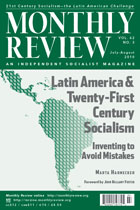
This is the forward to the July-August 2010 issue of US socialist journal Monthly Review. It provides a good summary of the origins of the Venezuelan revolution, and serves as an idroduction to the much longer essay “Latin America & Twenty-First Century Socialism: Inventing to Avoid Mistakes” by Venezuelan-based activists and author Marta Harnecker.
It’s important to be reminded that, to begin with, Venezuela’s Bolivarian Revolution was not deliberately socialist, or even “anti-capitalist”, but certainly anti-neoliberal. Aiming to build, as Chavez put it, “an economic alternative to dehumanized capitalism”—to “humanize capitalism.”
This is similar to the stated aim of the recently released Council of Trade Unions Alternative Economic Strategy which states: “Capitalism is brutal but innovative and our aim is to retain and spread the benefits of innovation while policing its brutality.”
However, as John Bellamy Foster argues, “The main political thrust of the Bolivarian Revolution was, in fact, anti-capitalist in its underlying logic”, because it aimed to mobilise and empower the ordinary people.
That, rather than whether or not Chavez proclaimed himself for socialism or even against capitalism from the outset, appears to be the crucial factor.
This is similar to the stated aim of the recently released Council of Trade Unions Alternative Economic Strategy which states: “Capitalism is brutal but innovative and our aim is to retain and spread the benefits of innovation while policing its brutality.”
However, as John Bellamy Foster argues, “The main political thrust of the Bolivarian Revolution was, in fact, anti-capitalist in its underlying logic”, because it aimed to mobilise and empower the ordinary people.
That, rather than whether or not Chavez proclaimed himself for socialism or even against capitalism from the outset, appears to be the crucial factor.
Foreword
By John Bellamy Foster
from Monthly Review
I’m certain that this process is irreversible. This movement of change, of restructuring, of revolution, will not be stopped.
El Caracazo
In the eyes of much of the world, the year 1989 has come to stand for the fall of the Berlin Wall, the demise of Soviet-type societies, and the defeat of twentieth-century socialism. However, 1989 for many others, particularly in Spanish-speaking countries, is also associated with the beginning of the Latin American revolt against neoliberal shock therapy and the emergence in the years that followed of a “socialism for the 21st century.” This revolutionary turning point in Latin American (and world) history is known as the Caracazo or Sacudón (heavy riot), which erupted in Caracas, Venezuela on February 27, 1989, and quickly became “by far the most massive and severely repressed riot in the history of Latin America.”2
The Caracazo started in the early morning in the suburb of Guarenas in response to a 100 percent increase in transport fares. These transport hikes were part of a set of neoliberal shock policies introduced by the government of President Carlos Andrés Pérez. The object was to put Venezuela back in good standing with the IMF and international financial institutions, obtain their assistance in the servicing of its foreign debt, and provide “fresh money” for the oligarchy to rely on—all on the backs of millions of poor people. Outraged by the doubling of transport fares, the Caracas demonstrators hurled stones at the buses and overturned them. Motorcycle couriers joined in the protests, going from one part of the city to the other and spreading the message. Riots also broke out that same morning in nineteen other cities across the country.
By late afternoon in Caracas, public transport had come to a standstill. Hundreds of thousands of people were walking home and buses were burning. The protestors began to loot shops and supermarkets in order to obtain basic needs—food and clothing. That night, in what came to be known as “the day the poor came down from the hills,” the impoverished barrio-dwellers, joined in some instances by the police, engaged in a campaign of massive looting, first in the commercial center of Caracas and then in the privileged residential districts of the wealthy. From the standpoint of the majority of the Venezuelan poor, the looting was an act of social justice and retribution, an attempt to take back a little of what had been taken from them for decades—as they watched the oligarchy become ever richer, while they struggled to get enough merely to survive. (President Peréz’s ostentatious inauguration, only a few weeks before the announcement of the austerity program, was reported as “one of the grandest celebrations Latin America has ever known,” with a total of ten thousand invited guests attending, consuming 650,000 hors d’oeuvres, 209 sides of lamb, and twenty sides of beef—washing it all down with twelve hundred bottles of scotch, accompanied by immense quantities of champagne.)
In response to the widespread riot, President Pérez imposed martial law and a nighttime curfew. This was followed by a brutal repression of the population. Soldiers entered the barrios with orders to “reestablish order.” One soldier recounted that they were ordered to “shoot anything that moved, and shoot to kill.” One citizen recalled that the soldiers “didn’t say raise your arms or anything. But everything that appeared, they killed.” Hundreds, even thousands, of people were killed, with numbers of the dead ranging from 396 to 10,000, and with many thousands more wounded. The brutality of the retaliation stripped away any illusions about Venezuela’s fake democracy, and set in motion the struggle for a new society. As Richard Gott stated, it “marked the beginning of the end of Venezuela’s ancien régime.”3
Sunday, 8 August 2010
The crisis of the American working class
From Lenin’s Tomb
 Obama and the Democrats are in trouble. Barring some unforeseeable development on a par with Katrina in terms of scale, the GOP is going to romp the mid-terms on a much reduced turn-out. The capitalist media will say that this is because of the Tea Party 'movement', or because the president moved too far to the left in a centre-right nation. Left-wing anger, and the disillusionment of working class constituencies previously supportive of Obama, will be ignored.
Obama's dual constituency in the 2008 election comprised the majority of the working class, and the dominant fraction of big capital, particularly the finance, insurance and real estate industries (the rentiers in other words) who gave Obama $37.5m toward his campaign. In the 2010 mid-term Congressional elections, the signs are that much of the working class component of that electoral coalition will fail to mobilise for the Democrats. This has already been foreshadowed in the Massachusetts by-election, where the core working class vote collapsed - and, of course, the media blamed it on Obama's excessive radicalism over healthcare, despite Massachusetts favouring socialised medicine by a wider margin than most states.

Obama's dual constituency in the 2008 election comprised the majority of the working class, and the dominant fraction of big capital, particularly the finance, insurance and real estate industries (the rentiers in other words) who gave Obama $37.5m toward his campaign. In the 2010 mid-term Congressional elections, the signs are that much of the working class component of that electoral coalition will fail to mobilise for the Democrats. This has already been foreshadowed in the Massachusetts by-election, where the core working class vote collapsed - and, of course, the media blamed it on Obama's excessive radicalism over healthcare, despite Massachusetts favouring socialised medicine by a wider margin than most states.
Tuesday, 3 August 2010
Video: Raj Patel on the battle for the world food system
Raj Patel, author of The Value of Nothing and Stuffed and Starved, interviewed by Jill Hickson and Simon Cunich for Green Left Weekly and Links International Journal of Socialist Renewal.
The battle for the world food system: an interview with Raj Patel from Jill Hickson on Vimeo.
The battle for the world food system: an interview with Raj Patel from Jill Hickson on Vimeo.
The battle for the world food system: an interview with Raj Patel from Jill Hickson on Vimeo.
Saturday, 31 July 2010
Shooting the messenger

Why are the British and US governments saying the leak of military documents about Afghanistan has “put our soldiers at risk?”
It’s us who’s been kept hidden from this information, not the Taliban. For example, many of the revelations are previously hidden details of civilian casualties, but Afghans in those areas probably already knew about those deaths.
I don’t suppose local insurgents have said “Well well, I’ve read the leaked documents, and you know that family whose house was bombed to rubble by an American plane, and the rest of the village arrived and wailed for three days and swore revenge and then there was a funeral that we all went to. Well it turns out they’re dead.”
Sunday, 11 July 2010
Video: David Harvey – ‘The animated crisis of capitalism’
On April 26, 2010, Marxist geographer professor David Harvey spoke to the the Royal Society for the encouragement of Arts, Manufactures and Commerce (RSA) to explain how capitalism came to dominate the world and why it resulted in the current financial crisis. He asks: is it time to look beyond capitalism towards a new social order? Above is the animated version of the longer speech he gave. You can view the original speech HERE.
Taking a long view of the current crisis, Harvey exposes the follies of the international financial system, looking closely at the nature of capitalism, how it works and why sometimes it doesn’t.
Hattip LINKS
Thursday, 17 June 2010
A World Cup for the elites
by Dave Zirin
from US Socialist Worker
first published at TheNation.com
AT LONG last, soccer fans, the moment is here. On Saturday, when South Africa took the field against Mexico, the World Cup was officially underway.
Nothing attracts the global gaze quite like it. Nothing creates such an undeniably electric atmosphere with enough energy to put British Petroleum, Exxon/Mobil and Chevron out of business for good. And finally, after 80 years, the World Cup has come to Africa. We should take a moment to celebrate that this most global of sports has finally made its way to the African continent, nesting in the bucolic country of South Africa.
And yet as we celebrate the Cup's long awaited arrival in the cradle of civilization, there are realities on the ground that would be insane to ignore. To paraphrase an old African saying, "When the elephants party, the grass will suffer."
In the hands of FIFA and the ruling African National Congress, the World Cup has been a neoliberal Trojan Horse, enacting a series of policies that the citizens of this proud nation would never have accepted if not wrapped in the honor of hosting the cup. This includes $9.5 billion in state deficit spending ($4.3 billion in direct subsidies and another $5.2 billion in luxury transport infrastructure). This works out to about $200 per citizen.
As the Anti-Privatization Forum (APF) of South Africa has written:
from US Socialist Worker
first published at TheNation.com
AT LONG last, soccer fans, the moment is here. On Saturday, when South Africa took the field against Mexico, the World Cup was officially underway.
Nothing attracts the global gaze quite like it. Nothing creates such an undeniably electric atmosphere with enough energy to put British Petroleum, Exxon/Mobil and Chevron out of business for good. And finally, after 80 years, the World Cup has come to Africa. We should take a moment to celebrate that this most global of sports has finally made its way to the African continent, nesting in the bucolic country of South Africa.
And yet as we celebrate the Cup's long awaited arrival in the cradle of civilization, there are realities on the ground that would be insane to ignore. To paraphrase an old African saying, "When the elephants party, the grass will suffer."
In the hands of FIFA and the ruling African National Congress, the World Cup has been a neoliberal Trojan Horse, enacting a series of policies that the citizens of this proud nation would never have accepted if not wrapped in the honor of hosting the cup. This includes $9.5 billion in state deficit spending ($4.3 billion in direct subsidies and another $5.2 billion in luxury transport infrastructure). This works out to about $200 per citizen.
As the Anti-Privatization Forum (APF) of South Africa has written:
Our government has managed, in a fairly short period of time, to deliver "world class" facilities and infrastructure that the majority of South Africans will never benefit from or be able to enjoy. The APF feels that those who have been so denied, need to show all South Africans as well as the rest of the world who will be tuning into the World Cup, that all is not well in this country, that a month-long sporting event cannot and will not be the panacea for our problems.
This World Cup is not for the poor--it is the soccer elites of FIFA, the elites of domestic and international corporate capital and the political elites who are making billions and who will be benefiting at the expense of the poor.
Monday, 17 May 2010
The Death of Capital
taxMichael E. Lewitt
From John Mauldin’s “Outside the Box” newsletter
May 10, 2010
Two years ago, John Mauldin was kind enough to publish my initial proposals for reforming the financial system. Entitled “How to Fix It,” the April 2008 issue of The HCM Market Letter raised a lot of eyebrows and upset many established interests on Wall Street with its outspoken call for financial reform. Among the changes I called for were the following:
• Compensation reform to better align the interests of Wall Street executives with those of society at large.
• Requiring private equity firms and hedge funds to be registered with regulators.
• Taxing private equity partners’ carried interests at ordinary tax rates instead of capital gains tax rates, and prohibiting private equity firms from going public.
• Sharply reducing the leverage of financial institutions (including hedge funds).
• Banning off-balance sheet vehicles such as Structured Investment Vehicles.
• Reining in quantitative trading strategies.
• Reinstituting the downtick rule with respect to short selling stocks.
At the time these proposals were considered controversial; in retrospect it is clear that they were not aggressive enough. While many of these suggestions have been adopted or are in the process of being adopted, much more needs to be done to stabilize the financial system.
From John Mauldin’s “Outside the Box” newsletter
May 10, 2010
Two years ago, John Mauldin was kind enough to publish my initial proposals for reforming the financial system. Entitled “How to Fix It,” the April 2008 issue of The HCM Market Letter raised a lot of eyebrows and upset many established interests on Wall Street with its outspoken call for financial reform. Among the changes I called for were the following:
• Compensation reform to better align the interests of Wall Street executives with those of society at large.
• Requiring private equity firms and hedge funds to be registered with regulators.
• Taxing private equity partners’ carried interests at ordinary tax rates instead of capital gains tax rates, and prohibiting private equity firms from going public.
• Sharply reducing the leverage of financial institutions (including hedge funds).
• Banning off-balance sheet vehicles such as Structured Investment Vehicles.
• Reining in quantitative trading strategies.
• Reinstituting the downtick rule with respect to short selling stocks.
At the time these proposals were considered controversial; in retrospect it is clear that they were not aggressive enough. While many of these suggestions have been adopted or are in the process of being adopted, much more needs to be done to stabilize the financial system.
Sunday, 16 May 2010
The First Socialist International of the 21st Century
by Kiraz Janicke, Federico Fuentes, and Julio Chavez
Venezuelanalysis.com
Apr 26th 2010
During the recently concluded five-month extraordinary congress [1] of the United Socialist Party of Venezuela, Kiraz Janicke & Federico Fuentes had the opportunity to discuss President Hugo Chavez’s proposal to form a Fifth Socialist International, with Julio Chavez, a delegate to the PSUV congress and a member of the congress’s international committee, which is charged with drafting a specific plan of action to form a new socialist international.
The proposal that President Hugo Chavez made regarding the formation of a Fifth Socialist International has attracted a lot of attention at a global level. I'm interested in your point of view, as a delegate and member of the International Committee of the Congress of the PSUV, why propose a 5th International and what is the importance of this proposal?
I believe that the proposal launched by the President Hugo Chávez, to raise at this time a global debate on historical relevance of the need to call on all parties, movements and leftist and anti-imperialist currents of the world to have a full discussion, is based on the characterization and in-depth analysis of the crisis of global capitalism. This leads unquestionably to the conclusion that the only way to overcome the cyclical crisis of world capitalism is, in fact, by proposing a model or a path that is completely different from the neo-liberal model, the predatory model, of capitalism. There is no other alternative than the path of transition to socialism.
Venezuelanalysis.com
Apr 26th 2010
During the recently concluded five-month extraordinary congress [1] of the United Socialist Party of Venezuela, Kiraz Janicke & Federico Fuentes had the opportunity to discuss President Hugo Chavez’s proposal to form a Fifth Socialist International, with Julio Chavez, a delegate to the PSUV congress and a member of the congress’s international committee, which is charged with drafting a specific plan of action to form a new socialist international.
The proposal that President Hugo Chavez made regarding the formation of a Fifth Socialist International has attracted a lot of attention at a global level. I'm interested in your point of view, as a delegate and member of the International Committee of the Congress of the PSUV, why propose a 5th International and what is the importance of this proposal?
I believe that the proposal launched by the President Hugo Chávez, to raise at this time a global debate on historical relevance of the need to call on all parties, movements and leftist and anti-imperialist currents of the world to have a full discussion, is based on the characterization and in-depth analysis of the crisis of global capitalism. This leads unquestionably to the conclusion that the only way to overcome the cyclical crisis of world capitalism is, in fact, by proposing a model or a path that is completely different from the neo-liberal model, the predatory model, of capitalism. There is no other alternative than the path of transition to socialism.
Thursday, 18 March 2010
Interview with Ben Peterson: Eyewitness to Nepal’s revolution
Ben Peterson is a young Australian socialist who spent four and half months in Nepal last year. Ben is crossing the Tasman for a speaking tour of New Zealand from 21–26 March. Ben was kind enough to answer some questions for UNITYblog about his experiences in Nepal.
When did you go to Nepal? How long were you there for?
I was in Nepal last year from the beginning of March to July, about four and half months in total.
Why did you go to Nepal?
I went to Nepal specifically to see the social and political transformations taking place there. I’d first come into contact with the revolutionary process there in 2006, but didn’t really start to study what was happening there until 2008 when the Maoists won the Constituent Assembly elections. The more I read into what was happening there the more excited I was. But all the time it was really hard to find good and reliable sources of information, particularly from a progressive point of view. So I decided that to really get a handle of what’s happening there, I should go and see it for myself.
Where you surprised by what you experienced there?
Well, yes I was. Its one thing to read about mass struggles going on, or about a peoples’ army, basically about a revolution, but its totally another to go and actually see it, to meet the people involved and to see this sort of process playing out in front of you. The level of popular engagement with politics, and how widespread the process was, was mind-blowing. Every little village had a union office, or a party organisation or something. It was amazing to see real revolutionary changes happening before my eyes, I couldn’t really be prepared for that, no amount of books can make you *really* understand these sort of processes until you see them.
Sunday, 14 March 2010
EYEWITNESS TO A REVOLUTION IN NEPAL
NZ speaking tour by Ben Peterson
21-27 March 2010
21-27 March 2010

Ben: "When I was in Nepal I met amazing people, peasant farmers, workers, students, youth, and the elderly, all fighting for a democratic future. Everywhere I went there was a common desire for something better."
Ben Peterson is a young Australian socialist who spent four and a half months in Nepal in close association with the revolutionary forces who recently overthrew feudalism and are today confronting capitalism and imperialism. Ben is crossing the Tasman for a speaking tour of New Zealand from 21-27 March. Ben's visit will be a great opportunity to learn more about the exciting events in Nepal.
There are meetings in Auckland, Hamilton, Rotorua, Wellington, Christchurch and Dunedin. The tour itinerary is as follows:
MEETING TIMES & VENUES
• Sunday 21 March - Auckland
2pm @ Auckland Trades Hall, 147 Great North Road, Grey Lynn.
• Monday 22 March - Auckland
1pm @ Function Room (over Quad café), Auckland University.
• Tuesday 23 March – Hamilton & Rotorua
1-2pm (followed by discussion) @ SUB G.20 (Guru Phabians room), Student Union Building, Waikato University.
7.30pm @ Ghandi Hall, 16 Gibson Street, (opp ten-pin bowling alley), Rotorua.
• Wednesday 24 March - Wellington
6pm @ Newtown Community Centre, 1 Columbo Street, Wellington.
• Thursday 25 March - Dunedin
1pm @ University Union Main Common Room, Dunedin University.
7pm @ Knox Church Hall, George Street, Dunedin.
• Friday 26 March - Christchurch
1pm @ Steed Meeting Room (next to the International Room), UCSA building, Canterbury University
• Saturday 27 March – Christchurch
7:30pm @ WEA, 59 Gloucester Street, Christchurch.
ORGANISERS
To help support and promote Ben’s tour contact these people:
Auckland - Daphna Whitmore, wpnz@clear.net.nz.
Hamilton - Jared Philips, jared@unite.org.nz, 029-4949 863.
Rotorua - Bernie Hornfeck, bernieh@clear.net.nz, (07)345 9853.
Wellington - Alastair Reith, alastair.reith@gmail.com, (04)384 1917.
Christchurch - Phil Ferguson, philip.ferguson@canterbury.ac.nz, 021-443 948.
Dunedin - Andrew Tait, andrewmtait@hotmail.com, 027-606 9549.
National co-ordination/publicity - Vaughan Gunson, svpl@xtra.co.nz, 021-0415 082.
You can join the Facebook group: Ben Peterson NZ Speaking Tour. More information on Ben's tour and events in Nepal can be found there.
DONATE
To help pay for the cost of Ben’s international and domestic airfares please make a donation into this account: Nepal Solidarity, Kiwibank 38-9010-0315883-00.
Ben Peterson’s tour of NZ was initiated by Socialist Worker and the Workers Party (workersparty.org.nz), with the International Socialist Organisation in Dunedin (iso.org.nz). Meetings in each centre are being organised with the support of other groups and individuals.
If you would like more information don't hesitate to contact us.
In solidarity,
Vaughan Gunson
svpl@xtra.co.nz
021-0415 082
Friday, 19 February 2010
Michael Albert: Fifth International?!
 By Michael Albert
Znet
January 21, 2010
To be a contender, “21st Century Socialist” vision needs elaboration, advocacy, and program. To improve focus and increase power, worldwide anti-capitalist organizations, projects, and movements need shared coherence and mutual solidarity. To fulfill these needs, Venezuela’s President Chavez recently announced to widespread support and also some critical response that a gathering in Caracas this April would establish a new International. [See Historic decision to form socialist Fifth International]
But what might this new International look like? What might it accomplish? How might people, such as those reading this essay, and particularly people in grassroots movements around the world, relate to it?
Tuesday, 2 February 2010
Should Climate Activists Support Limits on Immigration?
by Ian Angus and Simon Butler
January 24, 2010
From Climate and Capitalism


Ian Angus Simon Butler
Immigrants to the developed world have frequently been blamed for unemployment, crime and other social ills. Attempts to reduce or block immigration have been justified as necessary measures to protect “our way of life” from alien influences.
Today, some environmentalists go farther, arguing that sharp cuts in immigration are needed to reduce greenhouse gas emissions and slow climate change. However sincere and well-meaning such activists may be, their arguments are wrong and dangerous, and should be rejected by the climate emergency movement.
Sunday, 2 January 2000
Fifth International?!
By Michael Albert
Znet
January 21, 2010
To be a contender, “21st Century Socialist” vision needs elaboration, advocacy, and program. To improve focus and increase power, worldwide anti-capitalist organizations, projects, and movements need shared coherence and mutual solidarity. To fulfill these needs, Venezuela’s President Chavez recently announced to widespread support and also some critical response that a gathering in Caracas this April would establish a new International.
But what might this new International look like? What might it accomplish? How might people, such as those reading this essay, and particularly people in grassroots movements around the world, relate to it?
Not Our Predecessor’s International
Suppose a new International is an excellent venue for debate but has no practical component, or, worse, is a gathering place for big egos who mostly preen at long, aimless meetings. Or suppose a new International intelligently addresses programs and ideas, but is a vehicle for a small group to issue instructions from above. Or suppose a new International’s focus, structure, or operational procedures are conceptually rooted in past flawed macho, racist, authoritarian or otherwise oppressive practices. Even if it grew large, such a new International, built with the intellectual bricks, social mortar, programmatic inclinations, and personal habits and ideas of the old world, would not likely help us attain a new world. Liberation will not stand well on old foundations. We must plant the seeds of the future, as best we can, in our present endeavors.
Most politically sophisticated people of today’s movements would not sign up with an old-style International. Even considering the relatively few eager souls who would sign up, most would not remain inspired for long. Predictably, support would not grow strong enough to win major change. We can’t win a new world without attaining wide and deep support, and we can’t attract wide and deep support offering structures and methods embodying the core ills of the past.
Thus, lesson one, already familiar to most: If a new International marches to the beat of past drumming, no matter what its members might want, and no matter how courageously its members might seek their worthy dreams, the support they gain will be too limited and their efforts will be too compromised by past destructive residues to generate desirable 21st century outcomes.
The Focus of a New International
Issue Focus
The “subject matter” of a new international should and will inevitably address all concerns which go into and are part of developing and sustaining a liberated society and world but there is no reason to think all sensible and caring people would or should agree about all such matters. Much will have to be worked out in practice. Much will differ from country to country. Maybe there is a best position - but we don’t yet know it. Maybe most people think they know a best position, but a few people differ, and perhaps the few will prove right later.
This indicates that regarding unity we ought to settle only on a minimalist but profoundly important set of principles and commitments that would characterize a new International. What minimal commitments would a new International need to adopt to do its job well. Those who agree with essential inviolable commitments, could join. Those who don’t agree with them, might want to join, but couldn’t.
Few would doubt that a new International should be centrally concerned with economics, gender and kinship, culture and community, politics, international relations, and ecology. Further, however, there is no need for, and we have learned in recent decades there is also no point trying to elevate any one of these focuses above the rest. They are all centrally important and powerfully entwined. Thus, it should be the case that a group in a new International might in some country, or at some time, or for some purpose, be primarily focused on one or another of these focuses, but to be part of the new International it would also have to acknowledge that their priority was just one among many, and that other priorities should inform their work as well as be informed by their work.
Surely, at least these six areas of struggle must be elevated by any organization trying to create a new world because: (a) all these six central domains will critically affect the character of a new world, (b) each of these six domains is capable of manifesting influences that would subvert efforts to reach a new world, and (c) the constituencies most involved in and affects by each of these six domains would be intensely alienated if their prime concerns were relegated to secondary importance.
But what minimalist political focus and commitment might a new International have regarding each of theses six broad areas of concern? What would it initially need to universally agree about each area to gain the wherewithal to really change that area and legitimately appeal to and empower constituencies most concerned about that area?
Some possibilities for general agreement are that:
economic production, consumption, and allocation should be classless - which of course includes equitable access for all to quality and accessible education, health care and the requisites of health like food, water, and sanitation, housing, meaningful and dignified work, and the instruments and conditions of personal fulfillment
gender/kinship, sexual, and family relations should not privilege by age, sexual preference, or gender any one group above others - which of course includes ending all forms of oppression of women, providing daycare, recreation, health care, etc.
culture and community relations among races, ethnic groups, religions, and other cultural communities should protect the rights and identity of each community up to equally respecting those of all other communities as well - which of course includes an end to racist, ethnocentric, and otherwise bigoted structures as well as securing the prosperity and rights of indigenous people
political decision making, adjudication of disputes and implementation of shared programs should deliver people’s power in ways that do not elevate any one sector or constituency to power above others - which of course includes participation and justice for all
international trade, communication, and other interactions should attain and protect peace and justice while dismantling all vestiges of colonialism and imperialism - which of course includes canceling the debt of nations of the global south and reconstructing international norms and relations to move toward an equitable and just community of equally endowed nations
ecological choices should not only be sustainable, but should care for the environment in accord with our highest aspirations for ourselves and our world - which of course includes climate justice and energy renovation
Is there room for difference and debate in what exactly each of the above points means, much less about more specific details? Of course there is. But having room for debate is good in an International that means to be a massive bloc of diverse projects each of which retain their own history and agenda. The International becomes the greatest sum of all its parts. It embodies differences as a source of strength. It avoids the temptation to become just a coalition attached only to universally agreed but least common denominator claims, or to homogenize all views into one narrow pattern.
Underlying Values
What about underlying values? Surely a new International would elevate solidarity as part of its ethos. An International is, after all, about aligning worldwide movements and projects into mutual aid and collective benefit.
A new International should also certainly elevate diversity as a core value, both due to the obvious ecological necessity of doing so, and due to the observation that in any undertaking minority views can become majority, or what is thought to be crazy today can lead to what is brilliant tomorrow.
A new International will no doubt also adopt equity as one of its core values, even if it retains contradictory “certainties” about just what constitutes equity. More, over time, presumably members will reach increased clarity about just what equity entails and requires. One possibility is, for example, that it means every person who can work gets a share of income based on his or her duration, intensity, and onerousness of socially valued labor, but not based on property, or power, or even output, while those who can’t work get special needs addressed and, beyond that, average income.
Peace with justice and ecological sustainability and wisdom would surely also be guiding values. Serious movements would have no problems with that.
Finally a new International will of course have to have an attitude about decisions, participation, and power. At a minimum a new International would presumably commit to the value called “democracy.” For myself, however, I would hope it would reach further to a more inspiring conception of “people’s power,” or “participatory democracy,” or “self management.” And that it will seriously assess the kinds of structural changes and innovations essential to ensure informed, confident, participation by all citizens in political, economic, and social life - perhaps also including, for example, changes in the way labor is divided and carried out, the way education is conceived and implemented, and of course the way preferences are debated, explored, resolved, and implemented. Perhaps that will prove possible, too!
At any rate, given its place and time of origin, suppose a new International adopts a name like Participatory Socialist International (PSI), where “participatory” connotes that it isn’t our forebears’ International, but is really new.
Suppose also that it commits to prioritizing at least economics, gender, race, power, peace, and ecology, and commits to solidarity, diversity, equity, peace with justice, ecological wisdom, and people’s power or self management. These commitments would certainly go a long way toward providing a new foundation for a new International.
But what about all the many clashing views that various members would hold beyond the minimal views they would universally share? How might different positions exist in a new International in mutual respect? How might they engage in mutual careful and creative consideration?
Currents in a New International
How can a new International be true to its core commitments, yet also a vehicle for constant growth and development? How can a new International prioritize shared core views, yet also practice diversity and prioritize innovation?
One possibility is to include and celebrate “currents” that serve as vehicles for contending views. There might be a current composed of various member organizations, projects, and/or movements who share a particular contested economic goal (such as participatory economics or market socialism, etc.), or a certain contested strategic orientation (such as electoralism or nonviolence, etc.). The International’s various currents would not be seen as a weakness undermining unity but as a strength warding off sectarianism and guaranteeing constant growth. The respectfully contending positions would all be part of the International, together interactively exploring their disagreements in hopes of reaching new insights.
To establish a congenial, productive context, currents would take for granted that the intentions of other currents were good, that differences were about substance and not motive, and that they were subject to substantive debate which would be a serious part of the whole project.
The International would thus welcome different currents affording each ample visibility and means to engage with all others to try to advance new insights bearing on policy and program.
Currents would not have hidden agendas or think everyone else is a fool because only their own views have merit. Rather, currents would take for granted that even ideas they think odd, strange, or counterproductive, might prove useful in time, so that all views held inside the International should be respected and substantively explored without defensiveness and without doubting the motives of other International members.
In short, in this formulation, as long as any particular current accepted the basic tenets of the International and operated in accord with its norms and methods, respectful dissent would be considered a strength preventing knee-jerk agreement and constantly pushing the envelope of beliefs toward new insights.
In debates about policy and program, for example, currents would always be heard. Minority positions would, to the extent possible, be given space not only to argue, but if they don’t prevail, to continue developing their views and trying to establish their merit or to discover their inadequacies. The idea of a political or programmatic line that everyone follows would be foreign to the culture and process of this type new International.
Members and Decisions in a New International
What permits one to be in the new International? Well, the International would presumably include movements, parties, organizations, and even projects - but a strong possibility is that individuals would not join as at-large members, belonging instead only by way of their group affiliations.
What kind of group could belong? I would think any group that convinced some agreed percentage - let’s say, hypothetically, 75% - of the existing membership that it sincerely accepted the defining norms of the International could belong. This could be political parties, movements, organizations, or even projects - so, for example, it could be the PSUV from Venezuela, or the Landless Workers Movement (MST) from Brazil, or the Rosa Luxembourg foundation from Germany, or even media organizations like ZCom, say, from the U.S. Members, employees, staff, etc., of each new International member organization would in turn gain membership in the International by virtue of their collective organizational membership. Individuals who want to be members of the International, therefore, but who have no member group that they belong too, would have to hook up with one. An at-large membership wouldn’t exist, at least in this conception. The benefit of this approach would be that the legitimacy of a person as a member need not be assessed by the international - but only by the member organization of the international that the person is part of. There would be no “paper” members and no mass of unattached and therefore essentially unknown members.
What kinds of decisions might an International make?
Every member group would have its own agenda for its own separate operations which would be inviolable. At the same time, each member group would presumably be strongly urged to make its own operations consistent with the norm, practices, and shared programmatic agendas of the International. There would be solidarity among member organizations, but, regarding their separate operations, there would also be autonomy. The International would have shared program, policies, norms, and rules to continually decide on, as well as having to decide on gatherings to hold, campaigns to support or undertake, and perhaps much else.
How might such decisions be made?
Membership groups would have wildly different sizes, no doubt - so in the future there could be a group with a handful of members in the International, and another group with thousands, or even millions of members. But since the International’s decisions would not bind those groups other than regarding the collective International agenda, a good way to arrive at decisions might be serious discussion and exploration, followed by polls of the whole International membership to see peoples’ leanings, followed by refinements of proposals to seek even greater support and to allow dissidents from minority viewpoints to make their case, culminating in final votes of the membership seeking to convey self managing participatory influence to all parties. The little group with five participants could have at most their five votes unless they were more heavily affected by some decision than others were. A big group with ten thousand or a million participants could have at most that number of votes - again, unless they were more affected by some choice - but member votes would not be delivered in bulk, by group, but rather one by one, each being counted individually. Online, this is no longer a technically daunting matter. Are there other possibilities? Of course. This is just one hypothetical, but desirable, possibility.
Possible Program in a New International
What might a new International do?
A new International might call for international events and days of dissent. It might support campaigns for existing struggles by member organizations. It might support member organizations against repression. It might undertake widespread debates and campaigns to advance understanding and mutual knowledge.
More ambitiously, an International might also decide on campaigns and projects of its own, financed via its membership. It might settle, for example, on a massive international focus on immigration, on ending a war, on shortening the work week all over the planet, and/or on averting climatic catastrophe. There might then be materials to prepare, education to convey, activist campaigns to carry out, boycotts to initiate and sustain, support for local efforts to engender, and even efforts to provide material aid and participants for events occurring across borders.
All such general programs, would be up to member organizations to decide how to relate to, yet there would be considerable collective momentum for each member organization to participate and contribute as best it can. Thus, program decided by the International would either be about the International’s own actions or would be very strong advisories to members, or perhaps calls to them and to the broader world - not legally binding, so to speak, but powerful and effective nonetheless.
Finally, regarding program, clearly one reason to have an International is to help organizations, movements, and projects escape single issue loneliness by becoming part of a larger process encompassing diverse focuses and united by agreements on various major shared endeavors.
Dream, or Reality?
The above is one possible rough picture. It isn’t complete and it isn’t unique. It could adapt, bend, mature, enlarge, or be refined in all manner of ways, whether before April in preparation, or after April, as an International develops.
Is it only a dream that worldwide parties, movements, organizations, and projects could operate with intellectual and programmatic respect and mutual aid, with deep diversity and sharp focus, with strong solidarity and equally strong autonomy, with profound coherence and commitment and also with material and social equity and overarching self management?
Yes, today this is a dream, or a wish, or a hope. But tomorrow, and literally, this April, it could become a reality. Wouldn’t that be a huge and historic step forward?
NOTE:
Please post any comments on the short version back on the main UNITYblog page. Thanks.


Should Climate Activists Support Limits on Immigration?
by Ian Angus and Simon Butler
January 24, 2010
From Climate and Capitalism
 Lifeboat ethics and anti-immigrant bigots
“Environmental” arguments for reducing immigration aren’t new. In a 1974 article, “Lifeboat Ethics: the Case Against Helping the Poor,” US biologist Garrett Hardin argued that “a nation’s land has a limited capacity to support a population and as the current energy crisis has shown us, in some ways we have already exceeded the carrying capacity of our land.” Immigration, he said, was “speeding up the destruction of the environment of the rich countries.”[1]
Elsewhere he wrote: “Overpopulation can be avoided only if borders are secure; otherwise poor and overpopulated nations will export their excess to richer and less populated nations.”[2]
Hardin’s ideas have been very influential in the development of the right-wing, anti-immigration movement in the US and elsewhere. In 1979, he helped to found the Federation for American Immigration Reform (FAIR), an anti-immigrant lobbying group that has been named a “hate organization” by the Southern Poverty Law Center.[3] In addition to the usual array of anti-immigrant arguments FAIR has made a particular point of linking concerns about the environment with opposition to immigration.
Virginia Abernethy, a Hardin collaborator who calls herself an “ethnic separatist,” argues that the ability to migrate to rich countries gives people in poor countries an incentive to have bigger families. “The U.S. would help, not harm, by encouraging an appreciation of limits sooner rather than later. A relatively-closed U.S. border would create most vividly an image of limits and be an incentive to restrict family size.”[4]
Shifting gears
In the past, the “environmental” anti-immigration argument was: immigrants should be kept out because their way of life is a threat to our environment. That argument is still made by anti-immigrant groups and some conservationists.
Recently, as concern about greenhouse gas emissions and global warming increased, the anti-immigrant argument has taken on a new form. Now the argument is: immigrants should be kept out because our way of life is a threat to the world’s environment.
That’s the argument made in a recent briefing from the US Centre for Immigration Studies, a “think tank” founded by FAIR: it says that immigration worsens CO2 emissions “because it transfers population from lower-polluting parts of the world to the United States, which is a higher polluting country.” CIS calculated that the “average immigrant” to the US contributed four times more CO2 than in their country of origin.[5]
Otis Graham, a founder of FAIR, made the same argument in his 2004 book Unguarded Gates:
“Most immigrants … move from poor societies to richer ones, intending to do what they almost always succeed in doing, take on a higher standard of living that carries a larger ecological footprint. This being the case, the logic of the relationship is straightforward. Population growth in both poor and wealthy societies, but especially in the latter, intensifies environmental problems. Where immigration shifts population numbers to wealthier societies, it does not leave global environmental damage the same, but intensifies global as well as local environmental degradation.”[6]
A recent FAIR report claims that increased population is the primary cause of the huge increase in U.S. greenhouse gas emissions between 1973 and 2007 – and that the population increase was caused by immigration. “The United States will not be able to achieve any meaningful reductions in CO2 emissions without serious economic and social consequences for American citizens unless immigration is sharply curtailed.”[7]
The racist British National Party, which likes to call itself the “true green party” because it opposes immigration, also uses this argument. BNP leader Nick Griffin recently told the European parliament that climate change isn’t real – but that hasn’t stopped him saying immigrants will make it worse. He told author Steven Faris that by accepting immigrants from the third world, “We’re massively increasing their impact of carbon release into the world’s atmosphere. There’s no doubt about it, the western way of life is not sustainable. So what on Earth is the point of turning more people into westerners?”[8]
(It is significant that none of these supposed defenders of the environment take their argument to its logical conclusion: if immigration to the North is bad for the climate then emigration to poor countries with low emissions must be good and should be encouraged.)
Lifeboat ethics and anti-immigrant bigots
“Environmental” arguments for reducing immigration aren’t new. In a 1974 article, “Lifeboat Ethics: the Case Against Helping the Poor,” US biologist Garrett Hardin argued that “a nation’s land has a limited capacity to support a population and as the current energy crisis has shown us, in some ways we have already exceeded the carrying capacity of our land.” Immigration, he said, was “speeding up the destruction of the environment of the rich countries.”[1]
Elsewhere he wrote: “Overpopulation can be avoided only if borders are secure; otherwise poor and overpopulated nations will export their excess to richer and less populated nations.”[2]
Hardin’s ideas have been very influential in the development of the right-wing, anti-immigration movement in the US and elsewhere. In 1979, he helped to found the Federation for American Immigration Reform (FAIR), an anti-immigrant lobbying group that has been named a “hate organization” by the Southern Poverty Law Center.[3] In addition to the usual array of anti-immigrant arguments FAIR has made a particular point of linking concerns about the environment with opposition to immigration.
Virginia Abernethy, a Hardin collaborator who calls herself an “ethnic separatist,” argues that the ability to migrate to rich countries gives people in poor countries an incentive to have bigger families. “The U.S. would help, not harm, by encouraging an appreciation of limits sooner rather than later. A relatively-closed U.S. border would create most vividly an image of limits and be an incentive to restrict family size.”[4]
Shifting gears
In the past, the “environmental” anti-immigration argument was: immigrants should be kept out because their way of life is a threat to our environment. That argument is still made by anti-immigrant groups and some conservationists.
Recently, as concern about greenhouse gas emissions and global warming increased, the anti-immigrant argument has taken on a new form. Now the argument is: immigrants should be kept out because our way of life is a threat to the world’s environment.
That’s the argument made in a recent briefing from the US Centre for Immigration Studies, a “think tank” founded by FAIR: it says that immigration worsens CO2 emissions “because it transfers population from lower-polluting parts of the world to the United States, which is a higher polluting country.” CIS calculated that the “average immigrant” to the US contributed four times more CO2 than in their country of origin.[5]
Otis Graham, a founder of FAIR, made the same argument in his 2004 book Unguarded Gates:
“Most immigrants … move from poor societies to richer ones, intending to do what they almost always succeed in doing, take on a higher standard of living that carries a larger ecological footprint. This being the case, the logic of the relationship is straightforward. Population growth in both poor and wealthy societies, but especially in the latter, intensifies environmental problems. Where immigration shifts population numbers to wealthier societies, it does not leave global environmental damage the same, but intensifies global as well as local environmental degradation.”[6]
A recent FAIR report claims that increased population is the primary cause of the huge increase in U.S. greenhouse gas emissions between 1973 and 2007 – and that the population increase was caused by immigration. “The United States will not be able to achieve any meaningful reductions in CO2 emissions without serious economic and social consequences for American citizens unless immigration is sharply curtailed.”[7]
The racist British National Party, which likes to call itself the “true green party” because it opposes immigration, also uses this argument. BNP leader Nick Griffin recently told the European parliament that climate change isn’t real – but that hasn’t stopped him saying immigrants will make it worse. He told author Steven Faris that by accepting immigrants from the third world, “We’re massively increasing their impact of carbon release into the world’s atmosphere. There’s no doubt about it, the western way of life is not sustainable. So what on Earth is the point of turning more people into westerners?”[8]
(It is significant that none of these supposed defenders of the environment take their argument to its logical conclusion: if immigration to the North is bad for the climate then emigration to poor countries with low emissions must be good and should be encouraged.)
 Greens versus immigration
For anti-immigration bigots, concern for the environment is just a ploy – they’ll say anything to justify keeping immigrants out. It’s an example of what author and feminist activist Betsy Hartmann has called “the greening of hate — blaming environmental degradation on poor populations of color.”[9]
But it is particularly disturbing to witness the promotion of similar arguments in the mainstream media, and by environmental activists whose political views are otherwise hostile to those of FAIR and the BNP.
For example, Ross Gittins, economics editor of the Sydney Morning Herald, said in 2008 that cutting Australia’s immigration was “one of the quickest and easiest ways to reduce the growth in our emissions” because “it’s a safe bet they’d be emitting more in prosperous Australia than they were before.”[10]
Australian renewable energy expert Mark Diesendorf has urged the Australian Greens to call for immigration restrictions because Australia is such a big polluter. “Australia is world’s biggest per capita emitter of greenhouse gases. So every additional Australian has a bigger impact than anywhere else.”[11]
Even the highly respected U.S. environmentalist Bill McKibben has written that, “the immigration-limiters … have a reasonable point,” because “If you’re worried about shredding the global environment, the prospect of twice as many world-champion super-consumer Americans has got to worry you.”[12]
Noted environmentalist and journalist Tim Flannery made a similar argument during a debate on immigration policy broadcast by the Australian Broadcasting Corporation in September 2009:
“Growing Australia’s population has a much greater impact than growing the population of a poor country. We are the heaviest carbon users in the world, about 23 tonnes per capita, so people that come to this country from anywhere on the planet will result almost certainly in an increase carbon emissions ….”
As these examples show, “green” arguments against immigration are no longer the exclusive property of anti-immigrant bigots. They are increasingly heard within the climate movement, and so require strong answers from climate activists.
Wrong Diagnosis, Wrong Cure
The view that stopping immigration to wealthy countries is a good way to fight global warming rests on a the simplistic idea that because immigrants come from countries with low per capita emissions to countries with high per capita emissions they supposedly increase total emissions simply by moving.
This argument is false on its face.
To calculate “per capita emissions,” we simply divide a country’s total greenhouse gas emissions by its total population. This provides a useful baseline for comparing countries of different sizes – but it tells us nothing at all about the emissions that can actually be attributed to individuals.
In fact, most emissions are caused by industrial and other processes over which individuals have no control.
In Canada, for example, no change in the number of immigrants will have any effect on the oil extraction industry at the Alberta Tar Sands, described by George Monbiot as “the world’s biggest single industrial source of carbon emissions.”[13]
Reducing immigration to the United States will have no effect whatsoever on the massive military spending – up 50% in the past decade – which ensures that the Pentagon is the world’s biggest consumer of oil.[14] To put that in context: a study published in March 2008 found that the CO2 emissions caused directly by the Iraq war until then were equivalent to putting 25 million more cars on the road in the U.S.[15]
Closing Australia’s borders would have had no effect on the climate denial policies of the previous Liberal Party government, or on the current Labor government’s determination to continue Australia’s role as “the world’s largest ‘coal mule.’”[16]
As US immigrant rights campaigner Patricia Huang has pointed out, “the relationship between population growth and environmental destruction is shaped by how we use our resources, not by the number of people who use them.”[17]
Labeling migrants as a climate change problem is not only unjust, but it obscures the real challenges the climate movement faces. The decisive question we must address is who makes decisions about resource use in society. In capitalist society, the big financial institutions, multinational corporations and fossil-fuel companies wield this power with devastating results for the planet’s ecosystems – and governments do their bidding.
Focusing on immigration diverts attention from the real social and economic causes of global warming, and makes it more difficult to solve them. This approach mistakenly links the trends of population and ecological harm, and so misdiagnoses the root causes of the current environmental crisis. It leaves social change out of the equation or consigns it to the far future. It downplays or ignores the fact that immigration would have a very different impact in the zero-emissions economy we need to fight for.
A pessimistic outlook
As we’ve seen, the argument that reducing immigration will protect the environment originated with right-wing, anti-immigrant bigots. Our major concern, however, is that virtually identical arguments have been adopted by progressive activists and writers who are sincerely concerned about global warming.
Despite their sincerity, their arguments betray regrettable pessimism about our common ability to build a climate emergency movement that is powerful enough to win the anti-emissions fight. As Larry Lohmann of Cornerhouse writes, the anti-immigration argument “relies on the premise that changing Northern lifestyles is a lower priority, or less achievable, than preventing others from sharing them.”[18]
In fact, including “close the borders” as an anti-emissions demand tends to make their pessimistic outlook self-confirming, by making it more difficult to build a mass movement. Not only does targeting immigration divert attention from the social causes of global warming, but it divides us from our allies, while strengthening our enemies.
Sadly, some groups that favor immigration control seem oblivious to the danger of lending credibility to bigots and racists who view immigrants as a threat to “our” way of life.
For example, last year the Australian Conservation Foundation praised Labor MP Kelvin Thompson, and Sustainable Population Australia named him to its “Population Role of Honour” when he called for immigration cuts to deal with climate change. Both ignored the fact that just 10 days earlier Thomson had revealed his real motives by calling for immigration cuts “to minimize the risk that people who do not respect Australia’s laws and legal system will enter this country.”[19]
The anti-immigration response to climate change raises a huge wall between the climate movement and the most oppressed working people in the imperialist countries. How can we possibly win migrants and refugees to the climate movement while simultaneously accusing them of responsibility for rising emissions and asking the government to bar them and their families from entering the country?
What’s more, it undermines efforts to work with the growing and important climate justice movement in the Third World, where global warming is now producing its first and most devastating effects. How can we expect to be taken seriously as allies, if we tell those movements that migrants are not welcome in our countries?
The Climate Justice and Migration Working Group, an international coalition of human rights and immigrant rights groups, estimates that between 25 and 50 million people have already been displaced by environmental change, and that could rise to 150 million by 2050. It calls for recognition of the right of human mobility across borders as an essential response to the climate change threat.[20]
The climate justice movement in the rich countries has a particular responsibility to support this demand – but blaming immigrants in general for global warming will make it more difficult to win public support for climate refugees.
Despite the good intentions of its green advocates, support for immigration controls strengthens the most regressive forces in our societies and weakens our ability to stop climate change.
It gives conservative governments and reactionary politicians an easy-out, allowing them to pose as friends of the environment by restricting immigration, while doing nothing to reduce real emissions.
It hands a weapon to climate change deniers, allowing them to portray the climate movement as hostile to the legitimate aspirations of the poorest and most oppressed people in the world.
People are not pollution. Inserting immigration into the climate change debate divides the environmental movement along race, class and gender lines, at a time when the broadest possible unity is essential. It is a dangerous diversion from the real issues, one the movement cannot afford and should not support.
Ian Angus is editor of Climate and Capitalism and co-editor of Socialist Voice. Simon Butler is a member of Australia’s Socialist Alliance and a staff writer for Green Left Weekly.
See also: ‘Population Justice’ — The Wrong Way to Go The combination of population reduction and women’s rights was already
like oil and water. Adding CO2 reductions to the mix only makes things
worse.
________________________________________
[1] Garrett Hardin. “Lifeboat Ethics: the Case Against Helping the Poor.”
[2] “Garrett Hardin Quotations.” l
[3] Southern Poverty Law Center. “New SPLC Report: Nation’s Most Prominent Anti-Immigration Group has History of Hate, Extremism.”
[4] Virginia Abernethy. “The Demographic Transition Revisited: Lessons for Foreign Aid and U.S. Immigration Policy.”
[5] Leon Kolankiewicz & Steven Camarota. “Immigration to the United States and World-Wide Greenhouse Gas Emissions.” Centre for Immigration Studies, August 2008. http://www.cis.org/GreenhouseGasEmissions.
[6] Otis L. Graham Jr. Unguarded Gates A History of America’s Immigration Crisis. Rowman & Littlefield. Lanham·MD. 2004. p. 140.
[7] FAIR. “Immigration, Energy and the Environment.”
[8] Fred Pearce. “How can Nick Griffin’s racist policies belong to the only ‘true green party’?” Guardian, December 10, 2009. .
[9] Betsy Hartmann. “Conserving Racism: The Greening of Hate at Home and Abroad.”
[10] Ross Gittins. “An inconvenient truth about rising immigration.” Sydney Morning Herald, March 3, 2008.
[11] Mark Diesendorf. “Why Environmentalists must address Population as well as Technology and Consumption.” Powerpoint presentation to a meeting organised by the NSW Greens, June 2008.
[12] Bill Mckibben. “Does it make sense for environmentalists to want to limit immigration?”
[13] George Monbiot. “The Urgent Threat to World Peace is … Canada.” December 1, 2009.
[14] Sara Flounders. “Pentagon’s Role in Global Catastrophe: Add Climate Havoc to War Crimes.” December 19, 2009.
[15] Ian Angus. “Global Warming and the Iraq War.”
[16] Guy Pearce. “Quarry Vision: coal, climate change and the end of the resources boom.” Quarterly Essay, March 2009. .
[17] Patricia Huang. “10 Reasons to Rethink the Immigration-Overpopulation Connection.” DiffernTakes, Spring 2009. .
[18] Larry Lohmann. “Re-imagining the Population Debate.” Corner House Briefing 28, March 2003.
[19]Emily Bourke. “Migrants may pose terrorist threat.” ABC News, August 7, 2009.
Australian Conservation Foundation. “Population boom will bust environment and quality of life.” September 22, 2009.
Sustainable Population Australia. “Kelvin Thomson Joins Population Roll Of Honour.”
[20] “Climate Justice and Migration: Position Statement.”
Greens versus immigration
For anti-immigration bigots, concern for the environment is just a ploy – they’ll say anything to justify keeping immigrants out. It’s an example of what author and feminist activist Betsy Hartmann has called “the greening of hate — blaming environmental degradation on poor populations of color.”[9]
But it is particularly disturbing to witness the promotion of similar arguments in the mainstream media, and by environmental activists whose political views are otherwise hostile to those of FAIR and the BNP.
For example, Ross Gittins, economics editor of the Sydney Morning Herald, said in 2008 that cutting Australia’s immigration was “one of the quickest and easiest ways to reduce the growth in our emissions” because “it’s a safe bet they’d be emitting more in prosperous Australia than they were before.”[10]
Australian renewable energy expert Mark Diesendorf has urged the Australian Greens to call for immigration restrictions because Australia is such a big polluter. “Australia is world’s biggest per capita emitter of greenhouse gases. So every additional Australian has a bigger impact than anywhere else.”[11]
Even the highly respected U.S. environmentalist Bill McKibben has written that, “the immigration-limiters … have a reasonable point,” because “If you’re worried about shredding the global environment, the prospect of twice as many world-champion super-consumer Americans has got to worry you.”[12]
Noted environmentalist and journalist Tim Flannery made a similar argument during a debate on immigration policy broadcast by the Australian Broadcasting Corporation in September 2009:
“Growing Australia’s population has a much greater impact than growing the population of a poor country. We are the heaviest carbon users in the world, about 23 tonnes per capita, so people that come to this country from anywhere on the planet will result almost certainly in an increase carbon emissions ….”
As these examples show, “green” arguments against immigration are no longer the exclusive property of anti-immigrant bigots. They are increasingly heard within the climate movement, and so require strong answers from climate activists.
Wrong Diagnosis, Wrong Cure
The view that stopping immigration to wealthy countries is a good way to fight global warming rests on a the simplistic idea that because immigrants come from countries with low per capita emissions to countries with high per capita emissions they supposedly increase total emissions simply by moving.
This argument is false on its face.
To calculate “per capita emissions,” we simply divide a country’s total greenhouse gas emissions by its total population. This provides a useful baseline for comparing countries of different sizes – but it tells us nothing at all about the emissions that can actually be attributed to individuals.
In fact, most emissions are caused by industrial and other processes over which individuals have no control.
In Canada, for example, no change in the number of immigrants will have any effect on the oil extraction industry at the Alberta Tar Sands, described by George Monbiot as “the world’s biggest single industrial source of carbon emissions.”[13]
Reducing immigration to the United States will have no effect whatsoever on the massive military spending – up 50% in the past decade – which ensures that the Pentagon is the world’s biggest consumer of oil.[14] To put that in context: a study published in March 2008 found that the CO2 emissions caused directly by the Iraq war until then were equivalent to putting 25 million more cars on the road in the U.S.[15]
Closing Australia’s borders would have had no effect on the climate denial policies of the previous Liberal Party government, or on the current Labor government’s determination to continue Australia’s role as “the world’s largest ‘coal mule.’”[16]
As US immigrant rights campaigner Patricia Huang has pointed out, “the relationship between population growth and environmental destruction is shaped by how we use our resources, not by the number of people who use them.”[17]
Labeling migrants as a climate change problem is not only unjust, but it obscures the real challenges the climate movement faces. The decisive question we must address is who makes decisions about resource use in society. In capitalist society, the big financial institutions, multinational corporations and fossil-fuel companies wield this power with devastating results for the planet’s ecosystems – and governments do their bidding.
Focusing on immigration diverts attention from the real social and economic causes of global warming, and makes it more difficult to solve them. This approach mistakenly links the trends of population and ecological harm, and so misdiagnoses the root causes of the current environmental crisis. It leaves social change out of the equation or consigns it to the far future. It downplays or ignores the fact that immigration would have a very different impact in the zero-emissions economy we need to fight for.
A pessimistic outlook
As we’ve seen, the argument that reducing immigration will protect the environment originated with right-wing, anti-immigrant bigots. Our major concern, however, is that virtually identical arguments have been adopted by progressive activists and writers who are sincerely concerned about global warming.
Despite their sincerity, their arguments betray regrettable pessimism about our common ability to build a climate emergency movement that is powerful enough to win the anti-emissions fight. As Larry Lohmann of Cornerhouse writes, the anti-immigration argument “relies on the premise that changing Northern lifestyles is a lower priority, or less achievable, than preventing others from sharing them.”[18]
In fact, including “close the borders” as an anti-emissions demand tends to make their pessimistic outlook self-confirming, by making it more difficult to build a mass movement. Not only does targeting immigration divert attention from the social causes of global warming, but it divides us from our allies, while strengthening our enemies.
Sadly, some groups that favor immigration control seem oblivious to the danger of lending credibility to bigots and racists who view immigrants as a threat to “our” way of life.
For example, last year the Australian Conservation Foundation praised Labor MP Kelvin Thompson, and Sustainable Population Australia named him to its “Population Role of Honour” when he called for immigration cuts to deal with climate change. Both ignored the fact that just 10 days earlier Thomson had revealed his real motives by calling for immigration cuts “to minimize the risk that people who do not respect Australia’s laws and legal system will enter this country.”[19]
The anti-immigration response to climate change raises a huge wall between the climate movement and the most oppressed working people in the imperialist countries. How can we possibly win migrants and refugees to the climate movement while simultaneously accusing them of responsibility for rising emissions and asking the government to bar them and their families from entering the country?
What’s more, it undermines efforts to work with the growing and important climate justice movement in the Third World, where global warming is now producing its first and most devastating effects. How can we expect to be taken seriously as allies, if we tell those movements that migrants are not welcome in our countries?
The Climate Justice and Migration Working Group, an international coalition of human rights and immigrant rights groups, estimates that between 25 and 50 million people have already been displaced by environmental change, and that could rise to 150 million by 2050. It calls for recognition of the right of human mobility across borders as an essential response to the climate change threat.[20]
The climate justice movement in the rich countries has a particular responsibility to support this demand – but blaming immigrants in general for global warming will make it more difficult to win public support for climate refugees.
Despite the good intentions of its green advocates, support for immigration controls strengthens the most regressive forces in our societies and weakens our ability to stop climate change.
It gives conservative governments and reactionary politicians an easy-out, allowing them to pose as friends of the environment by restricting immigration, while doing nothing to reduce real emissions.
It hands a weapon to climate change deniers, allowing them to portray the climate movement as hostile to the legitimate aspirations of the poorest and most oppressed people in the world.
People are not pollution. Inserting immigration into the climate change debate divides the environmental movement along race, class and gender lines, at a time when the broadest possible unity is essential. It is a dangerous diversion from the real issues, one the movement cannot afford and should not support.
Ian Angus is editor of Climate and Capitalism and co-editor of Socialist Voice. Simon Butler is a member of Australia’s Socialist Alliance and a staff writer for Green Left Weekly.
See also: ‘Population Justice’ — The Wrong Way to Go The combination of population reduction and women’s rights was already
like oil and water. Adding CO2 reductions to the mix only makes things
worse.
________________________________________
[1] Garrett Hardin. “Lifeboat Ethics: the Case Against Helping the Poor.”
[2] “Garrett Hardin Quotations.” l
[3] Southern Poverty Law Center. “New SPLC Report: Nation’s Most Prominent Anti-Immigration Group has History of Hate, Extremism.”
[4] Virginia Abernethy. “The Demographic Transition Revisited: Lessons for Foreign Aid and U.S. Immigration Policy.”
[5] Leon Kolankiewicz & Steven Camarota. “Immigration to the United States and World-Wide Greenhouse Gas Emissions.” Centre for Immigration Studies, August 2008. http://www.cis.org/GreenhouseGasEmissions.
[6] Otis L. Graham Jr. Unguarded Gates A History of America’s Immigration Crisis. Rowman & Littlefield. Lanham·MD. 2004. p. 140.
[7] FAIR. “Immigration, Energy and the Environment.”
[8] Fred Pearce. “How can Nick Griffin’s racist policies belong to the only ‘true green party’?” Guardian, December 10, 2009. .
[9] Betsy Hartmann. “Conserving Racism: The Greening of Hate at Home and Abroad.”
[10] Ross Gittins. “An inconvenient truth about rising immigration.” Sydney Morning Herald, March 3, 2008.
[11] Mark Diesendorf. “Why Environmentalists must address Population as well as Technology and Consumption.” Powerpoint presentation to a meeting organised by the NSW Greens, June 2008.
[12] Bill Mckibben. “Does it make sense for environmentalists to want to limit immigration?”
[13] George Monbiot. “The Urgent Threat to World Peace is … Canada.” December 1, 2009.
[14] Sara Flounders. “Pentagon’s Role in Global Catastrophe: Add Climate Havoc to War Crimes.” December 19, 2009.
[15] Ian Angus. “Global Warming and the Iraq War.”
[16] Guy Pearce. “Quarry Vision: coal, climate change and the end of the resources boom.” Quarterly Essay, March 2009. .
[17] Patricia Huang. “10 Reasons to Rethink the Immigration-Overpopulation Connection.” DiffernTakes, Spring 2009. .
[18] Larry Lohmann. “Re-imagining the Population Debate.” Corner House Briefing 28, March 2003.
[19]Emily Bourke. “Migrants may pose terrorist threat.” ABC News, August 7, 2009.
Australian Conservation Foundation. “Population boom will bust environment and quality of life.” September 22, 2009.
Sustainable Population Australia. “Kelvin Thomson Joins Population Roll Of Honour.”
[20] “Climate Justice and Migration: Position Statement.”
Ian Angus Simon Butler
Immigrants to the developed world have frequently been blamed for unemployment, crime and other social ills. Attempts to reduce or block immigration have been justified as necessary measures to protect “our way of life” from alien influences.
Today, some environmentalists go farther, arguing that sharp cuts in immigration are needed to reduce greenhouse gas emissions and slow climate change. However sincere and well-meaning such activists may be, their arguments are wrong and dangerous, and should be rejected by the climate emergency movement.
 Lifeboat ethics and anti-immigrant bigots
“Environmental” arguments for reducing immigration aren’t new. In a 1974 article, “Lifeboat Ethics: the Case Against Helping the Poor,” US biologist Garrett Hardin argued that “a nation’s land has a limited capacity to support a population and as the current energy crisis has shown us, in some ways we have already exceeded the carrying capacity of our land.” Immigration, he said, was “speeding up the destruction of the environment of the rich countries.”[1]
Elsewhere he wrote: “Overpopulation can be avoided only if borders are secure; otherwise poor and overpopulated nations will export their excess to richer and less populated nations.”[2]
Hardin’s ideas have been very influential in the development of the right-wing, anti-immigration movement in the US and elsewhere. In 1979, he helped to found the Federation for American Immigration Reform (FAIR), an anti-immigrant lobbying group that has been named a “hate organization” by the Southern Poverty Law Center.[3] In addition to the usual array of anti-immigrant arguments FAIR has made a particular point of linking concerns about the environment with opposition to immigration.
Virginia Abernethy, a Hardin collaborator who calls herself an “ethnic separatist,” argues that the ability to migrate to rich countries gives people in poor countries an incentive to have bigger families. “The U.S. would help, not harm, by encouraging an appreciation of limits sooner rather than later. A relatively-closed U.S. border would create most vividly an image of limits and be an incentive to restrict family size.”[4]
Shifting gears
In the past, the “environmental” anti-immigration argument was: immigrants should be kept out because their way of life is a threat to our environment. That argument is still made by anti-immigrant groups and some conservationists.
Recently, as concern about greenhouse gas emissions and global warming increased, the anti-immigrant argument has taken on a new form. Now the argument is: immigrants should be kept out because our way of life is a threat to the world’s environment.
That’s the argument made in a recent briefing from the US Centre for Immigration Studies, a “think tank” founded by FAIR: it says that immigration worsens CO2 emissions “because it transfers population from lower-polluting parts of the world to the United States, which is a higher polluting country.” CIS calculated that the “average immigrant” to the US contributed four times more CO2 than in their country of origin.[5]
Otis Graham, a founder of FAIR, made the same argument in his 2004 book Unguarded Gates:
“Most immigrants … move from poor societies to richer ones, intending to do what they almost always succeed in doing, take on a higher standard of living that carries a larger ecological footprint. This being the case, the logic of the relationship is straightforward. Population growth in both poor and wealthy societies, but especially in the latter, intensifies environmental problems. Where immigration shifts population numbers to wealthier societies, it does not leave global environmental damage the same, but intensifies global as well as local environmental degradation.”[6]
A recent FAIR report claims that increased population is the primary cause of the huge increase in U.S. greenhouse gas emissions between 1973 and 2007 – and that the population increase was caused by immigration. “The United States will not be able to achieve any meaningful reductions in CO2 emissions without serious economic and social consequences for American citizens unless immigration is sharply curtailed.”[7]
The racist British National Party, which likes to call itself the “true green party” because it opposes immigration, also uses this argument. BNP leader Nick Griffin recently told the European parliament that climate change isn’t real – but that hasn’t stopped him saying immigrants will make it worse. He told author Steven Faris that by accepting immigrants from the third world, “We’re massively increasing their impact of carbon release into the world’s atmosphere. There’s no doubt about it, the western way of life is not sustainable. So what on Earth is the point of turning more people into westerners?”[8]
(It is significant that none of these supposed defenders of the environment take their argument to its logical conclusion: if immigration to the North is bad for the climate then emigration to poor countries with low emissions must be good and should be encouraged.)
Lifeboat ethics and anti-immigrant bigots
“Environmental” arguments for reducing immigration aren’t new. In a 1974 article, “Lifeboat Ethics: the Case Against Helping the Poor,” US biologist Garrett Hardin argued that “a nation’s land has a limited capacity to support a population and as the current energy crisis has shown us, in some ways we have already exceeded the carrying capacity of our land.” Immigration, he said, was “speeding up the destruction of the environment of the rich countries.”[1]
Elsewhere he wrote: “Overpopulation can be avoided only if borders are secure; otherwise poor and overpopulated nations will export their excess to richer and less populated nations.”[2]
Hardin’s ideas have been very influential in the development of the right-wing, anti-immigration movement in the US and elsewhere. In 1979, he helped to found the Federation for American Immigration Reform (FAIR), an anti-immigrant lobbying group that has been named a “hate organization” by the Southern Poverty Law Center.[3] In addition to the usual array of anti-immigrant arguments FAIR has made a particular point of linking concerns about the environment with opposition to immigration.
Virginia Abernethy, a Hardin collaborator who calls herself an “ethnic separatist,” argues that the ability to migrate to rich countries gives people in poor countries an incentive to have bigger families. “The U.S. would help, not harm, by encouraging an appreciation of limits sooner rather than later. A relatively-closed U.S. border would create most vividly an image of limits and be an incentive to restrict family size.”[4]
Shifting gears
In the past, the “environmental” anti-immigration argument was: immigrants should be kept out because their way of life is a threat to our environment. That argument is still made by anti-immigrant groups and some conservationists.
Recently, as concern about greenhouse gas emissions and global warming increased, the anti-immigrant argument has taken on a new form. Now the argument is: immigrants should be kept out because our way of life is a threat to the world’s environment.
That’s the argument made in a recent briefing from the US Centre for Immigration Studies, a “think tank” founded by FAIR: it says that immigration worsens CO2 emissions “because it transfers population from lower-polluting parts of the world to the United States, which is a higher polluting country.” CIS calculated that the “average immigrant” to the US contributed four times more CO2 than in their country of origin.[5]
Otis Graham, a founder of FAIR, made the same argument in his 2004 book Unguarded Gates:
“Most immigrants … move from poor societies to richer ones, intending to do what they almost always succeed in doing, take on a higher standard of living that carries a larger ecological footprint. This being the case, the logic of the relationship is straightforward. Population growth in both poor and wealthy societies, but especially in the latter, intensifies environmental problems. Where immigration shifts population numbers to wealthier societies, it does not leave global environmental damage the same, but intensifies global as well as local environmental degradation.”[6]
A recent FAIR report claims that increased population is the primary cause of the huge increase in U.S. greenhouse gas emissions between 1973 and 2007 – and that the population increase was caused by immigration. “The United States will not be able to achieve any meaningful reductions in CO2 emissions without serious economic and social consequences for American citizens unless immigration is sharply curtailed.”[7]
The racist British National Party, which likes to call itself the “true green party” because it opposes immigration, also uses this argument. BNP leader Nick Griffin recently told the European parliament that climate change isn’t real – but that hasn’t stopped him saying immigrants will make it worse. He told author Steven Faris that by accepting immigrants from the third world, “We’re massively increasing their impact of carbon release into the world’s atmosphere. There’s no doubt about it, the western way of life is not sustainable. So what on Earth is the point of turning more people into westerners?”[8]
(It is significant that none of these supposed defenders of the environment take their argument to its logical conclusion: if immigration to the North is bad for the climate then emigration to poor countries with low emissions must be good and should be encouraged.)
 Greens versus immigration
For anti-immigration bigots, concern for the environment is just a ploy – they’ll say anything to justify keeping immigrants out. It’s an example of what author and feminist activist Betsy Hartmann has called “the greening of hate — blaming environmental degradation on poor populations of color.”[9]
But it is particularly disturbing to witness the promotion of similar arguments in the mainstream media, and by environmental activists whose political views are otherwise hostile to those of FAIR and the BNP.
For example, Ross Gittins, economics editor of the Sydney Morning Herald, said in 2008 that cutting Australia’s immigration was “one of the quickest and easiest ways to reduce the growth in our emissions” because “it’s a safe bet they’d be emitting more in prosperous Australia than they were before.”[10]
Australian renewable energy expert Mark Diesendorf has urged the Australian Greens to call for immigration restrictions because Australia is such a big polluter. “Australia is world’s biggest per capita emitter of greenhouse gases. So every additional Australian has a bigger impact than anywhere else.”[11]
Even the highly respected U.S. environmentalist Bill McKibben has written that, “the immigration-limiters … have a reasonable point,” because “If you’re worried about shredding the global environment, the prospect of twice as many world-champion super-consumer Americans has got to worry you.”[12]
Noted environmentalist and journalist Tim Flannery made a similar argument during a debate on immigration policy broadcast by the Australian Broadcasting Corporation in September 2009:
“Growing Australia’s population has a much greater impact than growing the population of a poor country. We are the heaviest carbon users in the world, about 23 tonnes per capita, so people that come to this country from anywhere on the planet will result almost certainly in an increase carbon emissions ….”
As these examples show, “green” arguments against immigration are no longer the exclusive property of anti-immigrant bigots. They are increasingly heard within the climate movement, and so require strong answers from climate activists.
Wrong Diagnosis, Wrong Cure
The view that stopping immigration to wealthy countries is a good way to fight global warming rests on a the simplistic idea that because immigrants come from countries with low per capita emissions to countries with high per capita emissions they supposedly increase total emissions simply by moving.
This argument is false on its face.
To calculate “per capita emissions,” we simply divide a country’s total greenhouse gas emissions by its total population. This provides a useful baseline for comparing countries of different sizes – but it tells us nothing at all about the emissions that can actually be attributed to individuals.
In fact, most emissions are caused by industrial and other processes over which individuals have no control.
In Canada, for example, no change in the number of immigrants will have any effect on the oil extraction industry at the Alberta Tar Sands, described by George Monbiot as “the world’s biggest single industrial source of carbon emissions.”[13]
Reducing immigration to the United States will have no effect whatsoever on the massive military spending – up 50% in the past decade – which ensures that the Pentagon is the world’s biggest consumer of oil.[14] To put that in context: a study published in March 2008 found that the CO2 emissions caused directly by the Iraq war until then were equivalent to putting 25 million more cars on the road in the U.S.[15]
Closing Australia’s borders would have had no effect on the climate denial policies of the previous Liberal Party government, or on the current Labor government’s determination to continue Australia’s role as “the world’s largest ‘coal mule.’”[16]
As US immigrant rights campaigner Patricia Huang has pointed out, “the relationship between population growth and environmental destruction is shaped by how we use our resources, not by the number of people who use them.”[17]
Labeling migrants as a climate change problem is not only unjust, but it obscures the real challenges the climate movement faces. The decisive question we must address is who makes decisions about resource use in society. In capitalist society, the big financial institutions, multinational corporations and fossil-fuel companies wield this power with devastating results for the planet’s ecosystems – and governments do their bidding.
Focusing on immigration diverts attention from the real social and economic causes of global warming, and makes it more difficult to solve them. This approach mistakenly links the trends of population and ecological harm, and so misdiagnoses the root causes of the current environmental crisis. It leaves social change out of the equation or consigns it to the far future. It downplays or ignores the fact that immigration would have a very different impact in the zero-emissions economy we need to fight for.
A pessimistic outlook
As we’ve seen, the argument that reducing immigration will protect the environment originated with right-wing, anti-immigrant bigots. Our major concern, however, is that virtually identical arguments have been adopted by progressive activists and writers who are sincerely concerned about global warming.
Despite their sincerity, their arguments betray regrettable pessimism about our common ability to build a climate emergency movement that is powerful enough to win the anti-emissions fight. As Larry Lohmann of Cornerhouse writes, the anti-immigration argument “relies on the premise that changing Northern lifestyles is a lower priority, or less achievable, than preventing others from sharing them.”[18]
In fact, including “close the borders” as an anti-emissions demand tends to make their pessimistic outlook self-confirming, by making it more difficult to build a mass movement. Not only does targeting immigration divert attention from the social causes of global warming, but it divides us from our allies, while strengthening our enemies.
Sadly, some groups that favor immigration control seem oblivious to the danger of lending credibility to bigots and racists who view immigrants as a threat to “our” way of life.
For example, last year the Australian Conservation Foundation praised Labor MP Kelvin Thompson, and Sustainable Population Australia named him to its “Population Role of Honour” when he called for immigration cuts to deal with climate change. Both ignored the fact that just 10 days earlier Thomson had revealed his real motives by calling for immigration cuts “to minimize the risk that people who do not respect Australia’s laws and legal system will enter this country.”[19]
The anti-immigration response to climate change raises a huge wall between the climate movement and the most oppressed working people in the imperialist countries. How can we possibly win migrants and refugees to the climate movement while simultaneously accusing them of responsibility for rising emissions and asking the government to bar them and their families from entering the country?
What’s more, it undermines efforts to work with the growing and important climate justice movement in the Third World, where global warming is now producing its first and most devastating effects. How can we expect to be taken seriously as allies, if we tell those movements that migrants are not welcome in our countries?
The Climate Justice and Migration Working Group, an international coalition of human rights and immigrant rights groups, estimates that between 25 and 50 million people have already been displaced by environmental change, and that could rise to 150 million by 2050. It calls for recognition of the right of human mobility across borders as an essential response to the climate change threat.[20]
The climate justice movement in the rich countries has a particular responsibility to support this demand – but blaming immigrants in general for global warming will make it more difficult to win public support for climate refugees.
Despite the good intentions of its green advocates, support for immigration controls strengthens the most regressive forces in our societies and weakens our ability to stop climate change.
It gives conservative governments and reactionary politicians an easy-out, allowing them to pose as friends of the environment by restricting immigration, while doing nothing to reduce real emissions.
It hands a weapon to climate change deniers, allowing them to portray the climate movement as hostile to the legitimate aspirations of the poorest and most oppressed people in the world.
People are not pollution. Inserting immigration into the climate change debate divides the environmental movement along race, class and gender lines, at a time when the broadest possible unity is essential. It is a dangerous diversion from the real issues, one the movement cannot afford and should not support.
Ian Angus is editor of Climate and Capitalism and co-editor of Socialist Voice. Simon Butler is a member of Australia’s Socialist Alliance and a staff writer for Green Left Weekly.
See also: ‘Population Justice’ — The Wrong Way to Go The combination of population reduction and women’s rights was already
like oil and water. Adding CO2 reductions to the mix only makes things
worse.
________________________________________
[1] Garrett Hardin. “Lifeboat Ethics: the Case Against Helping the Poor.”
[2] “Garrett Hardin Quotations.” l
[3] Southern Poverty Law Center. “New SPLC Report: Nation’s Most Prominent Anti-Immigration Group has History of Hate, Extremism.”
[4] Virginia Abernethy. “The Demographic Transition Revisited: Lessons for Foreign Aid and U.S. Immigration Policy.”
[5] Leon Kolankiewicz & Steven Camarota. “Immigration to the United States and World-Wide Greenhouse Gas Emissions.” Centre for Immigration Studies, August 2008. http://www.cis.org/GreenhouseGasEmissions.
[6] Otis L. Graham Jr. Unguarded Gates A History of America’s Immigration Crisis. Rowman & Littlefield. Lanham·MD. 2004. p. 140.
[7] FAIR. “Immigration, Energy and the Environment.”
[8] Fred Pearce. “How can Nick Griffin’s racist policies belong to the only ‘true green party’?” Guardian, December 10, 2009. .
[9] Betsy Hartmann. “Conserving Racism: The Greening of Hate at Home and Abroad.”
[10] Ross Gittins. “An inconvenient truth about rising immigration.” Sydney Morning Herald, March 3, 2008.
[11] Mark Diesendorf. “Why Environmentalists must address Population as well as Technology and Consumption.” Powerpoint presentation to a meeting organised by the NSW Greens, June 2008.
[12] Bill Mckibben. “Does it make sense for environmentalists to want to limit immigration?”
[13] George Monbiot. “The Urgent Threat to World Peace is … Canada.” December 1, 2009.
[14] Sara Flounders. “Pentagon’s Role in Global Catastrophe: Add Climate Havoc to War Crimes.” December 19, 2009.
[15] Ian Angus. “Global Warming and the Iraq War.”
[16] Guy Pearce. “Quarry Vision: coal, climate change and the end of the resources boom.” Quarterly Essay, March 2009. .
[17] Patricia Huang. “10 Reasons to Rethink the Immigration-Overpopulation Connection.” DiffernTakes, Spring 2009. .
[18] Larry Lohmann. “Re-imagining the Population Debate.” Corner House Briefing 28, March 2003.
[19]Emily Bourke. “Migrants may pose terrorist threat.” ABC News, August 7, 2009.
Australian Conservation Foundation. “Population boom will bust environment and quality of life.” September 22, 2009.
Sustainable Population Australia. “Kelvin Thomson Joins Population Roll Of Honour.”
[20] “Climate Justice and Migration: Position Statement.”
Greens versus immigration
For anti-immigration bigots, concern for the environment is just a ploy – they’ll say anything to justify keeping immigrants out. It’s an example of what author and feminist activist Betsy Hartmann has called “the greening of hate — blaming environmental degradation on poor populations of color.”[9]
But it is particularly disturbing to witness the promotion of similar arguments in the mainstream media, and by environmental activists whose political views are otherwise hostile to those of FAIR and the BNP.
For example, Ross Gittins, economics editor of the Sydney Morning Herald, said in 2008 that cutting Australia’s immigration was “one of the quickest and easiest ways to reduce the growth in our emissions” because “it’s a safe bet they’d be emitting more in prosperous Australia than they were before.”[10]
Australian renewable energy expert Mark Diesendorf has urged the Australian Greens to call for immigration restrictions because Australia is such a big polluter. “Australia is world’s biggest per capita emitter of greenhouse gases. So every additional Australian has a bigger impact than anywhere else.”[11]
Even the highly respected U.S. environmentalist Bill McKibben has written that, “the immigration-limiters … have a reasonable point,” because “If you’re worried about shredding the global environment, the prospect of twice as many world-champion super-consumer Americans has got to worry you.”[12]
Noted environmentalist and journalist Tim Flannery made a similar argument during a debate on immigration policy broadcast by the Australian Broadcasting Corporation in September 2009:
“Growing Australia’s population has a much greater impact than growing the population of a poor country. We are the heaviest carbon users in the world, about 23 tonnes per capita, so people that come to this country from anywhere on the planet will result almost certainly in an increase carbon emissions ….”
As these examples show, “green” arguments against immigration are no longer the exclusive property of anti-immigrant bigots. They are increasingly heard within the climate movement, and so require strong answers from climate activists.
Wrong Diagnosis, Wrong Cure
The view that stopping immigration to wealthy countries is a good way to fight global warming rests on a the simplistic idea that because immigrants come from countries with low per capita emissions to countries with high per capita emissions they supposedly increase total emissions simply by moving.
This argument is false on its face.
To calculate “per capita emissions,” we simply divide a country’s total greenhouse gas emissions by its total population. This provides a useful baseline for comparing countries of different sizes – but it tells us nothing at all about the emissions that can actually be attributed to individuals.
In fact, most emissions are caused by industrial and other processes over which individuals have no control.
In Canada, for example, no change in the number of immigrants will have any effect on the oil extraction industry at the Alberta Tar Sands, described by George Monbiot as “the world’s biggest single industrial source of carbon emissions.”[13]
Reducing immigration to the United States will have no effect whatsoever on the massive military spending – up 50% in the past decade – which ensures that the Pentagon is the world’s biggest consumer of oil.[14] To put that in context: a study published in March 2008 found that the CO2 emissions caused directly by the Iraq war until then were equivalent to putting 25 million more cars on the road in the U.S.[15]
Closing Australia’s borders would have had no effect on the climate denial policies of the previous Liberal Party government, or on the current Labor government’s determination to continue Australia’s role as “the world’s largest ‘coal mule.’”[16]
As US immigrant rights campaigner Patricia Huang has pointed out, “the relationship between population growth and environmental destruction is shaped by how we use our resources, not by the number of people who use them.”[17]
Labeling migrants as a climate change problem is not only unjust, but it obscures the real challenges the climate movement faces. The decisive question we must address is who makes decisions about resource use in society. In capitalist society, the big financial institutions, multinational corporations and fossil-fuel companies wield this power with devastating results for the planet’s ecosystems – and governments do their bidding.
Focusing on immigration diverts attention from the real social and economic causes of global warming, and makes it more difficult to solve them. This approach mistakenly links the trends of population and ecological harm, and so misdiagnoses the root causes of the current environmental crisis. It leaves social change out of the equation or consigns it to the far future. It downplays or ignores the fact that immigration would have a very different impact in the zero-emissions economy we need to fight for.
A pessimistic outlook
As we’ve seen, the argument that reducing immigration will protect the environment originated with right-wing, anti-immigrant bigots. Our major concern, however, is that virtually identical arguments have been adopted by progressive activists and writers who are sincerely concerned about global warming.
Despite their sincerity, their arguments betray regrettable pessimism about our common ability to build a climate emergency movement that is powerful enough to win the anti-emissions fight. As Larry Lohmann of Cornerhouse writes, the anti-immigration argument “relies on the premise that changing Northern lifestyles is a lower priority, or less achievable, than preventing others from sharing them.”[18]
In fact, including “close the borders” as an anti-emissions demand tends to make their pessimistic outlook self-confirming, by making it more difficult to build a mass movement. Not only does targeting immigration divert attention from the social causes of global warming, but it divides us from our allies, while strengthening our enemies.
Sadly, some groups that favor immigration control seem oblivious to the danger of lending credibility to bigots and racists who view immigrants as a threat to “our” way of life.
For example, last year the Australian Conservation Foundation praised Labor MP Kelvin Thompson, and Sustainable Population Australia named him to its “Population Role of Honour” when he called for immigration cuts to deal with climate change. Both ignored the fact that just 10 days earlier Thomson had revealed his real motives by calling for immigration cuts “to minimize the risk that people who do not respect Australia’s laws and legal system will enter this country.”[19]
The anti-immigration response to climate change raises a huge wall between the climate movement and the most oppressed working people in the imperialist countries. How can we possibly win migrants and refugees to the climate movement while simultaneously accusing them of responsibility for rising emissions and asking the government to bar them and their families from entering the country?
What’s more, it undermines efforts to work with the growing and important climate justice movement in the Third World, where global warming is now producing its first and most devastating effects. How can we expect to be taken seriously as allies, if we tell those movements that migrants are not welcome in our countries?
The Climate Justice and Migration Working Group, an international coalition of human rights and immigrant rights groups, estimates that between 25 and 50 million people have already been displaced by environmental change, and that could rise to 150 million by 2050. It calls for recognition of the right of human mobility across borders as an essential response to the climate change threat.[20]
The climate justice movement in the rich countries has a particular responsibility to support this demand – but blaming immigrants in general for global warming will make it more difficult to win public support for climate refugees.
Despite the good intentions of its green advocates, support for immigration controls strengthens the most regressive forces in our societies and weakens our ability to stop climate change.
It gives conservative governments and reactionary politicians an easy-out, allowing them to pose as friends of the environment by restricting immigration, while doing nothing to reduce real emissions.
It hands a weapon to climate change deniers, allowing them to portray the climate movement as hostile to the legitimate aspirations of the poorest and most oppressed people in the world.
People are not pollution. Inserting immigration into the climate change debate divides the environmental movement along race, class and gender lines, at a time when the broadest possible unity is essential. It is a dangerous diversion from the real issues, one the movement cannot afford and should not support.
Ian Angus is editor of Climate and Capitalism and co-editor of Socialist Voice. Simon Butler is a member of Australia’s Socialist Alliance and a staff writer for Green Left Weekly.
See also: ‘Population Justice’ — The Wrong Way to Go The combination of population reduction and women’s rights was already
like oil and water. Adding CO2 reductions to the mix only makes things
worse.
________________________________________
[1] Garrett Hardin. “Lifeboat Ethics: the Case Against Helping the Poor.”
[2] “Garrett Hardin Quotations.” l
[3] Southern Poverty Law Center. “New SPLC Report: Nation’s Most Prominent Anti-Immigration Group has History of Hate, Extremism.”
[4] Virginia Abernethy. “The Demographic Transition Revisited: Lessons for Foreign Aid and U.S. Immigration Policy.”
[5] Leon Kolankiewicz & Steven Camarota. “Immigration to the United States and World-Wide Greenhouse Gas Emissions.” Centre for Immigration Studies, August 2008. http://www.cis.org/GreenhouseGasEmissions.
[6] Otis L. Graham Jr. Unguarded Gates A History of America’s Immigration Crisis. Rowman & Littlefield. Lanham·MD. 2004. p. 140.
[7] FAIR. “Immigration, Energy and the Environment.”
[8] Fred Pearce. “How can Nick Griffin’s racist policies belong to the only ‘true green party’?” Guardian, December 10, 2009. .
[9] Betsy Hartmann. “Conserving Racism: The Greening of Hate at Home and Abroad.”
[10] Ross Gittins. “An inconvenient truth about rising immigration.” Sydney Morning Herald, March 3, 2008.
[11] Mark Diesendorf. “Why Environmentalists must address Population as well as Technology and Consumption.” Powerpoint presentation to a meeting organised by the NSW Greens, June 2008.
[12] Bill Mckibben. “Does it make sense for environmentalists to want to limit immigration?”
[13] George Monbiot. “The Urgent Threat to World Peace is … Canada.” December 1, 2009.
[14] Sara Flounders. “Pentagon’s Role in Global Catastrophe: Add Climate Havoc to War Crimes.” December 19, 2009.
[15] Ian Angus. “Global Warming and the Iraq War.”
[16] Guy Pearce. “Quarry Vision: coal, climate change and the end of the resources boom.” Quarterly Essay, March 2009. .
[17] Patricia Huang. “10 Reasons to Rethink the Immigration-Overpopulation Connection.” DiffernTakes, Spring 2009. .
[18] Larry Lohmann. “Re-imagining the Population Debate.” Corner House Briefing 28, March 2003.
[19]Emily Bourke. “Migrants may pose terrorist threat.” ABC News, August 7, 2009.
Australian Conservation Foundation. “Population boom will bust environment and quality of life.” September 22, 2009.
Sustainable Population Australia. “Kelvin Thomson Joins Population Roll Of Honour.”
[20] “Climate Justice and Migration: Position Statement.”
Subscribe to:
Posts (Atom)






