Showing posts with label human rights. Show all posts

Friday, 18 June 2010

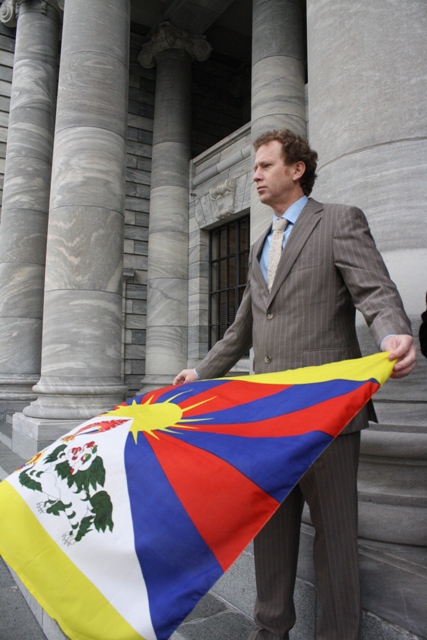
Green co-leader Russel Norman assulted by Chinese goon squad

According to reporters and Russel Norman himself, a dozen Chinese agents surrounded him, shoved him, pulled an umbrella over his head, stole his Tibetan flag and stomped on it, and his hand when he tried to get it back. PM John Key says all this is very ‘disappointing’, but it’s clear he means any embarrassment caused to the Chinese Vice President Xi Jinping, not this thugs’ attack on freedom of speech.

There’s a bit of history of this sort of thing. 11 years ago in Christchurch it was the New Zealand police who tried to protect the Chinese premier from the horrifying sight of pro-Tibetan protesters, the cops pushed the protesters back and parked a bus in front of them. They were later found to have abused their powers.

Oddly enough I’ve been thinking and reading a bit about China and Tibet recently, although not because of the VP’s trade delegation.

A recent report on New Zealand agribusiness says Chinese demand saved the economy from the worst of the (first round of) the global economic crisis. How long will this last?

Meanwhile, strikes by Chinese workers have been making the news and prompting debate among socialist bloggers in the UK. UNITYblog readers might be interested in this post by Lenin’s Tomb and this response from sympathetic to China Andy Newman at Socialist Unity.

And on the topic of Tibet, this article in the latest Austrian Green Left Weekly (a paper Mr Norman used to sell) responding to a report in the May 22 Sydney Morning Herald, that the Dalai Lama has declared himself “half Marxist half Buddhist”
– David


Incident outside Parliament – Russel Norman’s statement


The mistreatment of Green Party Co-leader Russel Norman on the grounds of Parliament by Chinese security personnel shows how important it is to stand up for democracy and human rights, the Green Party said today.

Dr Norman was assaulted by Chinese security personnel outside Parliament as he was making a stand against China’s human rights record in Tibet.

“Because John Key’s Government let Chinese security control our Parliament, it stopped being a safe place for democracy,” Dr Norman said.

“I’ve laid a complaint with the Police because New Zealanders need to know they are free to speak without fear of violence or recrimination.”

Dr Norman said the Government needs to defend the right of its citizens to free speech because it is one of the cornerstones of democracy.

“I’m asking that John Key make a clear statement that this sort of behaviour is not acceptable in New Zealand,” Dr Norman said.

Thursday, 12 June 2008

NZers call for US to release Cuban 5


Dozens of New Zealand supporters of civil rights have added their names to a letter being delivered to the US consulate in Auckland at 4pm today demanding the release of five Cubans jailed in the USA.

“Their so-called crime was to gather information about terrorist groups that operate on US soil and carry out attacks in Cuba,” said Mike Treen on behalf of the NZ Cuba Friendship Society.

“Their actions helped prevent terrorist actions and protected innocent civilians. It is a travesty of justice for them to remain in jail for so long.”

Saturday, 7 June 2008

Labour’s Human Rights Nightmare: The New Immigration Bill

by Gordon Campbell June 5th, 2008 Few Labour voters may realise the full extent of what the Clark government has in mind - or has allowed to get out of hand - with its rewrite of the 1987 Immigration Act. To date, the parties on the centre right (National, Act, United Future) have also shown little interest in the Immigration Bill’s sweeping extensions of state power, while the anti-immigrant crew within New Zealand First must be thinking all their Christmasses have come at once. Continue at http://election08.scoop.co.nz/labour%e2%80%99s-human-rights-nightmare-the-new-immigration-bill/

Sunday, 27 April 2008

The struggle to redefine the workday


In the photo above ordinary Venezuelans meet together in a Communal Council to discuss community issues and the revolutionary process. The Venezuelan constitution recognises the importance of everyone having time in the day to participate in these democratic structures. In his article 'The capitalist workday, the socialist workday' (included below) Micheal Lebowitz says that the Communal Councils are part of the struggle to redefine the workday.

In New Zealand today there's a democratic and social deficit being created by low pay and overwork. Working people are struggling (and often failing) to earn enough money to meet the most basic human needs, like housing, food, electricity etc. This is having a terrible impact on the health and well-being of individuals, families and communities. Lebowitz argues that this human cost is ingrained in capitalism, it's the direct result of the exploitation of workers' labour - the source of the capitalist's profits.

In his conclusion Lebowitz says:

"[W]hen we look at the workday from the perspective of socialism, we see that the simple demand for reducing the workday is a demand from within capitalism. Its message is simple - end this horror! This is an "infected" conception of the workday. It starts from a view of labour as so miserable that the only thing you can think of doing is reducing and ending it.

When we think about building socialism, however, we recognise that the demand is to transform the workday - to recognise all parts of our workday explicitly and to transform that day qualitatively. Rather than only "free time" being time in which we can develop, from the perspective of socialism it is essential to make the whole day time for building human capacities.

In short, there are two ways of looking at the demand for the reduced workday: one way talks simply about a shorter work week and thus longer weekend vacations; in contrast, a second way stresses the reduction of the traditional workday in order to provide the time on a daily basis for education for self-managing, for our work within the household and our work within our communities. In other words, it is the demand to redefine and transform our workday."

Should we in New Zealand make the struggle to redefine and transform the workday a core part of the broad left project?


The capitalist workday, the socialist workday

by Michael A. Lebowitz

from Links - International Journal of Socialist Renewal
24 April, 2008

As May Day approaches, there are four things that are worth remembering:

1. For workers, May Day does not celebrate a state holiday or gifts from the state but commemorates the struggle of workers from below.

2. The initial focus of May Day was a struggle for the shorter workday.

3. The struggle for the shorter workday is not an isolated struggle but is the struggle against capitalist exploitation.

4. The struggle against capitalist exploitation is an essential part but not the only part of the struggle against capitalism.

What I want to do today is to set out some ideas about the capitalist workday and the socialist workday which I hope can be useful in the current struggles in Venezuela and, more immediately, in today's discussion.

Continue

Wednesday, 23 April 2008

10 Commandments to Save the Earth


Speaking at the United Nations on 21 April popular left-wing Bolivian president Evo Morales proposed 10 commandments to save the planet, life and humanity. They were:


1. Acabar con el sistema capitalista
Putting an end to the capitalist system

2. Renunciar a las guerras
Renouncing wars

3. Un mundo sin imperialismo ni colonialismo
A world without imperialism or colonialism

4. Derecho al agua
Right to water

5. Desarrollo de energías limpias
Development of clean energies

6. Respeto a la madre tierra
Respect for Mother Earth

7. Servicios básicos como derechos humanos
Treat basic services as human rights

8. Combatir las desigualdades
Fighting inequalities

9. Promover la diversidad de culturas y economías
Promoting diversity of cultures and economies

10. Vivir bien, no vivir mejor a costa del otro
Living well, not living better at the expense of others


What do UNITYblog readers think of Evo Morales' 10 "commandments"? Post your feedback by clicking 'comments' beneath this post. Or maybe come up with your own list of commandments.

Monday, 21 April 2008

NZ Labour - a party without principle

A recent headline in The Guardian (18 April) reads: ‘Chinese ship carries arms cargo to Mugabe regime’. Here we have a ship full of arms for Robert Mugabe so he can repress the democratic revolt in Zimbabwe, supplied by the same Chinese regime which the Labour government in New Zealand has embraced in a free trade deal, held up by a dockers’ strike in South Africa which, if done in New Zealand, would be illegal under the Employment Relations Act passed by Helen Clark's administration in 2000. Makes you think doesn’t it? This series of events on the on other side of the world highlights just how far Labour is from a progressive politics grounded in basic human rights. It’s all about the almighty dollar, and to hang with basic principles like democracy and workers’ right to strike. To secure a free trade agreement with China that will boost the profits of Fonterra and other NZ companies, Labour is willing to turn a blind eye to human rights abuses in China. And what chance that Helen Clark is going to loudly condemn gun-running by China to help a despotic Zimbabwe regime crush a broad based democratic movement? Not likely. This is the tangled world of pro-corporate profit driven politics without principle that the Labour Party has embraced. The party is no longer a progressive force in New Zealand.
Chinese ship carries arms cargo to Mugabe regime by David Beresford in Johannesburg The Guardian 18 April 2008 A Chinese cargo ship believed to be carrying 77 tonnes of small arms, including more than 3m rounds of ammunition, AK47 assault rifles, mortars and rocket-propelled grenades, has docked in the South African port of Durban for transportation of the weapons to Zimbabwe, the South African government confirmed yesterday. It claimed it was powerless to intervene as long as the ship's papers were in order. Copies of the documentation for the Chinese ship, the An Yue Jiang, show that the weapons were sent from Beijing to the ministry of defence in Harare. Headed "Dangerous goods description and container packing certificate", the document was issued on April 1, three days after Zimbabwe's election. It lists the consignment as including 3.5m rounds of ammunition for AK47 assault rifles and for small arms, 1,500 40mm rockets, 2,500 mortar shells of 60mm and 81mm calibre, as well as 93 cases of mortar tubes. The carrier is listed as the Cosco shipping company in China. Continue

Tuesday, 1 January 2008

NZers call for US to release Cuban 5

Dozens of New Zealand supporters of civil rights have added their names to a letter being delivered to the US consulate in Auckland at 4pm today demanding the release of five Cubans jailed in the USA. “Their so-called crime was to gather information about terrorist groups that operate on US soil and carry out attacks in Cuba,” said Mike Treen on behalf of the NZ Cuba Friendship Society. “Their actions helped prevent terrorist actions and protected innocent civilians. It is a travesty of justice for them to remain in jail for so long.” The letter signed by union leaders, law professors, student leaders and others reads: June 12, 2008 John Desrocher Consul General U.S. Consulate General in Auckland Private Bag 92022 Auckland Dear Mr Desrocher, We are writing to add our voices to thousands around the world who oppose the June 4 ruling by the 11th Circuit Court of Appeals in Atlanta, which upheld the convictions of Gerardo Hernández, Ramón Labañino, Antonio Guerrero, Fernando González and René González. We ask that you pass on to your government our call for their immediate release. The Cuban Five, as these five men are known, were engaged in a peaceful mission to stop Miami-based organisations from continuing to carry out terrorist attacks against Cuba. Following their arrest they were held for 17 months in brutal conditions of solitary confinement and near-total isolation to hinder the preparation of their defence. At their trial there was not a single page of classified information produced showing espionage or any action directed against the U.S. government. Without any proof, frame-up charges of conspiracy were used to convict the five. They were tried and convicted in an atmosphere of hype and hysteria in Miami, Florida. These men have been held in jail now for ten years. Continuation of their imprisonment is an absolute injustice. Therefore, we urge the United States government to free the Cuban Five now! Yours faithfully - Dr Jane Kelsey, professor of law, University of Auckland - Laila Harre, National Secretary, National Distribution Union - Mike Treen, National Director, Unite Union - Mike Ingpen, Secretary, South Pacific and Oceanic Council of Trade Unions (SPOCTU) - Dr David V Williams, Professor of Law, University of Auckland - John Minto, Spokesperson, Global Peace and Justice, Auckland - Dave Wickham, Project Co-ordinator, CTU Centre for Food & Beverage Workforce Development - Omar Hamed, International Affairs Officer, Auckland University Students Association - Paul Piesse, President, Alliance Party - Grant Morgan, RAM Chair, Auckland - Pat Bolster, Wellington - Louisa Jones, National Industry Organiser, NZ Engineering, Printing and Manufacturing Union - Kathryn Tucker, Unite Organiser, Hamilton - Ina Lawrence, NZ Cuba Friendship Society, Auckland - Tom Buckley, Unite Organiser, Auckland - Roger Fowler, RAM Co-organiser - Joe Carolan, Organiser, Socialist Aotearoa - John Flygenring, Christchuch - Cameron Walker, student - Lyn Doherty, Project Co ordinator, Ohomairangi Trust - Hana Spierer, Alt TV Producer - Nico Woodward, student - Dr Gael Donald, Westfono Healthcare, Auckland - Julie Webb Pullman, Wellington - Ian Powell, Wellington - Janet Roth, Auckland - Paul Bruce , Greater Wellington Regional Councillor - Adrian Guerrero, Carla Batista, Katia Cisternas, Victor Batista, Tomas Guerrero, Nicolas Guerrero, Nadia Batista, Cristian Batista, Enrique Batista, Antonia Marchesse (from Latin America living in NZ) - Oliver Woods - RAM Co-organiser, Auckland - Helen Ritchie - Annalucia Vermunt, Communist League - Mike Tucker, Communist League - Nick Fowler, Young Socialists - John B. Turner, Waitakere - Susie Powell, teacher - Jane Bucholz, Auckland - Gillian Magee, National Distribution Union - Janfrie Wakim, Palestine Human Rights Campaign, Auckland - Christine Blance, Christchurch - Malcolm McAllister, teacher, Auckland - Joel Hildebrandt - Denis O'Connor - Paul Maunder, Greymouth - Ron R. Miller, Auckland - Jim Holdom, Hamilton - Jeremy Gorham, Business Manager, Mt Eden - Warren Brewer - Colin Pounder, Christchurch - Nick Laery, undergraduate student, University of Auckland Contact Mike Treen National Director, Unite Union Organiser, Postal Workers Union Aotearoa Ph: DD - 64 9 846 9485 Mobile - 64 29 525 4744 Ph: Office - 64 9 845 2132; Fax - 64 9 846 9509

The capitalist workday, the socialist workday

by Michael A. Lebowitz from Links - International Journal of Socialist Renewal 24 April, 2008 As May Day approaches, there are four things that are worth remembering: 1. For workers, May Day does not celebrate a state holiday or gifts from the state but commemorates the struggle of workers from below. 2. The initial focus of May Day was a struggle for the shorter workday. 3. The struggle for the shorter workday is not an isolated struggle but is the struggle against capitalist exploitation. 4. The struggle against capitalist exploitation is an essential part but not the only part of the struggle against capitalism. What I want to do today is to set out some ideas about the capitalist workday and the socialist workday which I hope can be useful in the current struggles in Venezuela and, more immediately, in today's discussion. The capitalist workday What is the relation between the work the capitalist workday and exploitation? When workers work for capital, they receive a wage which allows them to purchase a certain amount of commodities. How much is that wage? There is nothing automatic about the wage level. It is determined by the struggles of workers against capital. Those commodities which form the worker’s wage contain a certain quantity of labour, and those hours of labour on a daily basis are often described as the "necessary labour" of the worker - the hours of labour necessary for workers to produce the commodities they consume on a daily basis. But, in capitalism workers do not just work their hours of necessary labour. Because they have been compelled to sell their ability to work to the capitalist in order to survive, the capitalist is in the position to demand they work longer than this. And the difference between their hours of necessary labour and the total work that workers perform for capital is surplus labour - the ultimate source of capital's profits. In other words, capitalist profits are based on the difference between the workday and necessary labour; they are based upon surplus labour, unpaid labour, exploitation. So, the more the capitalist is able to drive up the workday, the greater the exploitation and the greater the profit. Marx commented that "the capitalist is constantly tending to reduce wages to their physical minimum and extend the working day to its physical maximum". How true. Marx continued, though, and noted "while the working man constantly presses in the opposite direction". In other words, class struggle: workers struggle to increase wages and to reduce the workday; they struggle to reduce exploitation by capitalists. Of course, your workday is more than just the time spent between clocking in and clocking out. There is the time it takes you to get to work, the time it takes to buy the food you need to survive, the time to prepare that food - all this is really necessary labour and part of the worker’s workday. But since this labour is free to the capitalist, since it is not a cost for him, it is therefore invisible to him. So, when the capitalists want to drive down necessary labour by driving down wages (or by increasing productivity relative to wages), it is not the labour he does not pay for that he wants to reduce. Rather, he wants as much free labour is possible, as much unpaid labour as possible. It is not surprising that workers want to reduce their unpaid labour for capital and to do so by struggling to reduce the capitalist workday. But it is not only the unpaid labour in the workday that is a burden for workers; it is also the paid labour that they are compelled to do for capital. In other words, the problem is not only exploitation. It is the way that capitalist production deforms working people. In the capitalist workplace, the worker works for the goals of capital, under the control of capital and with an organisation of production which is designed not to permit workers to develop their capabilities but, rather, has the single goal of profits. "All means for the development of production", Marx stressed about capitalism, "distort the worker into a fragment of a man, they degrade him" and "alienate from him the intellectual potentialities of the labour process". In other words, the process of capitalist production cripples us as human beings. Life in the capitalist workplace is a place where we are commanded from above, where we are mere tools that capital manipulates in order to get profits. That is why we want to reduce the capitalist workday. That is why we cannot wait to escape. It is not only the exploitation, the unfairness and the injustice in the distribution of income. Time away from capitalist production appears as the only time in which we can be ourselves, a time when our activity can be free time, time for the full development of the individual. This is what it necessarily looks like within capitalism. But we have to recognise that so many of our ideas within capitalism are infected. The most obvious example is the phenomenon of consumerism - we must buy all those things! What we own defines us. The socialist answer, though, is not that everyone should own the same things - in other words, equalisation of alienation; rather, the socialist idea is to end the situation in which we are owned and defined by things. The battle of ideas, which is central to the struggle for socialism, is based on the alternative conception of socialism. Its focus is not to reform this or that idea that has developed within capitalism but, rather, to replace ideas from capitalism with conceptions appropriate to socialism. So, is our idea of the workday within capitalism infected? And, can we get any insights into the workday by thinking about the workday within socialism? The socialist workday Firstly, what do we mean by socialism? The goal of socialists has always been the creation of a society which would allow for the full development of human potential. It was never seen as a society in which some people are able to develop their capabilities and others are not. That was Marx's point in stating clearly that the goal is "an association, in which the free development of each is the condition for the free development of all." And this is clearly the point, too, of Venezuela’s Bolivarian constitution where it stresses in article 20 that "everyone has the right to the free development of his or her own personality" and in the explicit recognition in article 299 that the goal of a human society must be that of "ensuring overall human development". In contrast to capitalist society, where "the worker exists to satisfy the need" of capital to expand, Marx envisioned a socialist society where the wealth that workers have produced "is there to satisfy the worker’s own need for development". So, what is the nature of the workday in a society oriented toward ensuring overall human development? Let us begin by talking about necessary labour - quantitatively. There is the labour which is contained in the products we consume daily - just like before. To this, however, we need to add the labour that workers want to devote toward expanding production in the future. In socialism, there are no capitalists who compel the performance of surplus labour and invest a portion of the profits in the search for future profits. Rather, workers themselves in their workplaces and society decide if they want to devote time and effort to expanding satisfaction of needs in the future. If they make this decision, then this labour is not surplus to their needs; it forms part of what they see as their necessary labour. Thus, the concept of necessary labour changes here. In a socialist society, further, we recognise explicitly that part of our necessary labour is labour within the household. In other words we acknowledge that our workday does not begin after we leave the household but includes what we do within the household. Article 88 of the Bolivarian constitution recognises the importance of this labour when it notes that labour within the household is "economic activity that creates added value and produces social welfare and wealth". The concept of necessary labour and our workday within a socialist society also includes the labour which is required to self-govern our communities. After all, if socialism is about the decisions we make democratically in our communities, then the time we need to do this is part of our necessary labour. Similarly, if socialism is about creating the conditions in which we are all able to develop our potential, then the process of education and of developing our capabilities is also activity which is necessary. When we think about the socialist workday, in short, we think about the workday differently. Our view of the quantity of necessary labour, for example, is not distorted by the capitalist perspective of treating as necessary only that labour for which capital must pay. That is the difference between the political economy of capital and the political economy of the working class. From the perspective of workers, we recognise as necessary labour all the labour that is necessary for "the worker’s own need for development". But the difference is not only quantitative. In socialism, the workday cannot be a day in which you receive orders from the top (even in strategic industries). Rather, it is only through our own activity, our practice and our protagonism that we can develop our capabilities. Article 62 of Venezuela’s constitution makes that point in its declaration that participation by people is "the necessary way of achieving the involvement to ensure their complete development, both individual and collective". In other words, in every aspect of our lives (the traditional workplace, the community, the household), democratic decision making is a necessary characteristic of the socialist workday; through workers’ councils, communal councils, student councils, family councils, we produce ourselves as new socialist subjects. Thus, when we look at the workday from the perspective of socialism, we see that the simple demand for reducing the workday is a demand from within capitalism. Its message is simple - end this horror! This is an "infected" conception of the workday. It starts from a view of labour as so miserable that the only thing you can think of doing is reducing and ending it. When we think about building socialism, however, we recognise that the demand is to transform the workday - to recognise all parts of our workday explicitly and to transform that day qualitatively. Rather than only "free time" being time in which we can develop, from the perspective of socialism it is essential to make the whole day time for building human capacities. In short, there are two ways of looking at the demand for the reduced workday: one way talks simply about a shorter work week and thus longer weekend vacations; in contrast, a second way stresses the reduction of the traditional workday in order to provide the time on a daily basis for education for self-managing, for our work within the household and our work within our communities. In other words, it is the demand to redefine and transform our workday. The first of these is simply a reform within capitalism. For socialists, May Day should be the day to struggle for the whole worker's day, to struggle for the socialist workday. Michael A. Lebowitz is professor emeritus of economics at Simon Fraser University in Vancouver, Canada, and the author of Beyond Capital: Marx's Political Economy of the Working Class and Build It Now: Socialism for the Twenty-First Century. This article was presented as initiating remarks to the "Roundtable Discussion on the Reduction of the Workday" held on April 24, 2008, at the Centro International Miranda, Caracas, Venezuela. The event brought together leaders from different union federations and currents, as well as a representative from the women’s movement, to discuss the importance of the demand of the reduction of the workday in the lead up to May Day. The event was organised by the program "Human Development and Transformatory Practise" coordinated by Lebowitz, at the Centro Internacional Miranda. Michael Lebowitz's book 'Build It Now: socialism for the 21st century' is reviewed by Daphne Lawless, editor of UNITY journal. Go to Book review: 'Build it Now' by Michael Lebowitz

NZ Labour - a party without principle

A recent headline in The Guardian (18 April) reads: ‘Chinese ship carries arms cargo to Mugabe regime’. Here we have a ship full of arms for Robert Mugabe so he can repress the democratic revolt in Zimbabwe, supplied by the same Chinese regime which the Labour government in New Zealand has embraced in a free trade deal, held up by a dockers’ strike in South Africa which, if done in New Zealand, would be illegal under the Employment Relations Act passed by Helen Clark's administration in 2000. Makes you think doesn’t it? This series of events on the on other side of the world highlights just how far Labour is from a progressive politics grounded in basic human rights. It’s all about the almighty dollar, and to hang with basic principles like democracy and workers’ right to strike. To secure a free trade agreement with China that will boost the profits of Fonterra and other NZ companies, Labour is willing to turn a blind eye to human rights abuses in China. And what chance that Helen Clark is going to loudly condemn gun-running by China to help a despotic Zimbabwe regime crush a broad based democratic movement? Not likely. This is the tangled world of pro-corporate profit driven politics without principle that the Labour Party has embraced. The party is no longer a progressive force in New Zealand.
Chinese ship carries arms cargo to Mugabe regime David Beresford in Johannesburg The Guardian 18 April 2008 A Chinese cargo ship believed to be carrying 77 tonnes of small arms, including more than 3m rounds of ammunition, AK47 assault rifles, mortars and rocket-propelled grenades, has docked in the South African port of Durban for transportation of the weapons to Zimbabwe, the South African government confirmed yesterday. It claimed it was powerless to intervene as long as the ship's papers were in order. Copies of the documentation for the Chinese ship, the An Yue Jiang, show that the weapons were sent from Beijing to the ministry of defence in Harare. Headed "Dangerous goods description and container packing certificate", the document was issued on April 1, three days after Zimbabwe's election. It lists the consignment as including 3.5m rounds of ammunition for AK47 assault rifles and for small arms, 1,500 40mm rockets, 2,500 mortar shells of 60mm and 81mm calibre, as well as 93 cases of mortar tubes. The carrier is listed as the Cosco shipping company in China. South Africa's national conventional arms control committee issued a permit on Monday for the trans-shipment of the cargo from Durban to Harare. The head of government information in South Africa, Themba Maseko, said yesterday: "We are not in a position to act unilaterally and interfere in a trade deal between two countries." South Africa had to "tread very carefully", given the complexity of the situation in Zimbabwe, Maseko said. South Africa was not encouraging the purchase of weapons by Zimbabwe, he said, pointing out that there was no UN trade embargo against that country. But Tony Leon, the South African opposition foreign affairs spokesman, said the shipment was tantamount to "putting a fuse in a powder keg". Dockers in Durban were refusing last night to unload the ship. The SA Transport and Allied Workers Union's general secretary, Randall Howard, said: "Satawu does not agree with the position of the government not to intervene with this shipment of weapons. Our members will not unload this cargo, neither will any of our members in the truck-driving sector move this cargo by road." Despite international criticism, the Chinese government has been a longstanding backer of Zimbabwe president Robert Mugabe's authoritarian regime, supplying it with jet fighters, military vehicles and guns. China, or Chinese businesses, are reported to have sold radio-jamming devices to prevent independent stations from contradicting the state-controlled media, and have signed vital agriculture deals. Even the blue tiles on Mugabe's latest 25-bedroom mansion, reminiscent of Beijing's Forbidden City, were a gift from China. China has in the past used its veto at the UN security council to prevent the Zimbabwe issue from being raised, on the grounds that the country's problems were an internal matter. In Britain, William Hague, the shadow foreign secretary, said last night: "The international community must speak with one voice on Zimbabwe. We call on China, as part of that community, to suspend arms sales to Zimbabwe. "The Mugabe regime continues to deny the right of the people of Zimbabwe to choose their leaders. To supply arms to it at time when opposition activists are being intimidated and attacked, not only sends the wrong signal, but will harm the reputation of China. "In addition, it is time that neighbouring states like South Africa made clear that such shipments are not welcome." The Foreign Office was more cautious. A spokeswoman said that Britain backed an EU ban on arms sales to Zimbabwe and was encouraging other governments to do the same. The FO said it was monitoring the situation and seeking to verify reports about the ship's cargo. A spokesman for China's foreign ministry said it was aware of the reports about the shipment, but needed more time to look into the matter. The disclosure about the ship's cargo follows claims by an official from the Zimbabwe opposition Movement for Democratic Change that Chinese soldiers had been seen in the country. There were some signs yesterday that South Africa may at last be bending under international pressure, when the cabinet joined calls for the release of Zimbabwe's election results. Zimbabwe's opposition leader, Morgan Tsvangirai, called on South Africa's president, Thabo Mbeki, to stand down as the chief mediator in the country's election crisis, as the US criticised African governments for lack of action on the issue. "It is time for Africa to step up," the US secretary of state, Condoleezza Rice, said. Tsvangirai told a news conference in Johannesburg: "President Mbeki needs to be relieved from his duty." Mbeki, is also under pressure from Jacob Zuma, the leader of the ruling African National Congress. Zuma has adopted a more hostile attitude towards Mugabe, saying that "the region cannot afford a deepening crisis in Zimbabwe".