Showing posts with label economics. Show all posts

Tuesday, 14 September 2010

Christchurch earthquake and the battle for ‘sustainable’


The following is from Australian blog Climate Change Social Change. As a Christchurch resident, I think the claim that “up to half the buildings in the region need repairing”, is an exaggeration, although I assume they’re simply repeating what they read in the mainstream media.
- David

Thankully, no lives were lost in the September 5 earthquake that hit the city of Christchurch, New Zealand. But it has caused vast damage, up to half the buildings in the region need repairing.

As I watched the evening news report about the disaster, I was struck by a comment a local resident made to reporters. Half jokingly, he said the good news was that the rebuilding effort would help pull New Zealand out of recession.

Without realising, he pointed to a key feature of the present economic system. Capitalism thrives on crisis and destruction. Half of Christchurch is wrecked, but that translates into more jobs, more economic activity and, most of all, more growth.

It reminded me of something the famous economist John Maynard Keynes once said about the way capitalism works.

He said it made more sense to employ people to dig holes then cover them up again than to allow economic growth to stagnate.

The point is that capitalist growth does not have to serve any social need or useful purpose. Capital must expand. Profits must rise. That’s all that matters.

And if the growth machine falters, it’s thrown into crisis — a recession.

Capitalism’s growth drive is what makes it so radically unsustainable. To survive, it needs ever-higher resource use. It needs an obedient workforce, on the lowest wages it can get away with. And it needs those same workers to be high consumers. It has to convince us to buy more and more stuff.

A healthy, expanding capitalist system is unhealthy for people and the planet. The ecological crisis shows us that.

Indeed, the climate emergency has reached truly dire proportions. A 2008 paper by climate scientists Kevin Anderson and Alice Bows predicted the planet was headed for a minimum 4°C of warming this century, even if sizeable emissions cuts were made. If temperatures do reach this high it would trigger runaway global warming.

The growth economy is also a waste economy: it has to treat the Earth as a giant trash can.
Just one example: a study by the Algalita Marine Research Foundation estimated there was about six times more plastic waste, by mass, in the Pacific Ocean than zooplankton.

A floating rubbish heap, roughly twice the size of Texas, spans an area of the north Pacific.

It’s not that most people don’t care. They do. Concern about these issues has probably never been higher.

But corporate interests exploit and distort this concern. They try to convince us we can consume our way to a sustainable world.

Sustainability is repackaged and sold back to us as merchandise. Most of us are aware that companies use greenwashing to sell their products. But the reason they keep doing it is because it works. Being “green” is a good marketing strategy.

We are in a struggle over the very meaning of “sustainable”. It’s been co-opted. Green capitalism allows industry to give the impression it is changing, even as it continues with business as usual.

At the same time, a relentless cultural message has been hammered home, telling us high individual consumption is the real problem.

So we are left with two ideas, which sum up the philosophy of green capitalism. Bad consumer choices are supposed to be the source of the crisis, while good consumer choices are said to be the path to salvation.

To an extent, this message has tainted the mainstream environment movement. We can see this with events such as Earth Hour, which suggest businesses and individuals have an equal responsibility to ride bicycles more often, have shorter showers and recycle milk cartons.

Now don’t get me wrong. We should try to reduce our personal waste and impact where we can. In this sense, we should “practice what we preach”.

But alone, it won’t solve even 1% of our environmental problems. We can’t treat the ecological crisis as independent from the economic system that gave rise to it.

The idea that consumers cause environmental problems obscures the fact that production is dominated by huge corporations. They are the ones pushing unsustainable growth. Collectively, they spend billions on advertising to create new consumer “needs”. They are the vested interests standing in the way of real sustainable change.

The free market won’t allow us to buy the things we really need. We need solar thermal power stations and wind farms. We need a redesign of our entire food system. But the system will not deliver these things in the short time we have left.

And capitalism doesn’t allow most of the world’s people to fulfil their basic needs at all. It excludes them. It leaves 1 billion people without enough food simply because it’s not profitable to have them eat.

To return to the New Zealand earthquake, another remarkable thing is it was slightly stronger than the earthquake that hit Haiti in January. But in Haiti, one of the world’s poorest nations, at least 230,000 people died.

The difference between the two earthquakes is the difference between a natural disaster and an unnatural disaster.

Capitalism is a system of unnatural disasters. It was never sustainable in the first place. It will be even less so in the future.


[Based on a speech delivered at the Green Left Weekly Sustainability Dinner, Sydney, September 11.]

Sunday, 11 July 2010

Video: David Harvey – ‘The animated crisis of capitalism’


On April 26, 2010, Marxist geographer professor David Harvey spoke to the the Royal Society for the encouragement of Arts, Manufactures and Commerce (RSA) to explain how capitalism came to dominate the world and why it resulted in the current financial crisis. He asks: is it time to look beyond capitalism towards a new social order? Above is the animated version of the longer speech he gave. You can view the original speech HERE

Taking a long view of the current crisis, Harvey exposes the follies of the international financial system, looking closely at the nature of capitalism, how it works and why sometimes it doesn’t.

Hattip LINKS

Tuesday, 26 January 2010

Reverse Robin Hood from tax working group

By David A report by the Tax Working Group has ignored the popular campaign for GST to be removed from food, calling instead for an across-the-board increase in GST to fund tax cuts for the wealthy. National, various business groups and much of the media have embraced this idea, although they appear less keen on the report’s proposal to tax rental properties. The Tax Working Group was one of several economic “taskforces” established by the National Government soon after the last election. It’s report has been contrasted with the free market fantasy produced by Don Brash’s 2025 Taskforce – which claimed cutting the minimum wage would somehow help wages increase to Australian levels. But praising the tax report as free from “ideological rhetoric” misses the point that many of its proposals are straight out of a neo-liberal economics text book. Cutting taxes on the rich and introducing GST was a core part of Labour and National’s free market reforms in the ’80s and ’90s. In the classic reverse Robin Hood free market style, they made the rich richer, by taxing them less and making everybody else pay more. This time round, the Dominion Post calculates that cutting the top personal tax rate from 38 percent to 33 percent would “put about $20 a week in the pockets of workers on $90,000 a year but give those earning less than $70,000 nothing.” And of course we’d also get hit with a 2.5 percent rise in the cost of everything else, thanks to the rise in GST. Rich rort tax system On top of the worn-out claims that making the rich richer will help us all, a new and bizarre argument is being deployed. The rich aren’t paying their fair share, wage and salary earners are paying too much, therefore (and this is the bizarre bit) we should cut the top tax rate and increase GST. According to the Dominion Post, “an Inland Revenue sample of 100 of the richest New Zealanders showed only about half were paying the highest marginal tax rate on their income.” The solution to this “tax rort”? Close the loopholes and go after the dodgers? No way, just cut the top tax rate. The economic theory behind this approach is that if the rich didn’t have to pay so much tax then they (or their accountants) wouldn’t work so hard to avoid it. In other words change the law to make the problem disappear. I’d love to see this logic applied to the crime. Instead of the new “three strikes” law we’d have something like this ... “In a bold new move to tackle rising violent crime figures the Government has announced they will stop counting assaults.” The funniest thing about the report may well be the claim by Finance Minister Bill English that he found “startling” the reports revelations that many rich people were “able to restructure their affairs” using a “company, trust or special savings vehicle” to avoid tax. Hang on. Wasn’t that pretty much what English himself did in the housing allowance scandal? The next sentence in the the Dominion Post report might be closer to the truth: “That only half of New Zealand’s wealthiest individuals were able to avoid paying the top rate of tax would be ‘astounding to the layman’, he [English] said.” This looks like English is saying that it’s surprising that only half were avoiding tax (surely this is a typo?). We can shift the tax debate In the run up to the last election, National was able to tap into discontent about low wages and rising prices with calls to close the wage gap between New Zealand and Australia. Of course they weren’t talking about a 25 percent increase in wages, instead they managed to focus the debate on tax cuts. Labour made things easy for them, because they opposed big wage rises too. Instead they cut taxes before the election, which not only looked like a pathetic election bribe attempt, but also backed up National’s argument that tax cuts are the solution to poor pay. Both parties were also united in their opposition to calls for GST to be removed from food. Nevertheless, the campaign to make food GST free – initiated by RAM and supported by the Maori Party, Grey Power and others – gained significant public support, with one pre-election poll showing 73 percent in favour. In power, National postponed its tax cuts, because of the recession. Now they are back on the agenda. But with such dodgy arguments being deployed in favour of tax cuts for the wealthy, paid for by a GST rise that will hit low and modest income people hardest, there’s wide open political space for a revival of the GST off food campaign. Another progressive tax reform supported by RAM as a way of funding GST cuts is a transaction tax on the movement of large sums of money. Ten years ago, this idea, some times known as a Tobin Tax, was a major spur to the European mass movement ATTAC, which played a key role in launching the World Social Forums. More recently, this idea has been raised by the Maori Party, Jim Anderton’s Progressives Party and Socialist Worker’s Bad Banks campaign. No doubt there are many other tax reforms that the Left could rally around, and that many people would support. With the next Budget four months away, there is plenty of time to campaign around this issue. But perhaps not enough time to build a campaign big enough to stop National’s reverse Robin Hood reforms. Nonetheless, if we can make a bit of a fuss, we can shift the tax and income debate away from the idea that income tax cuts, rather than wage rises are the way to boost take home pay. We may also be able to pressure Labour and the Greens into supporting taking GST off food, setting this up as a central issue at the next election.

Wednesday, 9 December 2009

Marxist accounts of the current crisis

by Joseph Choonara from International Socialism Journal Issue: 123 Just as medical science progresses through pathology, Marxist political economy develops through the analysis of the actual crises of capitalism. It is therefore no surprise that the current paroxysm has sparked both a revival of interest in Marxism1 and a flurry of responses by prominent Marxists. My focus here should not be taken to indicate that non-Marxist accounts are unworthy of engagement. A number of mainstream economists have been forced, whether enthusiastically or reluctantly, to grapple with the realities of the system.2 But the crisis has also revealed the paucity of what passes for academic economic theory, captured in an astonishing admission by Willem Buiter, a London School of Economics professor and a former member of the Bank of England monetary policy committee:
The typical graduate macroeconomics and monetary economics training received at Anglo-American universities during the past 30 years or so may have set back by decades serious investigations of aggregate economic behaviour and economic policy-relevant understanding. It was a privately and socially costly waste of time and other resources. Most mainstream macroeconomic theoretical innovations since the 1970s…have turned out to be self-referential, inward-looking distractions at best. Research tended to be motivated by the internal logic, intellectual sunk capital and aesthetic puzzles of established research programmes, rather than by a powerful desire to understand how the economy works—let alone how the economy works during times of stress and financial instability. So the economics profession was caught unprepared when the crisis struck.3
The record of Marxists has been better. Nonetheless, their approaches to the crisis are far from homogenous, have often been developed in isolation from each other and diverge on several points. Here I consider widely accessible accounts that have appeared in English over the past few months, appraising their strengths and weaknesses relative to each other and to the tradition associated with this journal.4 The “real” and the financial All Marxist accounts of the current crisis have been forced to recognise its financial dimension. The crisis has been marked by the near collapse of the banking system in several countries and began with the bursting of the subprime mortgage bubble in the US. One of the first Marxist accounts to draw attention to subprime was produced by Robin Blackburn, who wrote on this subject as early as spring 2007, a few months before the real panic began:
In recent months “subprime” defaults have jumped. A Lehman Brothers analyst warns that some $225 billion worth of subprime loans will be in default by the end of 2007 but others say the figure will be nearer $300 billion. The “equity tranch” [the riskiest slice of the repackaged debt] is now dubbed “toxic waste” by the insiders and analysts are waiting to see which bodies float to the surface… The default crunch will not only cause great unhappiness to the victims who stand to lose their homes—it hurts the housing market and increases the chances of a downturn.5
Back then the term subprime barely warranted a mention in most newspapers. The Financial Times was more attentive than most, carrying an article entitled “Subprime Sickness”, which argued:
There are plenty of reasons to believe that the [subprime] fallout can largely be confined to the sector… Even the fact that so many Wall Street banks were heavily involved in the subprime sector…need not be a cause for alarm. The exposure for any bank should be small. Typically they did not hold on to such mortgages, but packaged them up and sold them on in securitisation…securitisation is doing what it is intended to do—spreading the risk.6
Unlike the Financial Times, Blackburn was “ahead of the curve” because he had focused in the preceding years on developing a detailed analysis of the fragilities of the global financial system.7However, it was possible to see the outlines of a potential crisis from a different starting point. International Socialism published a remarkably prophetic article in summer 2007, which, by coincidence, came out just in time for the onset of the credit crunch. This saw the growth of finance originating in the decline of profit rates during the post-war boom and the failure to sufficiently restore them from the low levels they had reached by the 1980s. This led to a scramble for alternative outlets for profits:
Low levels of past profitability do not stop capitalists imagining that there are miraculous profits to be made in the future and in sucking surplus value from all over the world to be ploughed into projects aimed at obtaining them. Many of these are purely speculative gambles in unproductive spheres, as with bubbles in real estate, commodities markets, share prices and so on… Against such a background, corporate profits will be being puffed up until they lose touch with reality, and things will seem to be going very well until overnight it is discovered they are going very badly.8
These two different accounts illustrate a dividing line in Marxist analyses of the current crisis. Some emphasise the internal logic of “financialisation” and tend to see the financial crisis as impinging upon the “real” economy from the outside; others, while recognising the importance of the financial dimension, emphasise the underlying problems in the “real” economy that drove the expansion of finance and paved the way for the crisis. The distinction between the “real” and the financial has to be qualified in two ways. First, the growth of finance has, in part, been driven by traditional corporations based in the “real” economy. For instance, by 2003, 42 percent of General Electric’s profits were generated by its financial wing, GE Capital.9 Second, and more fundamentally, for Marxists the financial system is not simply something grafted onto a pure, non-financial capitalism. Whenever money ceases to function simply as money, when it also functions as capital, it opens up the possibility of credit and financial speculation.10 As David Harvey has recently argued, “There is a more dialectical relationship between what you might call the ‘real’ and ‘financial’ sides of the economy”.11 The real questions at stake are whether financial growth is driven by processes autonomous from the non-financial areas of the economy; whether the current crisis is a new type of crisis or is rooted in tendencies Marx identified, even if the crisis is deferred and given unique characteristics by the growth of finance;12 and whether the dynamic of the system has been fundamentally changed by a process of “financialisation”. I will begin by considering those accounts that emphasise the transformation of capitalism through finance over the recent period.

Saturday, 28 November 2009

Bad Banks: everything leads back to financial capital

The following are Daphne Lawless’s notes from the talk she gave the Socialist Worker forum on “Bad Banks” on October 1.

Thank you all for coming. Thanks especially to Sue [Bradford, who was also on the panel], taking her first step out of that unpleasant bear-pit in Wellington and towards real-people politics again. Kia kaha, e hoa.

So, this is the first major meeting for the Bad Banks campaign. So it’s probably best to explain why Socialist Worker chose to initiate this campaign, and where we see it going.

Socialist Worker for the last few years has consistently followed a strategy of broad-party Marxism. What we need in this country, above all else, is a real mass party which unites radical leftists, traditional social democrats, trade unionists, Maori, feminist, queer, ecological and other social movements, which rejects neo-liberalism and commits to remaining politically independent of the Labour Party. The 57 varieties of leftist splinter groups which currently exist have no purchase on a real mass mood, and we must move past this kind of clique politics.

We have worked within RAM, the Residents Action Movement, as a demonstration of how this kind of broad-party politics might work in practice - although we are far from suggesting that RAM *is* the broad party. We have always been very clear that all groups and tendencies have to get over their small-group chauvinism, and be prepared to compromise to work together. We have had successes and failures, but it still seems clear that the broad-party strategy is the only strategy with any hope of success in the current climate.

How do we build this real political alternative? The alternative can’t be built by mechanical means - putting together the existing fragments like Lego blocks. No, the alternative has to be a political alternative. Which means it needs to be based on not only clear ideas pointing away from the current system, but on real social forces of real masses of people backing up those ideas.

The “transitional method”, which has been followed by radicals since Marx’s time, insists that you can’t get there by just jumping along any popular or populist bandwagon that happens by. But neither can you get there by drawing up a programme in some smoke-free room and then going out and preaching it on a soapbox. The essence of a transitional approach is to start with common sense – what everyone already knows from their personal experience – and follow a trail of logic that points towards a fundamental problem in the whole current set-up.

Rosa Luxemburg, the great German socialist, talked about the fusion of “workers and science”. That’s the essence of transitional politics – the combination of real grassroots anger at the system, with an analysis showing clearly how we can move beyond that system. We believe that Bad Banks has a good chance of having real success in those terms.

When we’ve been out on the streets on our Bad Banks stalls, we have confirmed what we suspected before – that ordinary people know clearly that “banks are a problem”. People turned down our first leaflet, not because they disagreed with it, but because they agreed totally and therefore there was no point reading it. When characters on Shortland Street are facing foreclosure issues, then you know it’s really a factor in mass consciousness.

Everyone knows that banks rip us off through fees. The media tells us all that the government keeps cutting the official cash rate, but the banks keep their mortgage rates high.

This is a crucial point that all radicals must understand. Since the mid 70s, the real world economy has pretty much stagnated. The income of ordinary people has not raised very much – in some countries like the USA, workers are actually paid less than they were in Richard Nixon’s day. The only reason that any major Western economy has grown is that the gap has been filled by cheap credit. Working people have been deliberately encouraged to take out mortgages, credit cards, hire purchase and in all other ways go into hock up to their eyeballs to make ends meet.

So this means that ordinary people are really screwed over when interest rates go up. And that means people’s attention is concentrated on the banks, as a visible sign that they’re being ripped off. That’s one of the problems with capitalism - the wage labour relationship *looks* fair, but it’s really exploitation. So workers find it much easier to see that the bank is ripping them off than the boss ripping them off. But it’s also a reason why in the absence of left-wing forces, workers can be distracted into how the government is ripping them off, and falling prey to right-wing tax-cut methodology. What Bad Banks is doing is attempting to find a “path of least resistance” in workers’ consciousness that leads in the right direction.

But on the other side of the equation, what this means is that finance capital – banks, insurance companies, private equity funds, all the other institutions which create pretend money – is now the political driver of the whole global system. What banks want, banks get. Huge bailouts, for one thing, paid for by cuts in public services. Wholesale dismantling of regulations back in the mid 90’s, and now resistance to putting any further regulations on them. Other forms of capital are subordinated to the needs of finance. Industry gets shut down by the truckload all over the advanced western states, smashing traditional working-class self-organisation and political consciousness.

Banks fund the kind of resource stripping which leads to ecological and social vandalism on a worldwide basis. Banks even brought down an entire country’s economic. Iceland was rich 18 months ago. Now it’s a basket case reduced to begging for the EU to let them in the door, because the banks sucked the whole country dry and then ran for it when the money-go-round stopped.

This eco-socio-economic vandalism creates a new form of proletariat in the Western countries - the French call it a “precariat”, from their “precarious” casualised lifestyle. Old-school capitalism was summed up by Henry Ford’s dictum that workers in his factory should be paid enough that they could afford one of the cars they make. A stable, suburban lifestyle for workers was encouraged, which also encouraged unions and other forms of worker self-confidence and self-organisation.

But increasingly in the Western countries, workers are roped into service industries - tourism, retail, call centres – or in making luxury goods for the rich. And most importantly – wages are so low that every worker simply must, at some stage, take out a loan or get a credit card just to survive. The industrial proletariat is not gone – it’s just moved to China, the Pacific Rim, the Mexican border and similar places where trade unions are illegal and the opposition is in jail. The brilliance of the current global system is that the industrial proletariat is now concentrated in countries where they don’t have basic democratic rights – while workers in the West have democratic rights, but are atomised and have no social power. The dominance of finance capital means creating a working class with no job security or historical memory, dependent on welfare and credit just to survive. That’s what they call “flexibility”.

While it was possible not to think about all of this during the bubble years, the economic crisis has just brought the central role of banks in a modern capitalist economy into sharp focus. And don’t be fooled by all this nonsense about “recovery” and “green shoots”. The media pundits talking like that have no historical memory and no vision of the future past the day after tomorrow. All that has happened is that the stimulus packages have worked – shovelling truckloads of free money the bankers’ way has opened up the doors of credit again. But the central problem is the same – that only continually increasing “helicopter drops” of free money can keep the system going. It’s just going to seize up again – and worse. Five cups of coffee might keep you awake all night, but you can’t drink thirty-five and hope to be able to stay up all week.

In modern capitalism, everything leads back to financial capital – which we can call by the shorthand of “banks”. This is why concentrating workers’ minds on the fact that banks are a threat is opening a small door to seeing the problem with the whole global system.

This is what some critics of Bad Banks don’t get. They seem to think that “Bad banks” must suggest that there are “Good banks”. Well, obviously some banks are worse than others. We’ve been asked whether Kiwibank or credit unions are as big a problem as the Aussie trading banks. Well, that’s a debate that we’re going to have to explore in the campaign.

But the message we have to get across is that the whole banking system is a parasitic growth on human society - but it’s not the fundamental problem. As long as we have capitalism, a system where production is devoted to private greed not public need, the banking system is a necessity - the system of economic and environmental exploitation just couldn’t work without it.

Lenin said that socialists should strike at the weak link. Socialist Worker believes that Bad Banks are the weak link - the weak link in the current global system, but also the weak link in ordinary people’s acceptance of that system. Masses of people can already see that banks are a problem. But if Bad Banks becomes a popular “meme”, it opens a door to an attack on neoliberalism or even capitalism as an entity – just like GST off food opens the door to a questioning of the whole edifice of sales tax, and why workers should even be paying tax in the first place.

SW does not want this campaign to be a “front”. We want this to be a properly broad campaign. Just about everyone on the further-left realises that banks are a problem. What we hope is that, in these early stages on the campaign, we will prove that “Bad Banks” has the ability to spread like wildfire through public consciousness. At that stage, it will become a self-sustaining phenomenon. We saw something like this in 2003 with the ARC rates revolt, and we took the initiative to found RAM to intersect with this public mood. Our analysis is that Bad Banks might get much, much bigger. But we do need an initial core of activists outside Socialist Worker – entire other organisations or groups, if possible – to help us with the campaign, to make it grow much faster.

So I urge everyone who’s not a SW member in this room to take away a truckload of Bad Banks pamphlets and sign-up sheets. You might also consider buying a few copies of UNITY, the magazine which I edit and is bloody good, which gives a few good articles on the problem with the current financial system. We urge you to write your own Bad Banks leaflets! We urge you to set up Bad Banks committees in every area, to spread the idea among your workmates, comrades, sports teams, knitting circles, whatever. And we urge you to keep in contact with Vaughan, our national organiser – send him your experiences on the stalls or wherever, so we can spread the word nationwide. Maybe a Bad Banks convention sometime next year might be a goer, who knows.

Practical politics is based on experiment. Bad Banks is an experiment to see whether we are right that the grassroots are turning away from neoliberal capitalism in their hearts – all they need is access to ideas and analysis which can offer a way forward. We encourage you to be part of the experiment.

“It is easier to rob by setting up a bank than by holding up a bank clerk.”

Friday, 6 November 2009

Is this as good as it gets?

by Marty G from The Standard November 5, 2009 Most of the wealth in New Zealand is owned by a tiny fraction of the people because our political/economic system makes it that way.
10% of people have more income than 50% combined.

income deciles

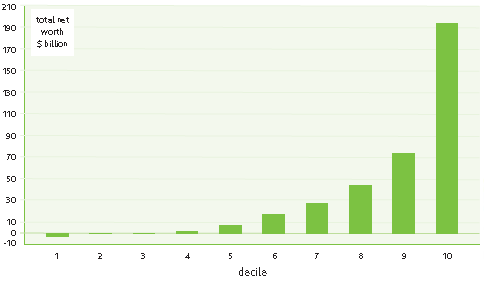
That’s just income. The inequality of wealth distribution is far greater. The net wealth of 10% of people is 20 times the wealth of 50% of us combined. In fact, the wealthiest 10% have more wealth than everyone else put together.

wealth by decile

These aren’t just numbers. That tiny amount of wealth the lowest 40% have is poverty, the cause of so many of society’s ills – crime, suicide, violence, obesity, social alienation, poor health, poor education are all linked to poverty. We allow a tiny portion of the population to control the wealth of this land. This isn’t some natural state, an inevitability. It is the result, the purpose, of the capitalist economic system, which is only possible because of the legal framework that exists to create and support it. Our company law, our land law, our tax system are all set up to enrich those few at the expense of the rest of us. My question is: ‘why do we let it be this way?’ We have a democracy, we have a relatively uncorrupted political system. The people that capitalism steals from far out-number the people it serves; we can out-vote them. Another way is possible. We can easily create a fairer, and ultimately more successful society than this without drastic reform, just sensible changes. So why don’t we do it? Why won’t we vote for it? Why don’t we demand change? Is it the endless pro-capitalist propaganda in the corporate media (not just the news, the ‘entertainment’ too)? Is it that the promise of some income growth blinds us to the greater injustice? Or is the reason that the capitalists have won and are still winning is that they are the most aggressive and greedy members of our society, while we are too weak and subservient to fight back? Although worth checking out is Marty G’s second post on this topic ‘The myth of upward mobility’

Saturday, 10 October 2009

Aussie tax dodging robber banks make bank robbers look like amateurs

by Murray Horton Secretary/ Organiser CAFCA The Australian-owned banks have been congratulating themselves on what a good recession they’ve been having and how it was all down to their prudence in not getting involved in any exotic financial transactions. Quite right, there’s nothing exotic about good old fashioned tax dodging, even if it was done via deliberately complicated structured financial transactions. So that’s how they rode out the recession, by not paying nuisance costs such as taxes. Not an option for the rest of us mugs, though. So far the courts have ruled that two of the Aussie banks (BNZ and Westpac) avoided taxes totaling more than $1.5 billion. The IRD’s cases pending against the ANZ and National Bank, if successful, could push that well over $2 billion. This is theft from the NZ taxpayer on a truly monumental scale, particularly at a time when the Government is cutting back public spending. This huge shortfall in tax could be used for health and education. NZ taxpayers are the guarantors of the deposits of these banks. Yet we get no say in their running, let alone ownership. Massive tax dodging can be added to the list of recidivist corporate crimes committed by these robber banks who make bank robbers look like rank amateurs. How come we never hear from the Sensible Sentencing Trust about locking up these criminals and throwing away the keys? Where are the judges who sermonise about beneficiaries stealing from the taxpayer? The taxpayer needs to be directly represented on the boards of each one of these Aussie banks that we’re underwriting with our money. And, if that doesn’t do the trick, nationalise them. And why is the Government still using Westpac as its bank? As Bill English would say, “it’s not a good look”. Too right, Bill, and you’d know all about that. How about only using a bank that actually pays its taxes, just like everybody else has to? CAFCA Campaign Against Foreign Control of Aotearoa Box 2258, Christchurch, New Zealand cafca@chch.planet.org.nz www.cafca.org.nz

Sunday, 20 September 2009

What's a “Fractional Reserve”?

by Daphne Lawless UNITY Journal Editor Simply put, “fractional reserve lending” is the reason why confidence is so important to banks. Banks don't have to have assets on hand to cover all the loans they issue. In New Zealand, they only need to hang on to 4% of the loans they make for housing – and 8% of other types of loan. Banks can't just make money up. If they want to lend out $100,000, say, they do need to have that money on their books to start with – from deposits, or from a central government monetary issue. But the “fractional reserve” rule mean that they don't have to hang on to those reserves when they make loans. If a bank lends $100,000 to a business, they only need to hang on to $8,000 in their own vaults. And only $4,000 if it's for a mortgage. One benefit of this is that money goes further, and faster. Because that $100,000 that has been lent out will end up as deposits in that same bank, or in other banks. And then it can be loaned out again – except for the $4,000 or $8,000 reserve. So that's another $92,000 or even $96,000 back into circulation! This is where we get what is called the “multiplier” effect. Because any initial deposit, or central bank issue, can be loaned out again and again and again, its actual effect on the economy will be much, much bigger than the initial input. So $100,000 which is made available to business, because it gets loaned out again and again, actually means something like $1,250,000 gets added to the economy. And with housing loans, that becomes a massive $2,500,000! The flaw in all of this, however, is that it means the system is all down to confidence. Capitalism needs a constantly growing and expanding economy. Anyone making a loan needs to be pretty sure that they will make enough money to pay it back, and the interest, in the future. So all this massive creation of credit - $1 million or more, or even $2 million or more – relies on the lenders' confidence in their ability to get it all back, once it's invested. It also relies on the confidence of the depositors – the people who paid in the $100,000 in the first place – that they too will get their money back, with interest. But what happens when that confidence disappears? It's called a run on the banks. If depositors have reason to believe that their deposits aren't safe, they run directly to the banks to ask for their deposits back. And of course the banks don't have those deposits – apart from the 4% or 8% that the law required them to keep back. In some cases, the money in those deposits will have been loaned out, then redeposited by someone else, then loaned out again, then redeposited, over and over and over. That's fine when economic growth means everyone wins. But that can't be guaranteed to happen all the time. So the bank goes bust – or the government bails them out. The financial house of cards collapses, and a million or two million dollars of wealth disappears overnight. The banking system is unsustainable because it's based on the presumption of eternal economic growth – or, in other words, on the ability of bosses to screw profits out of workers indefinitely. Isn't it time we had a system where credit and growth were supplied for need, not for greed? Daphne Lawless is one of the speakers at the Socialist Worker Forum on Bad Banks, along with Sue Bradford, Green Party MP. The forum is at 7.30pm, Thursday 1st October, @ Socialist Centre, 86 Princes Street, Onehunga, Auckland. Contact Bronwen i_c_red(at)slingshot.co.nz

Monday, 19 January 2009

Production-Side Environmentalism: Can we produce less and consume more?

by Don Fitz from Climate and Capitalism 12 January 2009 Corporate “environmentalism” is consumer-side environmentalism. “Make your dollars work for the Earth.” “Buy green!” “Purchase this green gewgaw instead of that ungreen gadget.” “Feel guilty about driving your car.” Consumer-side environmentalism is loath to discuss production. Consumer-side environmentalism does not challenge the manufacture of cars. Rather, it assumes that producing more and more cars is a sacred right never to be questioned.

Friday, 24 October 2008

Essential contradiction of consumer capitalism – keep wages low but keep spending high

Below is a brilliant must-read exposure by Ondine Green of the irrational world of financial speculation and how the bursting of the biggest bubble in history will impact on us in New Zealand. The financial markets are on the verge of complete systematic failure. The kings of finance want us to fall on their swords. As Ondine Green argues, we need to urgently put forward concrete demands which connect with the fears of ordinary people and opens up pathways to a more rationally controlled economy. Henry Ford's genius was to get workers to buy into the system as consumers, by using mass production to make consumer goods affordable. Wages at Ford's factories were set to make sure that a worker could buy one of the cars they made within a reasonable amount of time. However, by introducing the contradiction that the health of capitalism was dependent on workers' purchasing power, the system was made less stable in the long run. The Great Depression was a cycle of attempts to restore profits by cutting wages, thus depressing demand, thus reducing profits. Only massive public works – including rearmament for WW2, especially in USA and Germany – broke the cycle.

Friday, 10 October 2008

A Futile Bailout As Darkness Falls On America

by Paul Craig Roberts from Counterpunch 8 October 2008 America has become a pretty discouraging place. Americans, for the most part, will never know what happened to them, because they no longer have a free and responsible press. They have Big Brother’s press. For example, on September 28, 2008, a New York Times editorial blamed the current financial crisis on “antiregulation disciples of the Reagan Revolution.”

A guide to the Wall Street meltdown

by Lee Sustar
6 October 2008
MANY PEOPLE are understandably frustrated when they try to make sense of the world financial crisis based on what they read in mainstream newspapers.
These papers typically fence off business news into a special section dominated by jargon. Until the economic crisis broke, television news anchors rarely mentioned the economy except to give stock market reports or figures on economic growth.

Tuesday, 19 August 2008

Against the Market Economy: Advice to Venezuelan Friends

by Robin Hahnel Monthly Review January 2008 Robin Hahnel is professor of economics at American University in Washington DC and currently visiting professor at Lewis and Clark College in Portland, Oregon. This article is adapted from a speech the author gave at the Ministry for the Communal Economy in Caracas, Venezuela on July 13, 2007, attended by both their employees and employees from the Ministry of Planning and Economic Development. Robin Hahnel was a guest of the Centro International Miranda in Caracas for its July 2007 Workshop in Socialism and Human Development. During his stay, we arranged for him to speak at the Ministry for the Communal Economy. This ministry not only oversees and supports the significant Venezuelan cooperative sector and provides training in the principles of cooperation but has also moved recently to develop “socialist enterprises,” which work closely with communal councils. Since one of the principal goals of these organizations is to attempt to avoid the infection of the market, Robin’s talk was oriented toward providing them with important weapons for the battle of ideas. It will be obvious, however, that his demystification of the wonders of the market can be a weapon not only in the Venezuelan struggle but in the movement for liberation globally.
- Michael A. Lebowitz (October 31, 2007)
I am here to salute you – because you are attempting to do what nobody has ever succeeded in doing before – help autonomous groups of workers and consumers plan their interrelated activities democratically, equitably, and efficiently themselves. You have already created the elements of what you call the “social economy” – worker-owned cooperatives, communal councils, municipal assemblies, participatory budgeting, subsidized food stores, health care clinics, and nuclei of endogenous development. Now you want the cooperatives and communal councils to display solidarity for one another rather than treat each other as antagonists in commercial exchanges. And sooner rather than later you want the benefits of this kind of participatory, socialist economy to encompass the entire economy and all Venezuelans.

Sunday, 15 June 2008

House price crash will see a wave of mortgagee sales and bankruptcies not seen since the 1930s

by Peter de Waal
15 June 2008

British commentators are advising of a 5 year slump and 50% loss in value in the UK housing market. I believe the effects will be far worse in NZ, on the periphery of the global market.
The Australian banks have had a sweetheart deal with the NZ government allowing them to loan $200 million for every $8 million they have on deposit for housing. This compares to ordinary business loans where they can only advance $100 million for each $8 million on deposit.
This amount of loan activity has inflated house prices and the banks' profits – up until now. With the global credit crunch banks can no longer find the foreign capital needed to make such huge loans for housing. With the bursting of the housing market bubble house prices in NZ will crash, perhaps down to 2-4 times the average wage ($80,000-160,000).
The New Zealand middle class has most of its money tied up in housing after being thoroughly fleeced by the share market crash of 1987. The loss of the "wealth effect" is going to be profound, much worse than after 1987.
There will be a wave of mortgagee sales and bankruptcies not seen since the 1930s.  

See the Herald on Sunday (15 June) article The boom has turned to bust  
Also see Peter de Waal’s UNITYblog article The 2008 banking crisis: Why the housing bubble? Why the crash?

Thursday, 12 June 2008

Latest terms of trade confirms NZ is a wealthy country

NZ’s terms of trade, as reported in the NZ Herald, is the best for 34 years. The terms of trade, which measures export values versus imports, rose 4.1% over the last 3 months, and in the year previous to that 11.3%. The growth is mainly due to soaring prices for dairy products exported overseas, and increasing costs of imports due to rising oil prices.

As the NZ Herald put it “the increased purchasing power of the export dollar makes New Zealand a richer country”. Fundamentally NZ is a wealthy country. In 2007 national income rose 5.1%. There's been sustained economic growth since 2000. The wealth, however, has not been shared around. The rich have been gorging themselves while the relative wealth of middle to low income earners has stagnated or fallen. There are real signs that the economy is heading for problems, as a result of the global economic crisis and the bursting of NZ’s housing market bubble. The wealthy elites now want workers and other grassroots people to tighten their belts and be "realistic" about what the country can afford. This would be injustice heaped on injustice. There should be no poverty in NZ today, and we should be rushing to fund public solutions that will cut greenhouse gas emissions. Finding the $400 million a year needed to make tertiary education free should be no problem at all. That's why the demands being put forward by RAM are simply common sense:

  • Remove GST tax from all our food.
  • Mobilise for climate security, like public transport funded by road budget.
  • 2% interest state loan for a first home.
  • Lift minimum wage to $15 per hour & legalise workers’ stolen rights.
  • Free tertiary education & student living allowance to stop the ‘brain drain’.
Campaigning to achieve them will be taking it to the rich in this country and will be a step towards shifting the power balance.

Tuesday, 3 June 2008

Sky-rocketing oil and food prices - the latest investment bubble?

Are sky-rocketing food and oil prices due to global shortages, or the result of a speculative rush of billions of dollars into commodities trading? According to many economic commentators it's the latter. The sickness of the system that we live under is that a "speculative boom" in commodity prices is seeing poor people starve, and is causing enormous stress to cash-strapped working people across the world. The latest investment bubble has been created by the largely unregulated trade in what's known as commodity futures. How this works is explained by Petrino DiLeo, in an article

Gambling with the Futures from US Socialist Worker.
DiLeo writes: "Futures are [...] traded by individual investors and financial institutions, based on a gamble as to whether the price of the goods will rise or fall. Today, traders of exchange-traded funds, hedge funds and other speculators far outstrip the actual buyers and sellers of commodities. As a result, these speculators have generated a big demand for futures contracts, therefore helping send the prices of underlying commodities upward." Mike Whitney in a recent article titled
 
The Great Oil Swindle: How much did the Fed really know? also argues that it's unregulated futures trading that's sending the price of oil (and food) upwards. And that a lot of this investment is coming from US banks who've been bailed out to the tune of hundreds of billions of dollars by the US Federal Reserve after the collapse of the housing and sub-prime mortgage markets. These big banks, argues Whitney, are trying to speculate their way out of the financial crisis through investing in oil and food futures. Not only are these banks the recipients of corporate welfare of truly historic proportions, but what they're doing with that money is inflicting pain and suffering on the majority of the world's population. Whitney claims the rising cost of oil "is a hoax cooked up by the investment banks and hedge funds who are trying to dig their way out of the trillion dollar mortgage-backed securities (MBS) mess that they created by turning garbage loans into securities." He quotes another financial analyst who calculates that at least 60% of the current price of oil comes from futures speculation by hedge funds, banks and financial groups, who are using unregulated futures exchanges to avoid public scrutiny. While perhaps overly dismissive of the current and future impact of Peak Oil, Whitney's analysis is compelling. The bigger picture is that trillions of dollars circulate the globe daily looking to be invested in shares, property, currency, commodities, and phony markets created to gamble on price or interest rate fluctuations, which points to the fact that the real economy - the one where goods or services are produced and purchased for actual use - is not delivering the profitable returns the capitalists want. This underlying economic crisis could not be avoided forever, and is now impacting on the global economy in a big way. What's important for us to realise is that this economic crisis is rapidly intensifying a global political struggle, where the naked self-preservation of the rich elites comes up against the rising anger of grassroots people. Like any war - which is what this indeed will be - it will be decided by superior organisation, strategy and will. Our side needs to build the political structures within individual countries and internationally to mobilise the world's grassroots majority in this historic struggle.  

UNITYblog directs readers to articles presented on the right-hand sidebar under the heading 'Building a broad left party' as a contribution to how we can organise.

Thursday, 17 April 2008

Read this! Excellent analysis of the global financial crisis

For an understanding of the global financial crisis and US imperialism Raymond Lotta's article provides plenty of insight. It's long, but very well written. The system is indeed mad, as Lotta convincingly shows us. And it's clear that the corporate imperialists will only "save" the system by destroying the rest of us. While Lotta's analysis focuses on the barbarism of capitalism, it's the mass grassroots struggles around the world which offer hope. The Venezuelan Revolution is one such beacon. There are lessons to be learnt from the revolutionary process in Venezuela that can help us here in Aotearoa. On the UNITYblog sidebar are a number of good articles looking at the exciting things happening in Venezuela. SW-NZ has argued that the Venezuelan Revolution, in the context of global economic, ecological and political crisis and intensifying inter-imperialist rivalry, can play a hugely important role in inspiring people around the world, but can also bring people and movements together. (See Organising to build a global broad left movement, 17.11.07). Nothing less than a global movement of the world's grassroots majority will be capable of bringing justice and sanity to the world. Financial Meltdown & the Madness of Imperialism by Raymond Lotta from Countercurrents.org 16 April, 2008 “The past 10 days will be remembered as the time the U.S. government discarded a half-century of rules to save American financial capitalism from collapse.” - David Wessel, economics editor, Wall Street Journal, March 27, 2008. “Be greedy when others are fearful.” - Warren Buffet, leading investment capitalist, quoted by The Economist, April 5, 2008 “[To the possessor of money capital] the process of production appears merely as an unavoidable intermediate link, as a necessary evil for the sake of money-making. All nations with a capitalist mode of production are therefore seized periodically by a feverish attempt to make money without the intervention of the process of production.” - Karl Marx, Capital, Volume II, ‘The Circuit of Money Capital’ The U.S. economy is experiencing the most wrenching financial turmoil since the Great Depression of the 1930s. Global markets have been reeling – as massive loans have turned bad, speculative bubbles have popped, and giant financial institutions have tottered. Financial turbulence originating in the U.S. has slowly expanded and worsened. There is now a global credit crisis. Banks and financial institutions are weighed down by huge losses caused by “non-performing loans.” Lending channels are choked up, as lenders are being called to pay back their loans, to clean up their balance sheets, and fearful that they are “throwing good money after bad” and won’t be paid back. There is real danger of a breakdown of the financial system. The new president of the International Monetary Fund has stated that the current turmoil poses the greatest financial crisis since the 1930s.1 The U.S. has been at the center of what is now a global financial storm. Bear Stearns, one of the largest and oldest investment banks in the U.S., collapsed in mid-March. The Federal Reserve Bank – which regulates and lubricates the U.S. banking system, and which also plays a special role in the world capitalist economy – has stepped in on an unprecedented scale. Continue

Saturday, 5 April 2008

US general's glum message to Senate links into crisis times for late capitalism

by Grant Morgan
Chair of RAM - Residents Action Movement


With practical military precision, retired US general William Odom told the Senate foreign relations committee on 2 April that Washington's Iraq strategy is doomed to fail.

Rather than creating a centralised political stability in Iraq suitable for US corporates to exploit Iraqi oil and for the US state to expand control over the Middle East, the general explained why that Washington's strategy was spreading political instability, bolstering the strength of regional militias and their political allies, and pushing Iran into the role of a regional power-broker utterly hostile to America.

The general is, of course, speaking for what he sees as being in the best interests of the US state - not in the interests of grassroots people. However, as an experienced military leader he knows what works and what doesn't.

Odom's Senate testimony exposes the huge divisions within America's elite circles over how to preserve US economic, political and military mastery over the world at a time of growing crisis for the US state.


GLOBAL TSUNAMIS

Washington is facing not only the unravelling of its Iraq strategy, but also:
• The rise of the European Union and, especially, China as economic super-rivals to America.
• The return of Russia as a nuclear-armed energy giant linking up with Beijing in a contra-US alliance.
• The threat of international financial meltdown on the back of a credit crunch, weakening stock market values and a faltering US dollar.
• Venezuela's "socialism of the 21st century", a political challenge to corporate imperialism which is infecting much of Latin America.
• The global uncertainties of an accelerating climate crisis that threatens human extinction unless there is an emergency mobilisation detrimental to market forces.
• The de-legitimisation of neo-liberalism as both an ideology and a political strategy which is spreading like a virus around the world.

In short, global tsunamis of a size that could swamp even the "unsinkable" USS Imperial are being whipped up by the storms of late capitalism. That forecast, given the central role of Washington in the way the world is run, has huge implications for the global system itself, not just the US state.

Naturally, ruling circles everywhere will try to escape the consequences of their own crises by trying to do what they've always done - shove the crisis burdens onto the backs of the world's majority: the workers, small farmers, professionals, homemakers and other grassroots people who do society's useful work for very little pay and even less say in how society is governed.


BROAD LEFT ALTERNATIVE

But it's not all doom and gloom for the grassroots. In many places in many countries, broad left parties are starting to arise which look likely to mobilise the mass forces needed to put humans at the centre of society, not the dollar.

Important successes are being won by broad left parties like the 5-million strong United Socialist Party of Venezuela, The Left in Germany and the Coalition of the Radical Left in Greece.

And important moves towards the creation of broad left parties are happening in countries like Indonesia, France and Malaysia, led by groups of socialists.

A similar process is underway even in New Zealand, sparked by the decision of RAM (Residents Action Movement) to spread nationwide from its Greater Auckland base and to contest parliamentary as well as council elections. (For more on RAM, email grantmorgan@paradise.net.nz or go to UNITYblog sidebar feature "Do we need a broad left party?" - www.UNITYblogNZ.com)

It is a global contest between the oppressive anarchy of system crisis, on the one hand, and the humanistic plan of broad left unity, on the other. Who will win this global contest? That is not pre-determined. Late capitalism's institutional insanity can be overcome through grassroots people uniting for a co-operative, democratic and ecological world.

Our progressive vision stands in stark contrast to the growing crises plaguing even late capitalism's heartland - the US state.

Below is a full reprint of general Odom's testimony to the US Senate. As well as exposing the US state's strategic incoherence, it reeks of a systemic decay that refuses any political quick-fix. Read it and get a better understanding of the system's crises so that people like us are in a better position to mobilise for a grassroots alternative.


US general William Odom tells Senate:
Rapid Withdrawal is Only Solution

TESTIMONY BEFORE THE SENATE FOREIGN RELATIONS COMMITTEE ON IRAQ


By William E. Odom, LT General, USA, Ret.

2 April 2008

Good morning Mr. Chairman and members of the committee. It is an honor to appear before you again. The last occasion was in January 2007, when the topic was the troop surge. Today you are asking if it has worked. Last year I rejected the claim that it was a new strategy. Rather, I said, it is a new tactic used to achieve the same old strategic aim, political stability. And I foresaw no serious prospects for success.

I see no reason to change my judgment now. The surge is prolonging instability, not creating the conditions for unity as the president claims.

Last year, General Petraeus wisely declined to promise a military solution to this political problem, saying that he could lower the level of violence, allowing a limited time for the Iraqi leaders to strike a political deal. Violence has been temporarily reduced but today there is credible evidence that the political situation is far more fragmented. And currently we see violence surge in Baghdad and Basra. In fact, it has also remained sporadic and significant inseveral other parts of Iraq over the past year, notwithstanding the notable drop in Baghdad and Anbar Province.

More disturbing, Prime Minister Maliki has initiated military action and then dragged in US forces to help his own troops destroy his Shiite competitors. This is a political setback, not a political solution. Such is the result of the surge tactic.

No less disturbing has been the steady violence in the Mosul area, and the tensions in Kirkuk between Kurds, Arabs, and Turkomen. A showdown over control of the oil fields there surely awaits us. And the idea that some kind of a federal solution can cut this Gordian knot strikes me as a wild fantasy, wholly out of touch with Kurdish realities.

Also disturbing is Turkey¹s military incursion to destroy Kurdish PKK groups in the border region. That confronted the US government with a choice: either to support its NATO ally, or to make good on its commitment to Kurdish leaders to insure their security. It chose the former, and that makes it clear to the Kurds that the United States will sacrifice their security to its larger interests in Turkey.

Turning to the apparent success in Anbar province and a few other Sunni areas, this is not the positive situation it is purported to be. Certainly violence has declined as local Sunni shieks have begun to cooperate with US forces. But the surge tactic cannot be given full credit. The decline started earlier on Sunni initiative. What are their motives? First, anger at al Qaeda operatives and second, their financial plight.

Their break with al Qaeda should give us little comfort. The Sunnis welcomed anyone who would help them kill Americans, including al Qaeda. The concern we hear the president and his aides express about a residual base left for al Qaeda if we withdraw is utter nonsense. The Sunnis will soon destroy al Qaeda if we leave Iraq. The Kurds do not allow them in their region, and the Shiites, like the Iranians, detest al Qaeda. To understand why, one need only take note of the al Qaeda public diplomacy campaign over the past year or so on internet blogs. They implore the United States to bomb and invade Iran and destroy this apostate Shiite regime. As an aside, it gives me pause to learn that our vice president and some members of the Senate are aligned with al Qaeda on spreading the war to Iran.

Let me emphasize that our new Sunni friends insist on being paid for their loyalty. I have heard, for example, a rough estimate that the cost in one area of about 100 square kilometers is $250,000 per day. And periodically they threaten to defect unless their fees are increased. You might want to find out the total costs for these deals forecasted for the next several years, because they are not small and they do not promise to end. Remember, we do not own these people. We merely rent them. And they can break the lease at any moment. At the same time, this deal protects them to some degree from the government¹s troops and police, hardly a sign of political reconciliation.

Now let us consider the implications of the proliferating deals with the Sunni strongmen. They are far from unified among themselves. Some remain with al Qaeda. Many who break and join our forces are beholden to no one. Thus the decline in violence reflects a dispersion of power to dozens of local strong men who distrust the government and occasionally fight among themselves. Thus the basic military situation is far worse because of the proliferation of armed groups under local military chiefs who follow a proliferating number of political bosses.

This can hardly be called greater military stability, much less progress toward political consolidation, and to call it fragility that needs more time to become success is to ignore its implications. At the same time, Prime Minister Maliki¹s military actions in Basra and Baghdad indicate even wider political and military fragmentation. What we are witnessing is more accurately described as the road to the Balkanization of Iraq, that is, political fragmentation. We are being asked by the president to believe that this shift of so much power and finance to so many local chieftains is the road to political centralization. He describes the process as building the state from the bottom up.

I challenge you to press the administration¹s witnesses this week to explain this absurdity. Ask them to name a single historical case where power has been aggregated successfully from local strong men to a central government except through bloody violence leading to a single winner, most often a dictator. That is the history of feudal Europe¹s transformation to the age of absolute monarchy. It is the story of the American colonization of the west and our Civil War. It took England 800 years to subdue clan rule on what is now the English-Scottish border. And it is the source of violence in Bosnia and Kosovo.

How can our leaders celebrate this diffusion of power as effective state building? More accurately described, it has placed the United States astride several civil wars. And it allows all sides to consolidate, rearm, and refill their financial coffers at the US expense.

To sum up, we face a deteriorating political situation with an over-extended army. When the administration¹s witnesses appear before you, you should make them clarify how long the army and marines can sustain this band-aid strategy.

The only sensible strategy is to withdraw rapidly but in good order. Only that step can break the paralysis now gripping US strategy in the region. The next step is to choose a new aim, regional stability, not a meaningless victory in Iraq. And progress toward that goal requires revising our policy toward Iran. If the president merely renounced his threat of regime change by force, that could prompt Iran to lessen its support to Taliban groups in Afghanistan. Iran detests the Taliban and supports them only because they will kill more Americans in Afghanistan as retaliation in event of a US attack on Iran. Iran¹s policy toward Iraq would also have to change radically as we withdraw. It cannot want instability there. Iraqi Shiites are Arabs, and they know that Persians look down on them. Cooperation between them has its limits.

No quick reconciliation between the US and Iran is likely, but US steps to make Iran feel more secure make it far more conceivable than a policy calculated to increase its insecurity. The president¹s policy has reinforced Iran¹s determination to acquire nuclear weapons, the very thing he purports to be trying to prevent.

Withdrawal from Iraq does not mean withdrawal from the region. It must include a realignment and reassertion of US forces and diplomacy that give us a better chance to achieve our aim.


A number of reasons are given for not withdrawing soon and completely. I have refuted them repeatedly before but they have more lives than a cat. Let try again me explain why they don¹t make sense.

First, it is insisted that we must leave behind a military training element with no combat forces to secure them. This makes no sense at all. The idea that US military trainers left alone in Iraq can be safe and effective is flatly rejected by several NCOs and junior officers I have heard describe their personal experiences. Moreover, training foreign forces before they have a consolidated political authority to command their loyalty is a windmill tilt. Finally, Iraq is not short on military skills.

Second, it is insisted that chaos will follow our withdrawal. We heard that argument as the ³domino theory² in Vietnam. Even so, the path to political stability will be bloody regardless of whether we withdraw or not. The idea that the United States has a moral responsibility to prevent this ignores that reality. We are certainly to blame for it, but we do not have the physical means to prevent it. American leaders who insist that it is in our power to do so are misleading both the public and themselves if they believe it. The real moral question is whether to risk the lives of more Americans. Unlike preventing chaos, we have the physical means to stop sending more troops where many will be killed or wounded. That is the moral responsibility to our country which no American leaders seems willing to assume.

Third, nay sayers insist that our withdrawal will create regional instability. This confuses cause with effect. Our forces in Iraq and our threat to change Iran¹s regime are making the region unstable. Those who link instability with a US withdrawal have it exactly backwards. Our ostrich strategy of keeping our heads buried in the sands of Iraq has done nothing but advance our enemies¹ interest.


I implore you to reject these fallacious excuses for prolonging the commitment of US forces to war in Iraq.

Thanks for this opportunity to testify today.

Friday, 21 March 2008

The 2008 banking crisis

The 2008 banking crisis: Why the housing bubble? Why the crash? by Peter de Waal Over the last three decades the economies of the western world have been driven by an expansion of credit rather than wage growth. And suddenly access to credit is now being switched off overnight as fear grips the rich over the US sub-prime mortgage losses. The house price boom was a global phenomenon coinciding with the low interest rate policies of the central banks of big economies, particularly the US, after the dotcom bust and 11 September 2001. However, a report published by the OECD in 2006 warned that the boom was out of step with economic fundamentals. (See http://www.olis.oecd.org/olis/2006doc.nsf/linkto/ECO-WKP(2006)3 Figure 4 shows how the price to income and price to rent ratios have shot past the trend line since 2001.) As with most other countries you can see that the NZ rents and income curves follow each other closely. So if house prices are rising it does not follow that rents will increase if incomes are static or falling (a fact apparently lost to many amateur property investors).
Typically though, falling rental yields have been masked by asset appreciation. Many landlords who have moved into “property investment” in the last five years have only been breaking even, many have been losing money from day one on the basis that capital appreciation will see them right. However, once the asset class price starts stagnating or falling (e.g. studio apartments in Auckland) the illusion of capital gain can no longer mask the cash drain. Yesterday’s cheery “can’t go wrong with property” speculator is today’s stressed seller, buying food for his family on his credit card because all his income is sucked up by an empty property he can’t let at a rate that covers the mortgage on it...

Friday, 1 February 2008

Essential contradiction of consumer capitalism – keep wages low but keep spending high

by Ondine Green Henry Ford's genius was to get workers to buy into the system as consumers, by using mass production to make consumer goods affordable. Wages at Ford's factories were set to make sure that a worker could buy one of the cars they made within a reasonable amount of time. However, by introducing the contradiction that the health of capitalism was dependent on workers' purchasing power, the system was made less stable in the long run. The Great Depression was a cycle of attempts to restore profits by cutting wages, thus depressing demand, thus reducing profits. Only massive public works – including rearmament for WW2, especially in USA and Germany – broke the cycle. The next time world capitalism decided to smash the crap out of worker's wages – the huge retrenchment of social spending and union-bashing in the 80s and early 90s (the Reagan/Thatcher/Douglas period) – things were a bit different. There was now a mass middle-class consumer market. Being able to effectively smash workers power meant a big inflation in the ranks of managers, marketing experts, and all the other mechanisms of control that corporate capitalism uses to keep people docile and cowed. Crucially, these people don't have to save to invest like capitalists do. They don't really have an economic function other than consuming. To some degree, part of the increased surplus was siphoned off to these guys, hence the explosion in luxury consumer goods in that period – the whole “yuppie” phenomenon, which is really still with us although more understated. But that wouldn't keep the whole ship afloat. Ford's legacy is still with us. Karl Marx said that in his time the natural wage of the working class was enough to keep them barely alive and able to put in 14 hours in the coal mines or wherever. But the modern capitalist system still relies on the working class – 80% of the nation in advanced countries – buying consumer goods. Crucially, and disturbingly, it's probably no longer true that the floor of possible wage rates is keeping body and soul barely together. The evidence for this is that while the American GDP per head has near to tripled over the last thirty years – the nation is producing three times as much wealth, in other words – real wages for American workers have actually fallen slightly. The only reason incomes have increased is that the hours of work have increased, to the point where they're massively greater than in any other Western country. Just as an example: American workers only get 2 weeks annual leave, if they're lucky. Think about that. In the current era, American workers are worse off than they were in the days of Richard Nixon. So how is the system kept afloat? They can't export all their consumer goods. Their middle classes can't spend that much... so? Credit! In the short term, credit is the answer to all the contradictions and problems of capitalism. In the long run, it just makes everything worse. As Marx wrote in Capital Volume 3, credit greatly expands the "scale of production, and enterprises which would be impossible for individual capitalists." This accelerated the development of capitalism, by eliminating the need for all transactions to directly involve the exchange of money. This sped up the rate at which commodities could circulate in the economy, something that was essential for the growth of a world market. The expansion of what later Marxists called "finance capital" created what Marx called "money capitalists", investors who have no direct relationship to the actual production of goods. Finance capital played a decisive role in the creation of modern corporations a century ago by organizing the mergers that led to monopolisation of entire industries. The credit system, according to Marx, "reproduces a new financial aristocracy, a new kind of parasite in the guise of company promoters, speculators and merely nominal directors; an entire system of swindling and cheating with respect to the promotion of companies, issue of shares and share dealing. It is private production unchecked by private ownership." In the years after Marx, of course, this wonderous magical potion called “credit” has moved from stopping the gaps in production, to smoothing out the troughs in production. And most crucially, filling the gap between wages and the level of consumption necessary to keep profits high and the system going. It's worth noting that there has been a consistent government ideological effort since the early 90s to train all young people into believing that taking on huge debts is an essential part of life: student loans schemes, for instance. It is vital for modern capitalism that the masses consume as they work. In the wake of the World Trade Centre attacks, Dubya Bush went on TV and said “SPEND SPEND SPEND or the terrorists win”. (It's worth noting that at a time when Americans' living standards and personal freedoms are under attack, there's always some war to sell them to keep them afraid, docile, isolated, passive, and SPENDING.) How are you going to spend with no money? Your credit card. Where do you go when rack-renters drive you out of your convenient apartment? To a nice house in the suburbs (and remember this is the USA, if you think Auckland's urban sprawl is bad, Atlanta will blow your mind, the suburbs go on halfway to the Grand Canyon) paid for by a mortgage company. To help with all this, the Federal Reserve in the US dropped interest rates to a staggering level. Banks, credit card companies, and the inevitable shady dealers had no problems getting as much as they wanted to lend out and hopefully make a tidy profit on. It's important to remember that this simply wouldn't have happened in another era, where growth was spurred by raises in real wages and credit was not for the likes of “Joe Sixpack”. I remember in the early 90s how difficult it was to even get a credit card. Now they send you ones uninvited in the mail, and raise your limit. In these conditions of mega-cheap credit, the housing market became more and more exciting. In countries with high levels of home ownership, like the US and New Zealand, the demand for new homes outstripped the supply, meaning the prices of existing homes rose and rose, meaning the owners of those home suddenly had much more credit at the bank without having had to work or even ask for it. This was an important part of the credit boom as well, supporting the middle classes in their spending on luxury commodity items. So what this all added up to, was that to keep the system running the working-classes, and to some extent the middle-classes, had to be spending more than 100% of their actual income. Anyone with half a brain in their head could tell you that that's not sustainable in the long term. Of course, no investment capitalist has even half a functioning brain when there's money to be made. But where was all this pretend money actually coming from? Now that's the other side of the question: the insane growth of the whole “pretend money” industry – derivatives, financial capitalism, call it what you will. As Bismarck said about laws, capitalist booms are like sausages, you're much happier with them if you don't understand how they're made. Capitalist booms are pretty much a huge confidence trick, a systematic campaign of denying reality and ignoring the evidence for as long as the fantasy world can be sustained. Marx and Lenin both saw more than a hundred years ago that credit, which evolved as a way to smooth over imbalances in the productive capitalist economy, was becoming a kind of parasitic growth form, warping its parent organism to its own needs. After the great trauma of the 1930s Depression and WW2 some controls were put on this entity. It's almost difficult to explain to young people today that there used to be a thing called “foreign exchange controls”. You had to ask special permission from the Reserve Bank to convert more than a few hundred into a foreign currency. And this was standard in all the capitalist nations. But it was propped up by a gold-standard currency system called Bretton Woods. That collapsed in 1973 when the Americans deliberately inflated their currency breaking the link to gold to pay for the Vietnam War. In the traumatic years of inflation and stagnation that followed the neo-liberals saw their chance. In all the Western countries we saw the whole idea of foreign exchange controls thrown out the window, along with pretty much any other regulations or controls over the financial industry. Soon these people were making untold billions doing nothing but shifting “hot money” as they call it around the world. In some cases – Britain in 1992 – they managed to cause the collapse of an entire economy policy that they didn't agree with. It's important to remember that all this “hot money” is essentially imaginary – that is, it isn't backed by any real life goods or services or other forms of useful wealth. It's based on nothing more than what John Maynard Keynes called the “animal spirits” of traders – their confidence, their willingness to believe, their trust. And no government was going to rock the boat regulating these guys as long as they were managing to double their imaginary money, and then bring it back into circulation to cover the gaps in the real economy. If lies are profitable, they will go unchallenged. Actually, in modern Western economies, the pretend economy is many times bigger than the productive economy. In a Marxist analysis, of course, the real creation of surplus value goes on in the factories of the world – increasingly based in places like China and the Pacific Rim, and only the profits get repatriated to the Western countries. Without a serious real industrial base to fall back on of course the various Governments would give Wall Street, the City of London, the “top end of town” anything they wanted. In fact, in countries like Britain an entire industrial base was sacrificed to keep the money-go-round in action. During the debt bubble years, 2001-2008 we'll call it, these people had even more pretend money than ever to play around with. Traders were given bonuses equivalent to perhaps 20 times the entire salary of the people who cleaned their offices for creating the biggest quantity of pretend money. So there was a huge incentive to create as much imaginary money as possible, and worry about the ramifications in the real world tomorrow, if at all. Deregulation in the US resulted in the creation of a “shadow banking system” that handles US$10 trillion of financial activities – equal in size to the traditional, regulated banking system. Much of the shadow banking system revolves around so-called “hedge funds”, which allow pools of private investors to speculate on various trends in the economy – movements in the value of national currencies, interest rates and more. Many hedge funds specialise in trading “derivatives”, financial instruments that are “derived” from the value of an underlying stock, bond or other security. For a long time, it seemed as if nothing could go seriously wrong as the Wall Street banks pulled in enormous profits in these new unregulated markets. One crisis was averted in 1998 when a hedge fund, Long Term Capital Management, made a bad bet on derivatives related to the Russia ruble, and went bankrupt. The US Federal Reserve had to line up several big Wall Street banks to bail out the fund and avoid a freeze-up of the credit system. Almost exactly 10 years later, however, the credit markets are once more freezing up. Again, the reason is a series of bad bets by traders of derivatives. Only this time, almost every big US and European bank is involved, with potentially devastating consequences for the world economy. Here’s where the housing bubble comes in. Millions of people borrowed by taking out a second mortgages on their homes – a figure equal to $1.1 trillion by early 2008. By the end of 2007, mortgage debt was $10.5 trillion, more than twice that in 2000. Mortgage lenders saw this as a can’t-lose proposition. They were able to sell the huge volume of loans to Wall Street banks, which bundled them into bonds known as mortgage-backed securities. These securities could then be sold off to other banks and investors around the world. “Subprime” mortgages (made to people who didn't have a hope in hell of paying them back) were bundled with other better debts so they could be hidden on everyone's balance sheets. This was essentially a massive long-term project of the market lying to itself, in order to keep the pretend-money-creation spiral going. In the circumstances it was inevitable that the expansion of credit would end up going far beyond any realms of sanity and begin lending money that would only be repaid in the Magical World of Lollipops. Bubbles aren't stable. Either they keep expanding, or they pop. If one trader gets rich lending money on bad credit, soon everyone is going to want to do it, and on worse and worse credit. Reality, in the trader's world, is what you can get away with. And in a situation where an entire industry is systematically deluding itself that the golden weather will continue forever it was inevitable that something like these dodgy derivatives would start to exist. Systematic lying would start to extend to the accountants rather than just the marketing guys. Remember, a speculative boom is what happens when people “think positive” so much that they begin to live in a fantasy world. As long as everyone keeps believing that the market will rise and everyone will get richer, the market does rise and everyone gets richer. A very good metaphor for this is caffeine. You can drink four cups of coffee and stay up all night. If you begin to believe that if you drink 28 cups of coffee you can stay up all week, then you by god are in for a rude awakening. And yet that's precisely how the markets work. Every time they think that the good times will last forever. Every time they're wrong. The scheme was bound to run into trouble at some point – when the market was flooded with too many houses or a recession cut into homeowners’ ability to make mortgage payments. But the problem was greatly magnified by the role of the shadow banking system. It worked like this: traders created a totally unregulated market in derivatives based on the value of mortgage-backed securities. The most important of these were “credit default swaps” – a form of insurance for those who invested in mortgage-backed securities. If the mortgage-backed securities declined in value the company that sold the credit default swap was obliged to cover those losses. By early 2008, the value of credit default swaps was an estimated $62 trillion – nearly five times the annual output of the US economy. Once the US housing market went into free fall the companies that sold these credit default swaps, like the insurance giant AIG, were on the hook, because they don’t have the money to cover the losses. That’s why the supposedly free-market conservative Bush administration stepped in to nationalise AIG. But the bad debt is everywhere, and it goes far beyond housing. Governments in the US and Europe have been forced to nationalise banks to avoid a chain reaction that could take down the entire financial system. The markets are only now beginning to realise how elegantly they had allowed Lehman Bros and the other creators of these bullshit derivatives to pull the wool over their eyes. They really have no idea how much of the world's huge quantity of financial instruments are totally worthless paper backed by less than nothing, which means that the whole world financial system is suspect. We have flipped from the era of trust and confidence and the expanding bubble to panic on Wall Street and in the City of London. And of course both attitudes are equally irrational. But this isn't just a disease of a few hot-blooded moneymen who ruined it for the rest of us. The “confidence game” is inherent in the nature of monopolised, imperialist capitalism. No government anywhere will tell the truth about anything if they think it'll “spook the market” into taking their pretend money somewhere else where the government won't make them face stupid reality, as Homer Simpson might have said. We agree to lie to ourselves. In fact, this huge “confidence game” is how the American economy as a whole kept itself going all through the last decade – trading on the ideology that as the “world's only superpower”, the American state would always be able to back up all this debt finance in the last resort. This shows how military force is the “iron fist in the velvet glove” of financial economics. Since America lost its dominant economic position in the 1980s what has been keeping its economy afloat is the idea that its overwhelming military superiority will allow it to “redraw the world map” to its own advantage if they needed to. I think we've seen the end of that fond illusion in Iraq and Afghanistan, and even the Chinese banks, who've been keeping the Americans buying Chinese exports for so long, seem to have twigged. And just to square the circle, since the subprime crisis exploded last year the collapse in the debt bubble has begun to have its effect in the real world. With only their actual income to spend – and interest to pay – the chickens are coming home to roost for the consumer economy. To some degree we've moved on from the old crisis to the new crisis. The credit crisis has been addressed to some extent, but now there's the recession, unemployment, and rising manufacturing costs in the pike. So now the Bush administration has gotten congressional approval to spend $700 billion of US taxpayer money to buy up bad debts from US banks – a colossal robbery of workers by the minority of wealthy parasites who presided over this catastrophe. Leaving the issue of fraud aside, the bail out scam is also doomed to fail because it avoids diagnosis and dodges the heart of the problem: the inability of more than five million homeowners to pay their fraudulently ballooned mortgage obligations. The first major problem is that the current financial disaster is not really a liquidity problem – that means “cashflow” – as it’s repeatedly portrayed to be. It’s a problem of faith and trust, or lack thereof, which in turn stems from the disproportionately large amount of junk assets or mortgages relative to real assets. The second major problem with the bailout scheme is that it is simply unfeasible and ineffectual because there is just not enough good money to redeem all the bad money that has ballooned or bubbled to a multiple of the good money and/or real assets. Third, instead of trying to salvage the threatened real assets or homes and save their owners from becoming homeless, the bailout scheme is trying to salvage the phoney or fictitious assets of the Wall Street gambler and reward their sins by sending taxpayers’ good money after gamblers bad money. It focuses on the wrong end of the problem. But it's interesting to note that the only real resistance to the bailout in Congress came from the right wing Republicans – people who actually really believe in the ideals of the free market, unlike Dubya and his mates who believe in anything that will mean they get more money. On the other hand Democratic leaders Barney Frank and House Speaker Nancy Pelosi said, in effect, “If you don’t give Wall Street firms enough money to cover their losses so that everyone wins, they’ll kill the economy until they get their way.” Basically, the banks have said “give us what we want or we'll crash the economy”. It’s the logic of an investment strike. It’s the logic that gets pulled out every time that the corporate sector suspects that its every whim won’t be catered to by a government. And as the Canadian economist Michael Lebowitz – now advising the revolutionary government in Venezuela says – when the corporate sector starts talking like that, you got two choices: give in, or move in. And by “move in” we need call their bluff, nationalise, let them go to the wall. Bail out the people not the speculators. We have to move to an international economic order based on rationality, not on maintaining “the markets” in a fantasy world where they are the masters of the universe. As long as people’s real lives are based on pretend money games, this will keep happening again and again as regular as clockwork. It’s worth noting that Venezuela is likely to be effected very little by this financial insanity, for two reasons. Unlike most of the world, Venezuela still has a fixed exchanged rate: 2.15 bolivares to the $US. Of course, there's a black market, but extremely small. Something like 90% of forex trade goes at the official rate. The other factor is the recent nationalisations of productive industry in Venezuela, which have taken most of the scope out of shifts on the Caracas stock exchange to screw anything up in the real world. It also helps that Venezuela isn’t devoting trillions of dollars every year to continuing unpopular occupations in foreign lands. Much like Vietnam caused the last big shake-up in the world financial system in the 70s – Nixon inflated the economy to pay for it – this “bailout” is coming up against the need to feed and equip the occupation forces in Iraq and Afghanistan. Soldiers aren’t going to want to be paid in pretend money. If the American financial system tanks, in the sense that the world wakes up and refuses to trade real wealth for fake money, then the only place in which America is actually still concretely the superior nation on the earth (its bloated war machine) could undergo its very own “house of cards” moment. Not much use having a flash nuclear submarine if the sailors mutiny for pay. So, perhaps here we have the basis of coming up with a few transitional demands i.e. demands which intersect with how real people are feeling about things in the real world, but point the way towards a system change. And that is of course how RAM works. Our current “protect our people” campaign is at least putting the idea that we don't have to do everything the financial system says up front, with emphasis on 3% home loans for first-time buyers, giving them an advantage against the shifters of imaginary money. But I think we must realise that it's early days yet. Preliminary indications seem to be that the financial crisis seen from the streets of Aotearoa is still a bit distant and foreign. It's not yet a real and pressing social phenomenon like it is in the States, where foreclosures are running rampant, with their accompanying social dislocation. Not a week goes by that you don't hear of another person snapping under the stress and committing any number of desperate acts, up to and including murder/suicide. A 90-year-old Ohio widow shoots herself in the chest as authorities arrive to evict her from the modest house she called home for 38 years. In Massachusetts, a housewife who had hidden her family's mounting financial crisis from her husband sends a note to the mortgage company warning: "By the time you foreclose on my house, I'll be dead." Then Carlene Balderrama shot herself to death, leaving an insurance policy and a suicide note on a table. In Ocala, Florida, Roland Gore shot his wife and dog in March and then set fire to the couple's home, which had been in foreclosure, before killing himself. His case was one of several in which people killed spouses or pets, destroyed property or attacked police before taking their own lives. Dr Edward Charlesworth, a clinical psychologist in Houston, said the current crisis was breeding a sense of chronic anxiety among people who felt helpless and panic-stricken, as well as angry that their Government had let them down. New Zealand has the advantage/disadvantage that we're generally a year or so out of sync with the global economy, which means that we can guess that by October 2009, the crisis will be becoming a real thing out there in Otara, in Porirua, in the working class suburbs, when the credit that's all that keeps most people afloat starts getting cut off in earnest. We have that amount of time to plant a flag for RAM as the only political party which really cares about the impact of shenanigans with pretend money on real people with real jobs. Our campaign can do this, but we have to keep it going after the election. We need to be raising the idea of regulation of the hot money men – fixed exchange rates, bank nationalisations, the financial transaction tax, anything up to mass cancellation of debts – everything to put speed-bumps in the financial highway, to force our medium of exchange and investment to conform to the needs of real people in the real world. Their system is based on systematic lying, we need an economy based on truth.