UNITY magazine presents...
PUBLIC FORUM “A New Left Party: Build it Now!”
The Labour government’s demonisation of the Urewera 17 is just another nail in the coffin of any claims it has to represent working people, Maori or anyone else up at th sharp end of globalisation and imperialism. Around the world, new left parties built by the millions and not the millionaires are rising up to take the fight to the “centre-left” parties who have spat upon the people who built them. Come and join the discussion, and hear about some of the things that have been happening in Aotearoa recently as activists and workers take the first step to our own new party of the Left.
Friday, 30 November 2007
PUBLIC FORUM: A new left in New Zealand
UNITY magazine presents...
PUBLIC FORUM “A New Left Party: Build it Now!”
The Labour government’s demonisation of the Urewera 17 is just another nail in the coffin of any claims it has to represent working people, Maori or anyone else up at th sharp end of globalisation and imperialism. Around the world, new left parties built by the millions and not the millionaires are rising up to take the fight to the “centre-left” parties who have spat upon the people who built them. Come and join the discussion, and hear about some of the things that have been happening in Aotearoa recently as activists and workers take the first step to our own new party of the Left.
Follow the Venezuelan referendum on live Internet radio
Venezuela En Vivo is a live web-streaming internet radio based in Caracas, Venezuela, and broadcast in English, French and Portuguese by a group of Venezuelan and international journalists, academics and activists living and working in Venezuela. The radio will report on the latest breaking news in and around the day of Venezuela´s December 2nd Constitutional Reform Referendum; cover the destabilization attempts against the democratic electoral process; put the events in to context with interviews and analytical content; and act as an alternative source of news to the mainstream media, which has proven time and again unable to report independently and unbiased on Venezuela.
The radio will begin periodic broadcast on Thursday, November 29th and will continue in to the following week. Special 24 hour coverage will take place on December 2nd. See upcoming program schedule for more details.
Thursday, 29 November 2007
Venezuela: CIA "destabilisation plan" includes faked opinion polls
Tuesday, 27 November 2007
INVEVAL – leading the struggle for workers’ control
by Vaughan Gunson
Across Latin America thousands of factories have been occupied and taken over by workers. The wonderful documentary film, The Take (2004), directed by Avi Lewi and written by Naomi Klein, follows the struggles of workers in occupied factories in Argentina at the time of the 2002 national elections. In the film an activist from the worker-run Bruckman garment factory tells us: “History is history – there have always been workers and bosses. But we are fighting for worker control. And I think it’s possible. I don’t know if I’m getting ahead of myself, but maybe we can run the country this way.”
This is what workers in Venezuela are beginning to believe and fight for. Workers in 1,200 occupied factories and workplaces are part of a mammoth struggle to not just achieve workers’ control of individual factories, but to extend workers’ control to the whole of the country. These workers are at the vanguard of the struggle for socialism in the 21st century.
Inveval – a leading light
One of the leading lights of the workers’ movement in Venezuela is Inveval, a factory on the outskirts of Caracas that makes valves. Inveval has been nationalised by the Chávez government and is operating under workers’ control.
The struggle of these workers, the obstacles they’ve faced and the conclusions they’ve reached is of great interest to all workers, not just in Venezuela, but around the world. In the middle of mass revolutionary movement, these workers are showing through their actions what’s possible.
The history of the struggle at Inveval goes back to the bosses’ lockout which shutdown the Venezuelan economy in 2001-02. The capitalist owners of the National Valve Manufacturer (as Inveval was previously named) never re-opened the factory after the lockout was defeated. They refused to pay the 330 workers their outstanding salaries and other payments they were entitled to. A group of 65 workers began a fight to get their money. They demanded justice from the labour courts and the labour ministry.
This small group of Inveval workers drew strength from the broader Chávista movement. Francisco Pinero, an Inveval worker and current treasurer, says: “We spent two years picketing at the gates before we decided to take it over. Through this process we developed political maturity very fast, not just through our own personal struggle, but the broader political struggles of the constituent assembly and the recall referendum.”
Never-the-less, the struggle took its toll and by December 2004 only one worker camped outside the factory. At this point the boss tried to sneak into the factory at night to take tools and half-finished valves. Pablo Cormenzana, a spokesperson for Inveval, tells how the workers then decided to camp in bigger numbers outside the factory to stop the boss from ransacking the factory. We were thinking: “this guy left us out in the streets and now he’s leaving with the few things that could be sold to pay us back what he owed us.”
“At the very same time,” says Cormenzana, “two very important situations developed in Venezuela. In January 2005 during the World Social Forum in Porto Alegre, President Chávez launched his proposal for socialism. This was very important moment for the worker controlled factories.
“The other important event for Inveval was the nationalisation of the paper mill Invepal. The paper mill Venepal was in a similar situation as Inveval. The owner in this case claimed bankruptcy with the idea of breaking up the company and selling off shares to the transnational cardboard producer, Murphy. The owner of Venepal went bankrupt and left the workers out to dry. The Venezuelan government told the workers at Venepal that if they led a serious struggle and rallied on a large scale, President Chávez may consider nationalising the company. The workers accepted the proposal and began to rally. They protested, pushing for nationalisation of Venepal.
The president accepted the proposal and decreed the nationalisation of Venepal. The workers later formed Invepal. “The nationalisation of Invepal motivated the workers of Inveval and they launched a new campaign to get their jobs back,” says Cormenzana.
A factory run democratically by workers
Inveval was nationalised by presidential decree in April 2005 and re-opened under workers’ control. “We’re talking about a huge factory that runs with computers and giant machinery. And yet, the workers were able to make it work,” says Cormenzana, “They’re proving the theory that workers can run industry without bosses. Not only are the workers at Inveval successfully running a company without bosses or an owner, they’re also doing it without technocrats or bureaucracy from the government. The government has had little participation in the functioning of the company.”
Pinero explains how the struggle to get their jobs back by taking over the factory led to formation of workers’ assemblies: “We were members of the union [Sintrametal, formerly aligned to the old corrupt CTV]. When we wanted to take over the factory we asked the union for legal help, but they didn’t help us. Because the union didn’t help us we began to form assemblies.” These were maintained after Inveval was nationalised.
Initially Inveval was to be run under a co-management model, with 51% ownership being in the hands of the state, and the other 49% with the workers. The management of the company was to be a Directors Board composed of three elected representatives of the workers’ assembly and two functionaries appointed by the state.
The two state appointees never turned up and Inveval workers quickly decided that the Directors Board was not a democratic or socialist way of running the company. The board was replaced by a Factory Council made up of 32 representatives elected by the workers’ assembly, which is the highest authority.
The Factory Council is divided into commissions responsible for specific tasks like finances, administration, design of valves, quality control, discipline, sales, etc. “Factories under worker control function democratically, unlike with a boss,” says Pinero, “The factory is run by worker delegates.
“If the delegates and representatives do not fulfill their responsibilities according to what the assembly says, the assembly can revoke the delegate from his or her position. All of the workers make the same salaries - it doesn’t matter if they are truck drivers, line workers or the president of the company.
“We want the state to own 100%, but for the factory to be under workers control, for workers to control all production and administration. This is how we see the new productive model; we don’t want to create new capitalists here,” stresses Pinero.
There has been a debate amongst workers, unionists and other grassroots activists about the relationship between Factory Councils and the trade unions. On this matter Jorge Paredes, Inveval’s worker president, is clear: “The Factory Councils cannot replace the trade unions. They must complement each other. The Factory Councils are a weapon of the workers to manage the companies and therefore to run the economy. The trade unions are a tool to defend our rights as workers. Some trade union comrades have a confused vision of this matter and reject the Workers Councils. This is a serious mistake. Revolutionary trade unions must promote the setting up of Factory Councils in order to develop workers’ control.”
FRETECO – organising to extend workers’ control
Workers at Inveval have been conscious of the need to share their knowledge and experiences with the rest of the movement in Venezuela. This is happening in a number of ways. They’re raising with workers in other occupied factories that representatives should attend each others meetings. Inveval workers have been invited by the Ministry of Light Economy and Trade to take a leading role in the socialist education of other public industrial companies.
And it was Inveval workers who were the force behind the establishment of the Revolutionary Front of Workers in Factories Occupied and under Co-management (FRETECO), formed in 2006. The Front’s goal is to push for the extension of workers’ power from its base in factories and workplaces to all levels of Venezuelan society. Article 1 of FRETECO’s constitution states:
“The Co-managed and Occupied Factories Worker’s Front declares its principal objective the extension of the expropriation and nationalisation of Venezuelan industry and its placement under control of its own workers. Its goal is to develop the process that started in 2005 with the expropriation of Venepal by the president of the Republic and to extend it to the rest of Venezuelan industry so it leads to the practice of socialism in the nation of Bolívar.”
As the path ahead for the Venezuelan revolution is debated by workers and other grassroots people, FRETECO’s ideas about workers’ control are gaining a hearing. A FRETECO organised gathering on 30 June brought together workers from a number of factories and workplaces, including from Intevep (the technology division of state-owned oil company PDVSA) and the Socialist Front of Workers of Caracas Electricity (EdC), recently nationalised by Chavez. Representatives of the government and other revolutionary political organisations also attended.
The focus of the meeting was to discuss Chávez’s decision to establish hundreds of new “social production enterprises” or “socialist companies” to produce a range of items, including food, ships, construction materials, cellular telephones, clothing, electrical appliances, wheelchairs and bicycles.
Also discussed was Chávez’s creation of a Central Planning Commission by presidential decree. The stated purposes of the commission are to promote the transition to centralised planning of the economy; promote the establishment of a socialist state; preserve national sovereignty; and promote international alliances. All government ministries and state owned companies will be subject to the decisions made by the Central Planning Commission.
These two new initiatives have been a hot topic of debate in Venezuela. On the right of the movement there are people who argue that it’s enough to nationalise industry under the control of the state. While on the left, groups like FRETECO are arguing that “socialist companies” must be controlled democratically by workers, or they’re not socialist. A focus of the debate has been whether industries currently run by the state should instead be directly under workers’ democratic control.
Federico Fuentes, in an interview in Green Left Weekly (1 August 2007), says: “This is a very intense discussion, because there is no doubt there are different wings within the government... There are those who are totally opposed to any real form of worker participation in state industry.” According to Fuentes this is the position that Chávez, for now at least, has backed. However, he believes the debate is far from over: “this is a discussion that will unfold and many are confident that it will be possible to clarify what workers’ participation means and why it is so important in the state industries.”
FRETECO, a grassroots workers’ organisation reflecting the knowledge and experiences of workers who’ve achieved workers’ control in individual factories, are well placed to intervene and give leadership to the rest of the movement.
In a sea of capitalism
One of the experiences workers at Inveval are generalising from and bringing to the attention of other workers and socialist activists, is that individual factories under workers’ control cannot survive in a sea of capitalism.
Inveval has trouble getting raw materials, necessary tools and machinery, and finding buyers for the valves they make. But they also face legal problems from the maintenance of bourgeois laws and outright opposition from corrupt bureaucrats within the old structures of the Venezuelan state. These state functionaries want worker controlled factories to accept the rules of the market and to compete against other factories, whether capitalist owned or run by workers.
Carlos Ramírez from the Revolutionary Marxist Current (CMR) spoke to the FRETECO gathering. He argued that: “An isolated company working under workers’ control will face many difficulties to survive. Even if it is expropriated by the state but remains isolated it will be subjected to the pressure of the state bureaucracy, which – as president Chávez has said – is one of the legacies of capitalism. Socialist companies can only survive if the take over, occupation and expropriation of factories spreads to the whole economy.”
Inveval workers have had trouble with the managers of PDVSA, the state owned oil company. PDVSA had negotiated a contract with Inveval to produce valves, which they did. PDVSA managers then reneged on the deal and refused to pick up the valves or pay for them. Even after a direct intervention by Chávez the valves remained on the factory floor. PDVSA has since placed orders with Inveval for valve sizes that they know the factory can’t produce, and then accused the Inveval workers of failing to fill orders, This economic sabotage by state capitalists within PDVSA is what the revolution is up against.
Socialism = workers running the country
Where you stand on workers’ control is fast becoming the issue which defines whether you are for or against the revolution. Workers at the FRETECO gathering are convinced that workers’ control has to be spread to every factory and workplace in Venezuela.
Nelson Rodriguez, an Inveval worker, says the Workers Councils “must link up with the Peasant Councils, the Communal Councils, in order to become the basis of the new revolutionary state we want to build. Only this can put an end to the sabotage of the capitalists, bureaucratism and corruption.”
Inveval workers have been meeting this year with the Communal Councils of Los Teques, a city 30km from Caracas. Los Teques currently has a mayor who claims to support Chávez, but who continues to block and disregard the demands of grassroots people. The mayor and his council have failed to maintain basic services like rubbish collection.
A private company was given the contract by the town council to collect rubbish, but this year through combined mismanagement and opposition to the revolution, rubbish has been left to pile up on the streets. In response to this major public issue, Inveval workers talked to members of the Communal Councils about the need for a new local assembly of representatives of the Factory Councils and Communal Councils, to begin to take over the functions of the corrupt town council.
At the same time they talked to workers from the rubbish collection company about workers’ control. They put forward the argument that rubbish collection needs to be organised and run by workers and the community.
Through FRETECO Inveval workers are calling on comrades in other worker occupied or expropriated factories to make the same links with the Communal Councils and begin to coordinate worker and community action to tackle the problems posed by corruption and economic sabotage. From these practical initiatives can emerge the democratic structures of a socialist state.
The next stage of the revolution
The confidence of Inveval workers, and their clarity in regard to what needs to be done, has seen them call for workers, elected and recallable, to participate in the new Commission of Planning announced by Chávez. “In this way,” Antonio Betancourt argues, “the revolutionary government and the workers could manage, lead and really plan the economy.“
As has often been the case, initiatives of Chávez spark new debate about the direction of the revolution and spur people to action, in the process deepening the consciousness of the movement. The government continues to open up space for workers to discuss themselves the path to socialism. Chávez & Co are not going to have all the answers, so workers’ revolutionary organisations like FRETECO, which are bringing together the best revolutionary fighters, are vital to the health of the revolution.
The ideas and experiences of Venezuela’s revolutionary workers are yet to connect with the mass of the working class and other grassroots people. The real flourishing of their ideas is set to occur when the 5-million-strong United Socialist Party of Venezuela (PSUV) takes the field of the revolution. Inveval workers know that they have to bring their knowledge to the wider workers’ movement and influence the debate as to how socialism of the 21st century will be achieved. “We can do this through the PSUV,” says Pinero.
This is an exciting prospect as the Venezuela revolution enters its next stage.
The majority of the quotes in this article have been drawn from:
- ‘Interview with FRETECO representative’, by Marie Trigona, Venezuelanalysis.com, 11 October 2006.
- ‘Historic FRETECO meeting – workers of occupied factories present ideas on socialist companies, workers’ councils, and the building of socialism’, by FRETECO, controlobrero.org, 6 July 2007.
- ‘Venezuela’s Co-Managed Inveval: Surviving in a Sea of Capitalism’, by Kiraz Janicke, Venezuelanalysis.com. 27 July 2007.
Saturday, 24 November 2007
From the new UNITY: Building It Now

The following is the editorial article from the most recent issue of UNITY magazine - "Socialism for the 21st century". Follow the link for subscription information.
Editional information
Building it now
by DAPHNE LAWLESS
If there was ever a time in history when socialists and revolutionaries could be forgiven for sitting back and letting others make the running, it is certainly long past. The failed and failing imperialist adventures in Iraq and Afghanistan are dragging the current world system down with them.
On a political and military level, it looks increasingly like the people of Iran will be made to pay with their lives for the hurt prestige of Bush and his new best buddy Brown. On an economic level, the chickens are coming home to roost for the Western economies, as the credit bubble which has kept consumption high and wages low deflates.
Ordinary people throughout the world – even in the rich capitalist countries – increasingly know something is going wrong. Neo-liberal capitalism is increasingly making it difficult to put food on the table – and the civil liberties which are the "free West"'s other main selling point are also increasingly curtailed by the endless War on Terror. In many areas,about the only thing which is holding back an explosion at the grassroots is fear – fear that the only alternative to the modern world of police torture and more work for less money is something even worse. Which is, of course, the main ideological effect that the War on Terror is meant to perpetuate.
The job of socialists in the current world climate is to tip the balance between fear and anger in the consciousness of the masses. We need to get across the idea that there is not only an alternative, but a credible means of fighting for it. We need to argue the case for a mass party of workers and the other oppressed and exploited communities, fighting for a socialist transformation of society.
This is why Socialist Worker in New Zealand points to the increasingly important example of the ongoing Bolivarian revolution in Venezuela. For the first time in living memory, we are able to point to a social process of ordinary people taking control of their own lives and telling the corporates where to get off, and say: "That's what we're talking about." Seattle put anti-capitalism back on the agenda. But Caracas has put socialism back on the agenda – most famously, in the statement of President Hugo Chávez Frias of Venezuela that his government is moving towards "socialism of the 21st century".
This issue of UNITY is devoted to exploring exactly what that idea means. As Marxists, we see socialism as a post-capitalist economy, run by bottom-up democracy, where production is carried out for need and for use rather than for profit. As Venezuela is the only nation in the world where a process informed by this idea is being carried out on a national level, much of this issue is devoted to examining critically where the Bolivarian process is going, the opportunities and pitfalls that it evokes.
As most of our readers know by now, Socialist Worker – NZ has been carrying on this discussion within the worldwide network of revolutionary groups to which we belong, the International Socialist Tendency. To put it mildly, our statements have been controversial. The first half of this issue is devoted to reprinting some of the major contributions on this issue. Two discussion papers from the Socialist Worker Central Committee are reproduced, along with a rebuttal from Alex Callinicos, representing our British sister group, the Socialist Workers Party. This ongoing discussion – including IST parties and others – is archived on full at our UNITYblog. We encourage you to check out the whole thing at www.unityaotearoa.blogspot.com
The remainder of this issue is grouped around various themes which we consider vital to imagining a post-capitalist society. Such a society will be thoroughly democratic, with all power of effective decision-making devolved to the lowest level. We include two articles on the current struggle to rewrite the Venezuelan constitution to make "popular power" even more of a reality. But the question of building a bottom-up structure of administration will be an empty shell without building a bottom-up structure of political debate and mobilisation. The fate of "worker self-management" in Yugoslavia shows that workers councils without a real workers' party are like a gun without any ammunition.
The formation of the United Socialist Party of Venezuela both mirrors and determines the future shape of the constitution of the Socialist Bolivarian Republic of Venezuela, and these articles deal with the two questions together. But along with the new politics must come a new economics – democracy in the workplace, and production for use rather than profit. Two opposite threats to this new economy arise in revolutionary Venezuela – from bureaucratic elements trying to impose a state-capitalist system to squash workers' democracy, and from elements within the working class themselves who want factory democracy as a means to compete and make profit in a market economy. Vaughan Gunson discusses INVEVAL, the worker-controlled valve manufacturer, for a glimpse of what workers' power for the 21st century might look like, while Stuart Munckton interviews Fred Fuentes about the problems facing organised labour's struggle to come into its own power in revolutionary Venezuela.
21st century socialism will need a new form of making production and consumption decisions which relies on neither bureaucratic commandism or the anarchy of a money-based marketplace. We reproduce a review of the book Parecon by Michael Albert, an American anarchist writer who has written an intriguing and plausible description of what a post-capitalist economy might look like. Most intriguingly, the centrepiece of his model – Producers' and Consumer Councils negotiating production decisions – increasingly resembles Venezuela's networks of factory councils and communal councils. Albert has visited Venezuela and is enthusiastic about what he's seen.
What will popular culture and the media look like in a free, post-capitalist civilisation? Chávez's decision not to renew the licence of the coup-plotting RCTV network drew nervous reactions from Western liberals intent on defending "freedom of speech". But Rob Sewell ably demonstrates why corporate media control is the precise opposite of freedom of speech – and draws from the Russian revolutionary tradition to suggest what an alternative media democracy might look like. Your UNITY editor also contributes her own thoughts as to the importance of mass media and the people who produce it to capitalism of today and the movement to overcome it.
So much more could have been written about in this issue but had to be cut for reasons of space. We regret not being able to provide an indepth look at the current credit crisis, or discuss the vital role of indigenous people at the heart of the Bolivarian project, or further explain what we see as the situation of “dual power” in Venezuela. We do offer Joe Carolan’s response to accusations that Marxists “fetishise” Muslim peoples and their struggles, and Anna Potts' thoughtful discussion of the place of women's struggle in a 21st century revolutionary movement.
In our final major article of this issue, your UNITY editor reviews Build It Now, a short but dynamite book by Michael Lebowitz, an academic who has been at the heart of the Bolivarian revolutionary process. In a model of what Marxist scholarship should look like, he cogently explains Marxist economics, discusses where the Bolivarian movement came from and how it has changed over time, and gives valuable hints and clues to how workers' power and popular democracy can mesh to create a new world.
The role of the Bolivarian revolution in ideologically sorting out the various strands of opinion in the anti-capitalist movement is perhaps the surest sign of its vital importance for today. The British autonomist John Holloway wrote a book entitled Changing the world without taking power – a seductive concept to generations who had been let down by various figures who had seized state power only to betray. Recently, Gregory Wilpert – one of the founders of the venezuelanalysis.com website – has released a book entitled Changing Venezuela by taking power. It can be argued that Holloway's central thesis – a variation on the old adage that "power corrupts" - has proved inadequate to the test of practice.
One vital lesson of Venezuela is that there are opportunities as well as dangers for revolutionaries in moving into the sphere of state power. Those of us who hold to the Marxist view of the state – that it is an apparatus devoted to the preservation of the power of the bourgeoisie and the capitalist system – have rightly concentrated on the dangers when we argue about reformism. But in the current historical era, where capitalism and imperialism are undergoing crises but there is no credible worldwide alternative, Marxism is faced with the question of either moving into the mainstream – or perhaps losing the last, best chance to save our civilisations and our planet.
By the time the next UNITY comes out, the United Socialist Party of Venezuela will have begun to take shape. This new party, as well the various new broad-left formations in which socialists have played a central role – Respect, the various Socialist Alliances, the German Left party and our own RAM – will be the central theme of the next issue of UNITY.
Thursday, 22 November 2007
E Tu! Free concert to oppose the Terrorism Suppression Act, Sat 1st December, Frank Kitts Park, Wellington
Wednesday, 21 November 2007
The PSUV: a reply to Mike Gonzales
The Struggle for a United Socialist Party of Venezuela
Monday, 19 November 2007
New film on Venezuela premieres in Auckland
New NZ Documentary
12 December, 8.15 pm
Academy Cinemas, AUK
Film followed by discussion with local directors
To reserve your ticket contact
activoproductions@yahoo.com or call 0210339220
$10 unwaged; $14 waged
Except for beauty queens and oil, Venezuela has never been on the international stage. Now Venezuela is at the center of international controversy: for some it has been stolen by a populist dictator, while for others Venezuela represents the centre of a continent-wide
democratic revolution. There is much at stake.
Venezuela sits atop the biggest oil reserves in the world, which are being used to foment a new order. President Hugo Chavez, who survived a military coup in 2002, has supported a number of controversial social programs which have pushed Venezuela onto the United States government, and media, enemy radar.
What makes Venezuela tick? Who is behind the movement and what does it seek? Filmed through the 2006 presidential elections, this is a film about the people of the new Venezuela.
Organising to build a global broad left movement
Saturday, 17 November 2007
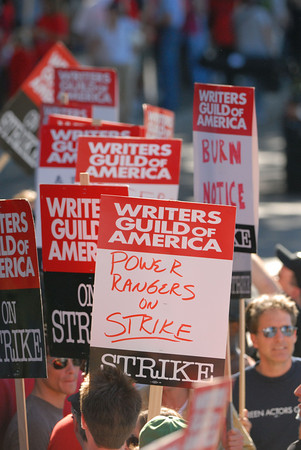
Victory to the American writers' strike!
Writers Make History on the Picket Lines
Galvanized by the Alliance of Motion Picture and Television Producers' refusal to bargain fairly members of the Writers Guild of America, West and Writers Guild of America, East refused to go to work and staged the largest action in the Guild's 74-year history.
On Monday, November 5 at 12:01 a.m, more than 3,000 WGAW members walked picket lines throughout the day at 14 locations and demanded that the Companies bargain fairly with writers. By Tuesday, the number had swelled to 3,200.
“The level of support is fantastic not only within the Guild but with the general public,” said former Simpsons showrunner Mike Scully. “We've never had more leverage than we have right now.”
“We've had more support than I could have imagined,” added TV writer Jamie Rhonheimer. “Everybody is in this for the long haul.”
Joe Medeiros, head writer for The Tonight Show with Jay Leno and a member since 1989, said he had never seen the membership as unified as it is now. For Medieros, the historic turnout spoke to the significance and urgency of these negotiations and the issue of New Media, in particular.
“I see the handwriting on the wall,” said Medieros about New Media. “That's the way television's going. That's how my kids watch stuff. They're downloading it, they're watching it on their computers, and the writers aren't being paid for that. If we don't do something now, we're gonna be out of business.”
Writers made it clear that this fight was not only for themselves but for those who will follow them. “I'm so terrified for the next generation of writers to come that their residuals will be diminished or taken away entirely once we make the move to computers,” said Desperate Housewives' Marc Cherry. “That's why this strike is so important. We're fighting for our fair share of the New Media business, and if we don't get it now, we may all be screwed in the future.”
“People who fought this fight before us have made sure that guys who only work half the time get enough residuals to live,” said Medieros. “That's why we're fighting this fight for the writers of the future. We can't leave them out in the cold when it comes to what's going to happen five, 10 years from now with the Internet.”
Writers are winning over the public
Study shows people side with scribes
By DAVE MCNARY
There's an image war raging during the WGA strike, and the writers seem to be winning.Public sympathy sides with the scribes, as a study, released Wednesday, indicates.
And during the past few weeks, mainstream media outlets have devoted significant coverage to the strike in news stories and op-ed pieces. Slate's Jack Shafer noted Tuesday that such coverage has been generally sympathetic.
It certainly helps the writers that the companies with which they are at war have CEOs that have to talk out of both sides of their mouths. On the one hand, they have to claim everything is financially rosy so shareholders are happy. That includes profit forecasts from downloads and other digital platforms. Problem is, when it comes to the strike, that's the very area which they claim isn't monetizable at all.
But while writers may be enjoying their public standing, IATSE topper Thomas Short is swiping away, claiming that a strike was always pre-set.
"It's time to put egos aside and recognize how crucial it is to get everyone back to work, before there is irreversible damage from which this industry can never recover," Short said in a letter to WGA West's Patric Verrone.
The WGA trumpeted a pair of surveys Wednesday showing plenty of public sympathy with backing of 69% in a Pepperdine poll and 63% in a SurveyUSA poll, while the companies received a only a smattering of support with 4% and 8%, respectively.
And the announcement came on the same day that WGA West prexy Patric Verrone and SAG topper Alan Rosenberg huddled with multiple elected officials in Washington, D.C., to explain the guilds' position.
"These polls prove that the public understands what's at stake here," Verrone said in a statement. "Our fight represents the fight for all American workers for a fair deal."
The news release also included a strong endorsement of the WGA's position by a labor economist at Pepperdine, which conducted the survey. "Public sentiment plus the economic disruption that the strike has caused can serve as powerful leverage and bodes well for writers in ongoing negotiations," said David Smith.
As for talks, no new ones are scheduled. In what could be a positive development, AMPTP chief Nick Counter has dropped the condition that the guild has to stop the strike for a few days for negotiations to resume.
In response to Short's letter, Verrone said: "Our fight should be your fight," and noted that "for every four cents writers receive in theaterical residuals, directors receive four cents, actors receive 12 cents and the members of your union receive 20 cents in contributions to their health fund."
The WGA's repeatedly referred to four cents as the usual residual writers receive per DVD sale. On the last day of contract talks, guild negotiators took the DVD proposal -- seeking to double that rate -- off the table but were infuriated by what they saw as a lack of movement by the companies and have hinted since then that it might be back on the table. The WGA had no comment Wednesday about the status of its DVD proposal.
Lack of progress in getting both sides back to the table, has led to the expectation that the Directors Guild of America will launch its negotiations soon — during what would be the typical window for DGA talks of at least six months before the June 30 expiration.
But the situation's so fluid that speculation's ruling the day, such as an "interim strike" scenario in which the WGA would go back to work at some point in the next few months -- and then go back on strike if talks don't lead to a favorable deal.
Short shots
Short noted in his letter to Verrone that more than 50 TV series have been shut down by the strike.
"More will come," he added. "Thousands are losing their jobs every day. The IATSE alone has over 50,000 members working in motion picture, television and broadcasting and tens of thousands more are losing jobs in related fields."
The IATSE topper noted that he took issue late last year with Verrone over the WGA's defense of its strategy in delaying contract talks with studios and nets until the summer.
"When I phoned you on Nov. 28, 2006, to ask you to reconsider the timing of negotiations, you refused," Short said. "It now seems that you were intending that there be a strike no matter what you were offered, or what conditions the industry faced when your contract expired at the end of October."
Short also took aim at recent comments by WGA West exec director David Young, in which the exec said he would not apologize for the strike's economic impact.
"This is hardly the point of view of a responsible labor leader, someone dedicated to the preservation of an industry that has supported the economies of several major cities for decades," he added.
SAG's Rosenberg said Wednesday he decided to join Verrone in Washington D.C., because the Screen Actors Guild will be facing the same issues next year. The SAG contract expires June 30.
"It's important to impress upon (Washington) that this isn't about wealthy actors or writers getting richer," Rosenberg added. "The average writer makes $60,000 a year, the average actor makes less. It's a question of keeping our heads above water with residual payments."
Verrone and Rosenberg met with Sen. Barbara Boxer (D-Calif.), Reps. Howard Berman (D-Calif.), Henry Waxman (D-Calif.), John Dingell (D-Mich.) and Edward Markey (D-Mass.). Dingell chairs the House Energy and Commerce Committee, and Markey is chairman of the Subcommittee on Telecommunications. At the FCC, they met with commissioners Michael Copps, Jonathan Adelstein and Robert McDowell.
Rosenberg and Verrone characterized the guilds as being at a disadvantage in trying to negotiate with seven multi-national conglomerates — noting that they all are supposedly competitors but negotiate together. "They're picking off the unions one at a time," Verrone said.
The WGA and supporters have also stayed on point during the past four months on the key issue of new media, in which bigwigs finding themselves infected with the mixed messaging bug.
On one hand CEOs of major media congloms are selling Wall Streeters on the fact that their digital offerings are growing like gangbusters and driving the bottom line. On the other hand, those same execs are holding out their hands and saying, a viable business model just doesn't exist and profits just aren't rolling in yet to give striking scribes what they want.
The problem is the congloms are stuck in the precarious position of angering shareholders: tell them that your company isn't growing and the stock plummets. Let the strike continue for six months or more and you anger those same shareholders, because in reality, companies will be losing revenue, as a result.
WGA supporters have compiled effective videos combining bullish pro-digital statements by moguls with the assertion that writers aren't getting anything.
So it's no surprise that company toppers are standing in the shadows and declining to state their case to an increasingly angry mob of writers. They just don't know what to say yet -- unless it's positive.
During the recent rounds of earnings reports, News Corp's Rupert Murdoch touted Fox Interactive Media as a strong profit generator, earning nearly $200 million in the past quarter alone, an 80% increase over last year, thanks to MySpace, Photobucket and other online properties.
Across town, Bob Iger said parts of 160 million TV episodes have been viewed on ABC.com, while 33 million downloads of the alphabet web's shows have been purchased on Apple's iTunes store. He estimated that the Mouse House's digital revenue will be about $750 million this year.
And NBC's Jeff Zucker said that the peacock made just $15 million in a year selling video on iTunes.
Oddly, those same toppers aren't pushing forward negative numbers to hold the WGA at bay — such as Forrester Research's prediction that growth of the paid download market will drop to 100% versus 200% next year; or that the sale of movies online will drop by 56% in 2008, according to PricewaterhouseCoopers.
When negotiations collapsed on Nov. 4, the AMPTP had offered to start paying for streaming video with a promotional window and had agreed to give the WGA exclusive jurisdiction on made-for-the-Internet writing on derivative works.
Disney pickets
The WGA has continued to picket more than a dozen locations in Los Angeles and staged a protest outside the World of Disney store on Fifth Avenue in New York on Wednesday, drawing more than 400 supporters.
A large, inflatable, cigar-chomping pig stood at Fifth and 55th Street outside the World of Disney store. Barricades ran the length of the block between 55th and 56th when it became clear that the picketers would not be contained to the sidewalk.
"I've had a lot of pedestrians telling me, ‘Hey, good luck with this,'" said "Late Show With David Letterman" scribe Steve Young. "I don't know if the approval of tourists is going to bring Les Moonves to his knees, but it makes us feel good."
Meanwhile, breaking a lengthy studio silence, ABC Studios has become the first arm of any conglom to respond individually to allegations made during the strike that it contends are inaccurate.
A Writers Guild of America East leaflet passed out Wednesday in front of Manhattan's World of Disney store quoted Disney's Bob Iger, who has said that the conglom generates $1.5 billion in digital revenue annually. The scribes, the WGAE claimed, earn nothing from that.
An ABC Studios spokesperson, who said she was tired of reading "distortion of information" by writers in newspaper articles and blog posts without any response from the producers, drafted this statement:
"The WGA leadership is deliberately distorting the facts. As the WGA knows full well, more than half of Disney's digital revenues are from sales of travel packages and the vast majority of the rest is from online advertising on sites like Disney.com and ESPN.com and through online merchandise sales. The WGA also knows its members have been paid residuals on entertainment content downloaded via iTunes. Deliberately misleading the public is not the best way to resolve this issue and get Hollywood back to work."
In response, the WGAE didn't disagree with Disney's account of where the $1.5 billion comes from, but did point out that the congloms have so far not been willing to open the books and prove how much money has been generated specifically from TV/film downloads and streaming:
"We would better know the nature of Disney's and ABC's revenues from digital if they would more fully and transparently reveal them to us. For example, their statement does not mention that much of the online advertising on their websites accompanies streaming video of our members' work in television and film for which they receive absolutely nothing. All we're asking for is a fair, respectful, small share."
Separately, a group of assistants is organizing a picket to support the WGA. Slated to take place Monday from 12-2 p.m. in front of the main gate of the Fox lot, organizers said the event is for below-the-line employees, "especially those who've lost their job due to the strike" to "show the media conglomerates that they need to take responsibility for their own decisions and not blame the writers for their layoffs."
Cops, SIS create terror panic over FOUR GUNS
Terror raids - charges linked to just 4 guns
5:00AM Saturday November 17, 2007 By Phil Taylor
The anti-terror raids of October 15 resulted in the seizure of only four weapons and 230 rounds of ammunition that have led to charges.
The early-morning raids involved more than 300 officers.
The police have not said what they seized in the property searches in Auckland, Waikato, the Bay of Plenty, Wellington and Christchurch using warrants alleging crimes under the Terrorism Suppression Act and have declined a request to do so.
But of 16 people charged with firearms offences, items seized on October 15 are the basis of charges against only two - Tame Iti, and a man who has name suppression.
The charges Iti faces include illegal possession on that date of three rifles - a Ruger, a Siga and a Machtech - while the other man is charged in regard to a Ruger rifle and 100 rounds of .22 calibre bullets and 130 rounds of .303 calibre ammunition.
The police said it was inappropriate to comment about matters before the court.
Many of the 16 are charged jointly with up to 12 others and the dates the offences are alleged to have occurred relate to dates of the alleged training camps in the Ureweras. The earliest charges relate to November 2006.
The Crown predominantly appears to rely on evidence from surveillance of the camps and interception of conversations. While the latter would be admissible for charges under the Terrorism Suppression Act, it is unlikely to be for firearms charges.
Meanwhile, the Solicitor-General says he has no plans to provide a detailed assessment of flaws he identified in the Terrorism Suppression Act, which he said was "almost impossible to apply in a coherent manner".
His criticism prompted the Government to refer the matter to the Law Commission.
An Auckland University specialist in criminal procedure, Associate Professor Scott Optican, said Dr Collins' input would be invaluable to the commission because he had assessed the evidence and the terrorism law.
"How can the Law Commission comment on the sufficiency of a law unless they know exactly what are the problems alleged with it with respect to the facts of this case," said Professor Optican, a former prosecutor.
"I haven't been convinced enough to know whether there really is a problem in the law or [whether] the case just failed for lack of proof.
"You have to make a rational argument as to what is wrong with the law and why you want it to get at behaviour that it doesn't get at. Just to say the law is rubbish isn't enough; you have to be very specific in light of the facts of the case."
A spokeswoman for Dr Collins said he was not doing a report on the matter and had not been asked to.
But it was usual for the commission in the course of reviews of legislation to consult all agencies with an interest in the particular legislation.
Wednesday, 14 November 2007
Defend free speech - defend the Urewera 17
EDITED TO ADD:
"...soon as the cops round the buggers up and treat them as criminals the better..."- Labour cabinet minister Shane Jones (right) shows an admirable devotion to the principles of free expression and "innocent until proven guilty".
In the wake of the collapse of the terror case against the Urewera 17, the police (and, possibly, the SIS) have been running around trying to pawn off their "evidence" on whichever media outlet is most keen for an old-fashioned lynching. First TV3, then the Herald on Sunday, and today the Dominion-Post.
The only way to explain this contempt for the judicial process is that the cops have decided that they can't criminalise most or even all of the defendants in a court of law, and have decided that trial by media, smear and innuendo is the only way forward to achieve their aims.
Socialist Worker has said from the beginning that the real agenda behind the terror raids was to criminalise radical dissent, particularly from Maori sovereigntists, ecological activists and anarchists. And if they can't manage that, they can at least try to line up public opinion behind a witchhunt. Witness the disgusting racist cartoons that appeared in yesterday's newspapers.
The police and their media patsies want you to be disturbed that people were allegedly talking about assassinations or property damage. Unfortunately for the cops, while making plans to do any such thing is illegal, simply discussing it is not. This is why the Urewera 17 aren't up on "conspiracy to murder" or "conspiracy to damage property" charges - the police have nothing.
The end goal of this media witchhunt is to gain public support for criminalisation of speech, thought and actions which aren't illegal yet. Do New Zealanders want to live in a country where even talking about certain subjects is illegal? That's the question we have to answer. If the Urewera 17 are branded with the scarlet letter of terrorism, how long before anyone who doesn't accept the current "rules of the game" are in the same boat? When will they come for Hone Harawira - or even Keith Locke?
The only thing in the leaked "evidence" which is even close to being illegal under actual existing law is the possession of unlicenced firearms - and, rumour has it, "possession" is a very loose term for quite a few of the defendants. Regardless of whether we agree with their political ideas or strategy, all those who believe that there should be real political debate in this country should stand by the Urewera 17, and by the idea that thought and speech should not be criminalised or anathematised unless there's a damn good reason for it.
The cheerleaders for state terror say that "there is no reason for violence in a democracy". Perhaps they might want to look at the social exclusion, exploitation and racism that underpins their vaunted "democracy for a few", and decide whether those who refuse to toe the line deserve to have state terror and media slander unleashed on them.
Unpopular political speech is not, nor should it be, a crime. The job of the police is to prevent crime, not to engage in media witchhunts against people they just don't like.
A new figurehead for Venezuelan counterrevolution?